Publications /
Book / Report

Back
Africa Economic Symposium (AES) 3nd edition - SUMMARY REPORT
Authors
General rapporteur Mahmoud Arbouch
September 2, 2025

The Africa Economic Symposium (AES) has firmly established itself as one of the flagship annual events of the Policy Center for the New South, alongside the Atlantic Dialogues and the African Peace and Security Annual Conference (APSACO). Now in its third edition, AES continues to provide a unique platform for economists, policymakers, and academics from across the continent and beyond to exchange perspectives on the pressing macroeconomic and structural challenges facing Africa. Its mission remains to foster rigorous, evidence-based debates that inform policymaking and support long-term strategies for Africa’s development in an era of uncertainty. 

The 2025 edition, convened under the theme “Bold Moves amid Global Shifts,” explored the difficult policy trade-offs confronting African governments as they navigate a volatile global environment. The continent’s recovery from COVID-19 has been uneven, while debt pressures, supply chain disruptions, and geopolitical tensions weigh heavily on fiscal and economic resilience. Structural challenges such as persistent unemployment, low productivity, and the exclusion of Africa’s youth continue to hinder inclusive growth, even as policymakers are called upon to adapt to deep systemic uncertainty. 

The symposium underscored that many African states are increasingly resorting to short-term stabilization measures—such as accumulating reserves and postponing reforms—that may provide immediate security but risk delaying the structural transformation urgently needed. Against this backdrop, AES 2025 called for a careful balance between fiscal prudence, social investment, and the pursuit of sustainable growth, placing emphasis on reforming governance, improving macroeconomic management, and accelerating structural change. 

The discussions highlighted the urgent need to rethink Africa’s economic strategies in a shifting global order. From debt sustainability and the role of central banks to the promise of financial innovation, digital inclusion, and new instruments such as central bank digital currencies, the symposium emphasized that policy choices must align with long-term transformation goals. The debates also explored the opportunities and challenges of regional integration, trade connectivity, and development finance, all of which are essential levers for Africa’s resilience and prosperity. 

As in previous editions, the Annual Report on African Economies was launched alongside the symposium, offering an in-depth analysis of the continent’s macroeconomic dynamics and structural transformation pathways. More than just a publication, the report reflects the collective intellectual effort of leading scholars and practitioners, providing evidence-based insights to guide decision- makers. Together, the symposium and the report reinforced the Policy Center for the New South’s commitment to fostering forward-looking economic thinking that moves beyond short-term headlines to tackle Africa’s enduring challenges.

RELATED CONTENT

  • November 5, 2024
    في هذه الحلقة من برنامج حديث الثلاثاء، نستعرض مستجدات مشروع قانون المالية لعام 2025، الذي يأتي في ظل سياق اقتصادي أكثر إيجابية مقارنة بالسنوات الماضية، مع انخفاض معدلات التضخم واستقرار أسعار المواد الأساسية. بصحبة ضيفنا بدر الزاهر الأزرق، سنقدم قراءة تحليلية لهذا السياق وللفرضيات التي ب...
  • Authors
    November 1, 2024
    Using panel data from a large group of developing economies and a Generalized Method of Moments (GMM) estimator, we examine the effects of trade and other factors on female labor-force participation and wage employment. We focus particularly on comparing the effects of trade openness in the Middle East and North Africa (MENA) region with Latin America and the Caribbean (LAC) and sub-Saharan Africa (SSA). The empirical results indicate that trade openness affects female labor-force p ...
  • Authors
    October 25, 2024
    Ding, dang, dong… Vous avez certainement entendu sonner le carillon. C’est la rentrée. Ou les rentrées. Elles s’étalent sur quasiment deux mois tant la reprise est plurielle et concerne des acteurs ou des agents multiples. La rentrée des élèves, tout d’abord. À la mi-septembre déjà, ils ont enlevé le sable de leurs chaussettes, rangé leurs nouvelles fournitures scolaires. Mais pas seulement, celle des parents aussi : septembre est le mois de toutes les dépenses :  les frai ...
  • Authors
    Karim El Mokri
    Idriss El Abbassi
    October 23, 2024
    This paper was originally published on cambridge.org   This paper explores the (de-)routinisation of employment structure in developing countries, through the case of Morocco. We investigate employment (de-)routinisation from an often-overlooked perspective, aiming to elucidate the interplay between the dynamics of occupational employment composition by the level of routine tasks intensity and two structural aspects: premature deindustrialisation and the prevalence of in ...
  • Authors
    Philip Yang
    October 23, 2024
    The digital revolution is bringing about a dramatic shift in power, from labor to capital. We assess what the impact of this transformation might be on land as a factor of production. The digital revolution is not happening in a historical vacuum. It unfolds within a framework of confrontation or collusion between market forces and government forces. Depending on the market power that companies can exercise, the digital transition will have different impacts on income distributions ...
  • October 16, 2024
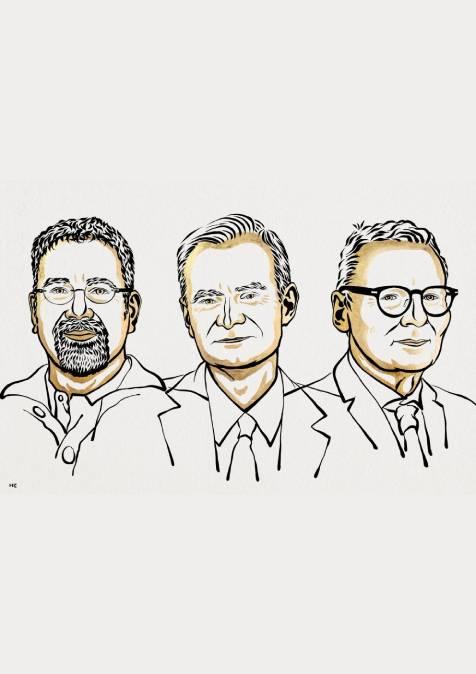
    Depuis que l’économie a été reconnue par les Nobel, en 1969, c’est à elle que revient de clore la semaine des cérémonies consacrées à la remise des prix. C’est ainsi que le 14 octobre 2024 trois hommes ont été nominés par l’Académie suédoise : un économiste turco-américain, Daron Acemoglu (MIT), un économiste britannique Simon Johnson (MIT) et un économiste américain James A.Robinson de l’Université de Chicago. Trois lauréats qui travaillent dans des universités américaines rec ...
  • October 11, 2024
    After the highly polarized 2022 presidential elections, Brazil's political landscape remains influenced by regional voting patterns and lingering divisions. In this episode, Ottaviano Can ...
  • Authors
    Paul Isbell
    October 11, 2024
    The evolving structure of international power—from the erosion of unipolarity to the emergence of multipolarity (though still susceptible to a scenario where multipolarity evolves into a new form of bipolarity)—is giving rise to various material and ideological factors that are steering global dynamics toward a new ‘regionalization of globalization’. The real opportunity lies in not just considering a new form of regionalism, but in focusing on the potential of a new kind of region: ...
  • Authors
    Antonio Jorge Martins
    October 9, 2024
    The road to decarbonizing the planet runs through the energy transition, which includes the shift from fossil-fueled cars to renewable energy vehicles. This automotive transition is unfolding as a true revolution in the industry. The evolution toward electric and hybrid vehicles has come in tandem with the ascent of Chinese producers. In the current context of geopolitical and technological rivalries, the automotive transition has been marked by an intense trade war, with implicati ...
  • Authors
    Paul Isbell
    October 9, 2024
    From a realist perspective, during a period of rising multipolarity, the Atlantic Basin can be identified as an emerging geostrategic region and a potential focal point of geostrategic competition, especially in the Southern Atlantic, raising the sub-basin’s strategic significance and its potential strategic autonomy. The liberal perspective – although its highest goal might be a global multilateral order – has embraced regionalism before, under the bipolar international regime of t ...