Publications /
Book / Report

Back
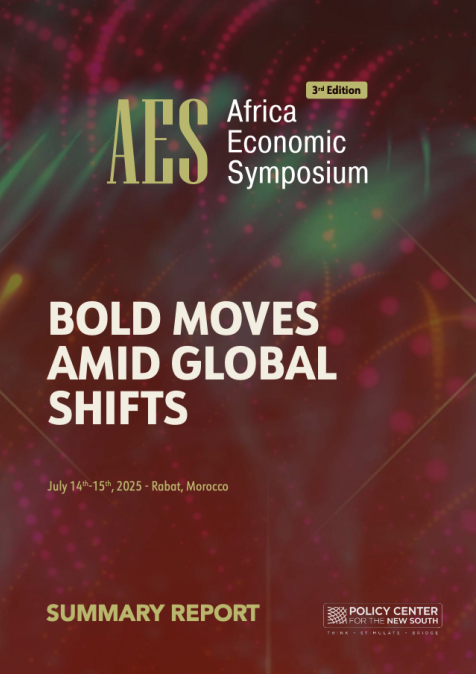
Africa Economic Symposium (AES) 3nd edition - SUMMARY REPORT
Authors
General rapporteur Mahmoud Arbouch
September 2, 2025

The Africa Economic Symposium (AES) has firmly established itself as one of the flagship annual events of the Policy Center for the New South, alongside the Atlantic Dialogues and the African Peace and Security Annual Conference (APSACO). Now in its third edition, AES continues to provide a unique platform for economists, policymakers, and academics from across the continent and beyond to exchange perspectives on the pressing macroeconomic and structural challenges facing Africa. Its mission remains to foster rigorous, evidence-based debates that inform policymaking and support long-term strategies for Africa’s development in an era of uncertainty. 

The 2025 edition, convened under the theme “Bold Moves amid Global Shifts,” explored the difficult policy trade-offs confronting African governments as they navigate a volatile global environment. The continent’s recovery from COVID-19 has been uneven, while debt pressures, supply chain disruptions, and geopolitical tensions weigh heavily on fiscal and economic resilience. Structural challenges such as persistent unemployment, low productivity, and the exclusion of Africa’s youth continue to hinder inclusive growth, even as policymakers are called upon to adapt to deep systemic uncertainty. 

The symposium underscored that many African states are increasingly resorting to short-term stabilization measures—such as accumulating reserves and postponing reforms—that may provide immediate security but risk delaying the structural transformation urgently needed. Against this backdrop, AES 2025 called for a careful balance between fiscal prudence, social investment, and the pursuit of sustainable growth, placing emphasis on reforming governance, improving macroeconomic management, and accelerating structural change. 

The discussions highlighted the urgent need to rethink Africa’s economic strategies in a shifting global order. From debt sustainability and the role of central banks to the promise of financial innovation, digital inclusion, and new instruments such as central bank digital currencies, the symposium emphasized that policy choices must align with long-term transformation goals. The debates also explored the opportunities and challenges of regional integration, trade connectivity, and development finance, all of which are essential levers for Africa’s resilience and prosperity. 

As in previous editions, the Annual Report on African Economies was launched alongside the symposium, offering an in-depth analysis of the continent’s macroeconomic dynamics and structural transformation pathways. More than just a publication, the report reflects the collective intellectual effort of leading scholars and practitioners, providing evidence-based insights to guide decision- makers. Together, the symposium and the report reinforced the Policy Center for the New South’s commitment to fostering forward-looking economic thinking that moves beyond short-term headlines to tackle Africa’s enduring challenges.
RELATED CONTENT

  • Authors
    Mouhamadou Moustapha Ly
    Bertrand Bio Mama
    Onasis Tharcisse A. Guèdègbé
    March 6, 2019
    L’évaluation d’impact des projets et programmes de développement est un exercice qui est de plus en plus adopté dans les pays en développement notamment ceux d’Afrique subsaharienne. Entre autres facteurs explicatifs, il y a la rareté des ressources allouées au développement mais aussi la nécessité de mieux connaître les contraintes structurelles au développement. Saisissant l’occasion de la première conférence de West Africa Capacity building and Impact Evaluation Program (WACIE-3i ...
  • Authors
    Sara Hasnaa Mokaddem
    March 5, 2019
    Since coming to power on April 2018, Dr. Abiy seems to be unstoppable, making the world headlines on many occasions. He has embarked the country on an ambitious and transformative project; he has freed thousands of prisoners and established a Reconciliation Commission, has called on the privatization of state-owned enterprises and signed a stunning peace treaty with Eritrea. Furthermore, in a complete shift from the old paradigm of developmental state, the new PM outlined his renewe ...
  • Authors
    March 5, 2019
    China’s economic growth has been in a downslide trend since 2011, while its economic structure has gradually rebalanced toward lower dependence on investments and current-account surpluses. Steadiness in that trajectory has been accompanied by rising levels of domestic private debt, as well as slow progress in rebalancing private and public sector roles. As the ongoing trade war with the US continues to unfold, it remains unclear at which growth pace China’s rebalancing will tend to ...
  • Authors
    Afrique Contemporaine
    February 28, 2019
    Dans son édition n°266, la revue scientifique Afrique Contemporaine consacre son Dossier à la question de l’industrialisation en Afrique. D’après la Rédaction de la publication, le choix de la thématique s’imposait d’autant plus que « la recomposition de l’ordre mondial repose la question de la place du continent à l’échelle planétaire, en l’occurrence sur le plan économique, social et environnemental tout à la fois. » Outre la coordination du Dossier, Dr. Karim Et Aynaoui, Préside ...
  • Authors
    Philippe Chalmin
    February 27, 2019
    Rarement, autant qu’en 2018, les marchés mondiaux de matières premières et de commodités auront été lle jouet non pas des tendances des « fondamentaux » (offre/demande et leur évolution), mais bien des convulsions d’une situation géopolitique mondiale qui, sous la houlette quelque peu déréglée des États-Unis de Donald Trump, a été particulièrement imprévisible. En effet, si 2018 restera dans les annales des marchés, c’est bien parce que les matières premières se sont retrouvées au p ...
  • Authors
    Yassine Msadfa
    February 25, 2019
    La transformation structurelle d’une économie demeure un point de passage nécessaire pour toute nation qui souhaite gravir les échelons du développement, cette transformation est souvent tributaire de la capacité d’une économie à s’ériger d’une société agraire de subsistance, dans son stade initial, vers une économie de productivité. Pour ce qui est du Maroc, le débat a pris de l’ampleur quant à la capacité des dynamiques actuelles à accélérer le rythme de l’activité économique au p ...
  • Authors
    February 20, 2019
    Ce papier évalue les effets asymétriques des cycles économiques sur le chômage et la pauvreté au Maroc, à travers un modèle VAR estimé sur des données trimestrielles allant de 2003 à 2012. Ce modèle inclut les composantes cycliques de quatre variables à savoir : l’output-gap, le salaire minimum réel, le taux de chômage et le taux de pauvreté. Afin de tester la robustesse des résultats, deux versions du modèle VAR ont été estimées, en utilisant les composantes cycliques calculées se ...
  • Authors
    Olalekan Samuel
    Mma Amara Ekeruche
    Adedeji Adeniran
    February 12, 2019
    This study was carried out within the framework of the Global Economic Governance Africa (GEGAfrica) funded by the UK Department for International Development. The GEGAfrica programme is a policy research and stakeholder engagement aimed at strengthening the influence of African coalitions at global economic governance forums and increase, inter alia, the visibility and the outreach of African views at the regional and worldwide levels. Policy Center for the New South was requested ...
  • Authors
    February 6, 2019
    Ce papier examine la plainte initiée par la Turquie devant l’Organisation mondiale du commerce (OMC) contre le Maroc au sujet des droits antidumping appliqués aux produits d’acier laminés à chaud. La plainte de la Turquie constitue à la fois un précédent et une opportunité. Un précédant d’abord, car jamais le Maroc n’a été impliqué, ni en qualité de partie plaignante ni en qualité de partie défenderesse, dans une affaire devant le GATT ou l’OMC. Une opportunité ensuite, par ce que l ...