Publications /
Policy Paper

Back
On Additional Issues in the Western Sahara Advisory Opinion
Authors
January 21, 2021

In the Western Sahara Advisory Opinion, formal questions specifically requested by the General Assembly were only on terra nullius and ‘legal ties’ at the time of Spain’s colonization of the Saharan Provinces. however, two other issues, which had not been specifically requested, were added to the formal question of ‘legal ties.” The additional issues concern the right to self- determination and ‘territorial sovereignty.’ The statements on additional issues have recently been referred to in the courts. Was the issue of the right to self-determination indispensable in deciding on ‘legal ties’ in 1884? The statements throughout the Western Sahara Advisory Opinion would indicate that the addition was politically motivated, under the guise of assisting the General Assembly in solving the Saharan Issue. Furthermore, in the statements, ‘territorial sovereignty’ is focused practically on ‘legal ties’ in a contradictory manner, because the opinion declares that ‘legal ties’ should not be limited to territorial ties. However, the phrase, “legal ties of allegiance,” which was demonstrated as one of the ‘legal ties,’ was referred to only to confirm the non-existence of a territorial tie between the Saharan Provinces and Morocco or Mauritania. Such statements shall be considered more specifically in relation to Article 65 (2), providing for ‘a written request.’ They may not form precedents. In the end, a proper way international and domestic courts or States should adopt when invoking the statements in advisory opinions, taking the Saharan Advisory Opinion as an example.


RELATED CONTENT

  • May 13, 2026
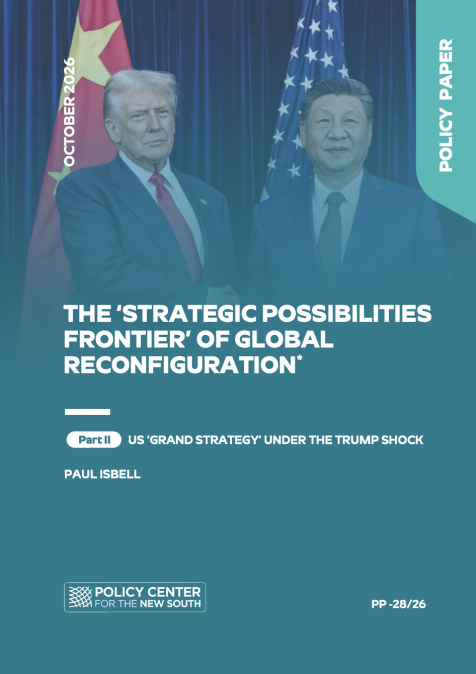
    The meeting between Donald Trump and Xi Jinping in Beijing this week goes far beyond the traditional framework of a bilateral encounter between the world’s two largest economies. In many respects, it is a symbolic moment in the transition toward a new international order—one increasingly shaped not only by great-power competition but also by the Global South’s growing political consciousness and strategic relevance. ...
  • April 29, 2026
    Cet oped a été publié initialement dans la revue afkar/ideas 77 (IEMed).  La politique étrangère du Maroc traverse une transition structurelle, sous l’effet de la polycrise mondiale, de la diversification de ses partenariats et de l’affirmation de nouveaux choix stratégiques. La centralité accordée aux notions de « hub », de « plateforme »ou de « corridor » traduit un glissement sémantique et fonctionnel dans le narratif national, accordant une priorité majeure aux considé ...
  • Authors
    April 21, 2026
    « C’est le moment me semble-t-il de sortir de cette dialectique de l’euphorie ou du désespoir pour entreprendre un effort de réflexion sur soi, sur notre situation dans le monde : se penser, se représenter, mener une réflexion critique sur ses propres réalités. Il est de la responsabilité des intellectuels, penseurs, artistes africains de mener à bien cette entreprise afin de dégager des horizons et contribuer à la transformation radicale des sociétés africaines » Felwin Sarr. Écriv ...
  • March 5, 2026
    This episode of Africafé explores the evolving dynamics of US-Africa relations, tracing their historical shifts from Cold War and War on Terror engagements to today’s focus on trade, investment, and strategic partnerships. Dr. Ian Lesser highlights how Africa’s role in US foreign policy...
  • Authors
    February 17, 2026
    La Marche Verte fait partie de ces moments féconds qui n’ont pas cessé d’influer sur le cours des événements politiques du Maroc, par la place qu’elle a prise, dès le départ, dans la longue durée, le contexte dans lequel elle s’est déployée, la logique des interactions dans laquelle elle s’est inscrite par ses causes et ses effets, et comme une des figures éclatantes du récit national. ...
  • Authors
    Amine Ghoulidi
    February 5, 2026
    This Paper was originally published on orient-online.com  The Western Mediterranean’s exposure to the Sahel is usually framed in terms of security spillovers and crisis management. This paper argues that this framing misreads how Sahelian access conditions now shape Mediterranean integration. Morocco’s Atlantic Initiative is a state-led corridor strategy combining Atlantic port infrastructure, inland transit routes, and energy systems to connect landlocked Sahelian economi ...
  • January 29, 2026
    Le Mali, le Burkina Faso et le Niger, réunis au sein de l’Alliance des États du Sahel (AES), affirment l’ambition de bâtir une souveraineté nationale qui leur permettrait de s’émanciper de la domination et des influences extérieures et de se doter d’une liberté d’action dans les choix de développement politique et économique. Cependant, cette ambition se heurte à de nombreuses contraintes économiques et sécuritaires.La souveraineté ne peut se construire sans une base économique soli ...
  • January 23, 2026
    The post-1945 international order, an architecture born of war-weariness and colonial twilight, is now a majestic but empty shell. Its foundational promise—a universal system of rules administered impartially—has been hollowed out by decades of selective enforcement, instrumentalized law, and a chasm between the rhetorical ideals of its custodians and their geopolitical practice. This is not a temporary dysfunction, but a systemic failure of legitimacy. From the invasion of Iraq und ...