Interview avec Abdellah Mouttaqi (Présentation du rapport ARCADIA 2019)

March 29, 2019

Présentation du rapport ARCADIA 2019 : l’Afrique et les marchés mondiaux de matières premières Abdellah Mouttaqi, Secrétaire Général, ONHYM www.policycenter.ma

Speakers

Abdellah Mouttaqi
Secrétaire Général, ONHYM et Membre du CESE
Titulaire d’un Doctorat d’Etat en 1997, Abdellah Mouttaqi, actuellement Secrétaire Général de l’Office National des Hydrocarbures et des Mines (ONHYM), avait commencé sa carrière en tant qu’enseignant chercheur à la faculté des sciences de l’université Cadi Ayyad de Marrakech. Il a rejoint l’ONHYM en 1998 où il a occupé plusieurs postes de responsabilité. En 2011, il est nommé par Sa Majesté le Roi Membre du Conseil Economique, Social et Environnemental (CESE). Titulaire de plusieurs publications sur les ressources naturelles, le développement durable et le développement humain, il est également administrateur de plusieurs compagnies minières, de la Fédération de l’Industrie Minérale, Vice-Président de l’Institut Marocain des Relations Internationales, Président de l’Associati ...


RELATED CONTENT

  • November 30, 2023
    This Chapter was originally published on Cape Town Chronicles   The history of debt in Africa is a long and painful one. It began in the 1980s, when the public finances of most developing countries deteriorated following two episodes of oil shocks, leading to a "lost decade" of low growth, increased poverty, and political instability. The recovery from the debt crisis only became possible following initiatives in favour of heavily indebted poor countries (HIPC) and ...
  • November 30, 2023
    In this episode, we dive into the pressing necessity for climate initiatives in Africa. Despite its minimal global emissions, Africa grapples with severe climate challenges and a substantial funding shortfall. Yet, as obstacles persist, including the disconnect between investor expectat...
  • November 28, 2023
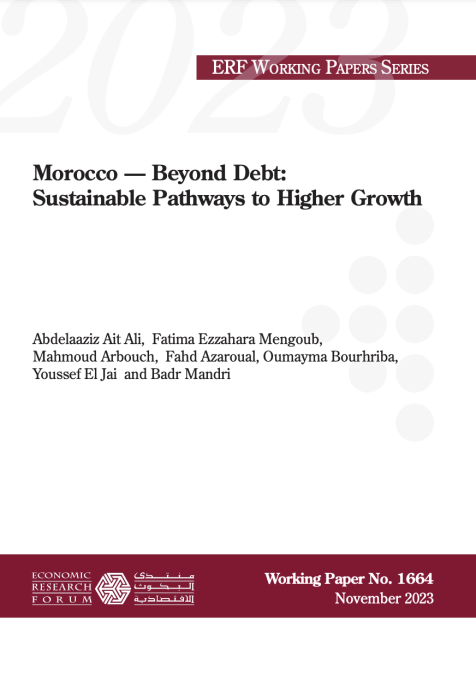
    This Working Paper was originally published on erf.org.eg Like many developing countries, Morocco faced a significant increase in public debt following the COVID-19 pandemic. In 2022, Central government debt reached 69.6% of GDP, up from 60.3% in 2019, highlighting the need for a thorough analysis of debt sustainability. This paper examines the main trends in the Moroccan economy over the past two decades, including growth performance, monetary policy and financial condit ...
  • November 14, 2023
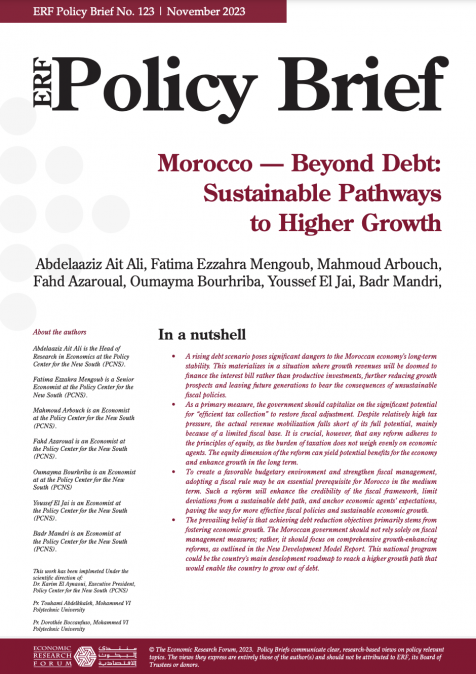
    This Policy brief was originally published on erf.org.eg Like many emerging and developing economies, Morocco has experienced a significant increase in public debt since the COVID-19 pandemic. Central government debt reached 69.6 percent of GDP in 2022, up from 60.3 percent in 2019, and overall public debt increased to 82.5 percent of GDP in 2022, well above the presumed critical threshold of 60 percent. Therefore, it becomes crucial to conduct a comprehensive debt sustainabil ...
  • Authors
    Touhami Abdelkhalek
    Dorothee Boccanfuso
    November 8, 2023
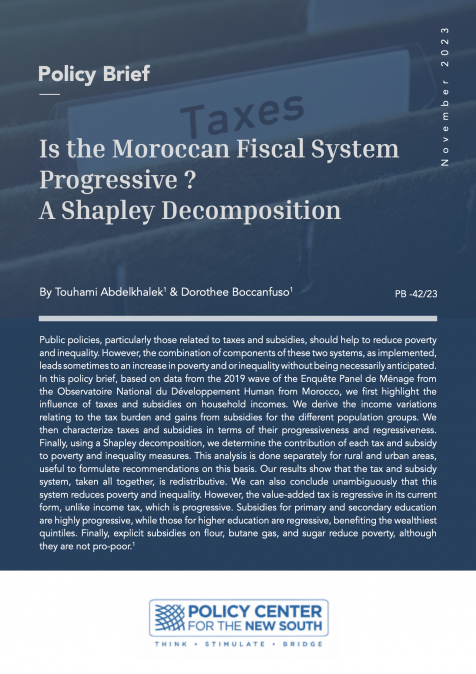
    Public policies, particularly those related to taxes and subsidies, should help to reduce poverty and inequality. However, the combination of components of these two systems, as implemented, leads sometimes to an increase in poverty and or inequality without being necessarily anticipated. In this policy brief, based on data from the 2019 wave of the Enquête Panel de Ménage from the Observatoire National du Développement Human from Morocco, we first highlight the influence of taxes ...
  • Authors
    November 2, 2023
    Le 1er octobre 2023 a marqué le début de la phase transitoire du Mécanisme d'Ajustement Carbone aux Frontières (CBAM en anglais) de l'Union européenne (UE). L'objectif de cette initiative est d'instaurer une tarification du carbone sur les biens importés qui soit équivalente à celle appliquée aux biens produits au sein de l'UE, visant ainsi à réguler les émissions de carbone. Cette démarche implique la mise en place d'un ensemble d'obligations de déclaration et de conformité pour le ...
  • Authors
    Ali Elguellab
    Elhadj Ezzahid
    November 1, 2023
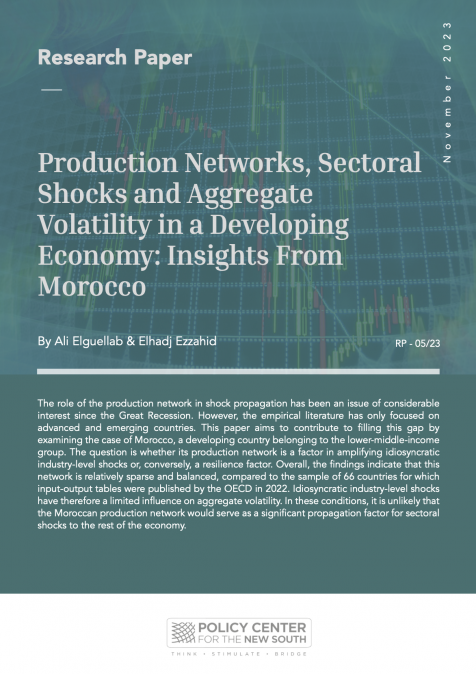
    The role of the production network in shock propagation has been an issue of considerable interest since the Great Recession. However, the empirical literature has only focused on advanced and emerging countries. This paper aims to contribute to filling this gap by examining the case of Morocco, a developing country belonging to the lower-middle-income group. The question is whether its production network is a factor in amplifying idiosyncratic industry-level shocks or, conversely, ...