حديث الثلاثاء - البنوك المغربية في أفريقيا: فرص وتحديات التوسع

August 13, 2024

شهد القطاع المصرفي المغربي توسعًا ملحوظًا في الأسواق الأفريقية خلال السنوات الأخيرة. من خلال هذا التوسع، تسعى البنوك المغربية إلى ترسيخ وجودها في أسواق تشهد طلباً متزايداً على الخدمات المالية، واستغلال الفرص الاستثمارية التي توفرها القارة الأفريقية. ولكن ما هي الدوافع الحقيقية وراء هذا التوجه؟ كيف استطاعت البنوك المغربية تحقيق النجاح في هذه الأسواق؟ وما هي التحديات التي تواجهها وكيف تتعامل معها؟ أسئلة وأخرى نجيب عنها في هذه الحلقة رفقة ضيفتنا أميمة بوغريبة، باحثة في الاقتصاد في مركز السياسات من أجل الجنوب الجديد

Speakers

Oumayma Bourhriba
Senior Economist
Oumayma Bourhriba is a Senior Economist at the Policy Center for the New South (PCNS).At the PCNS, which she joined in 2019, Oumayma Bourhriba conducts research focusing on macroeconomic policies and international trade, with a particular emphasis on services.She has contributed to major publications on the Moroccan economy, such as the IMF’s Morocco's Quest for Stronger and Inclusive Growth (2023) and the World Bank’s Trade Policy in Morocco: Taking Stock and Looking Ahead (2023). Beyond her research, she has coordinated the Africa Economic Symposium, one of the flagship convenings organized by the PCNS.Oumayma Bourhriba holds a master’s degree in applied economics from University Mohammed V (UM5), where she is currently a PhD candidate.She is fluent in Arabic, English, ...
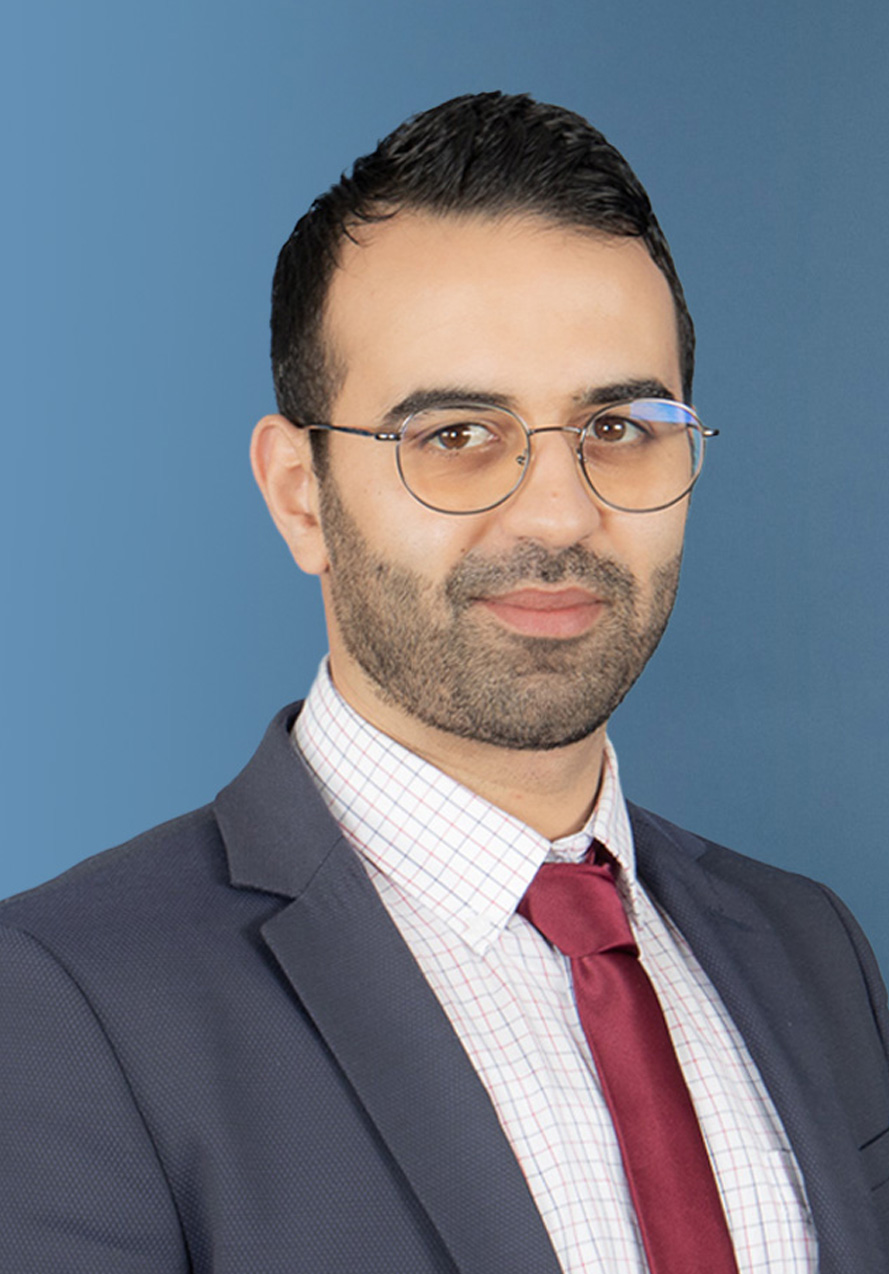
Badr Mandri
Economist
Badr Mandri is a Senior Economist at the Policy Center for the New South (PCNS), after an experience at Morocco's Haut-Commissariat au Plan (HCP). His research focuses primarily on macroeconomics, commodity markets, and development economics, having notably directed a collective volume on human capital. He also serves as an executive trainer at Mohammed VI Polytechnic University (UM6P), delivering specialized programs on public finance and fiscal policy for public sector professionals.Badr Mandri holds a Master's degree in Applied Economics from Mohammed V University in Rabat. ...
RELATED CONTENT

  • November 30, 2023
    This Chapter was originally published on Cape Town Chronicles   The history of debt in Africa is a long and painful one. It began in the 1980s, when the public finances of most developing countries deteriorated following two episodes of oil shocks, leading to a "lost decade" of low growth, increased poverty, and political instability. The recovery from the debt crisis only became possible following initiatives in favour of heavily indebted poor countries (HIPC) and ...
  • November 30, 2023
    In this episode, we dive into the pressing necessity for climate initiatives in Africa. Despite its minimal global emissions, Africa grapples with severe climate challenges and a substantial funding shortfall. Yet, as obstacles persist, including the disconnect between investor expectat...
  • November 28, 2023
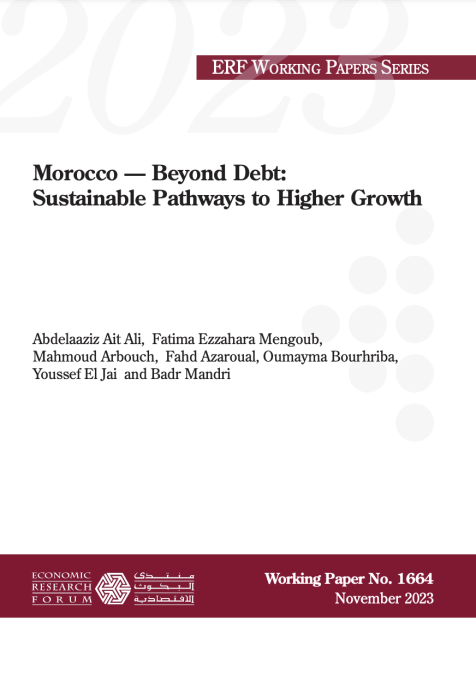
    This Working Paper was originally published on erf.org.eg Like many developing countries, Morocco faced a significant increase in public debt following the COVID-19 pandemic. In 2022, Central government debt reached 69.6% of GDP, up from 60.3% in 2019, highlighting the need for a thorough analysis of debt sustainability. This paper examines the main trends in the Moroccan economy over the past two decades, including growth performance, monetary policy and financial condit ...
  • November 14, 2023
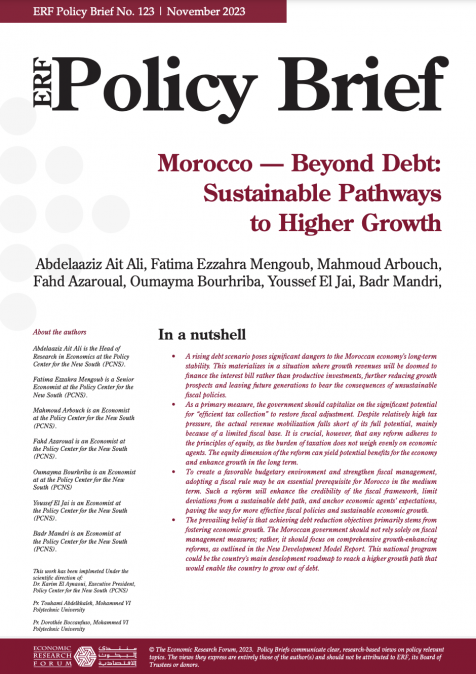
    This Policy brief was originally published on erf.org.eg Like many emerging and developing economies, Morocco has experienced a significant increase in public debt since the COVID-19 pandemic. Central government debt reached 69.6 percent of GDP in 2022, up from 60.3 percent in 2019, and overall public debt increased to 82.5 percent of GDP in 2022, well above the presumed critical threshold of 60 percent. Therefore, it becomes crucial to conduct a comprehensive debt sustainabil ...
  • Authors
    Touhami Abdelkhalek
    Dorothee Boccanfuso
    November 8, 2023
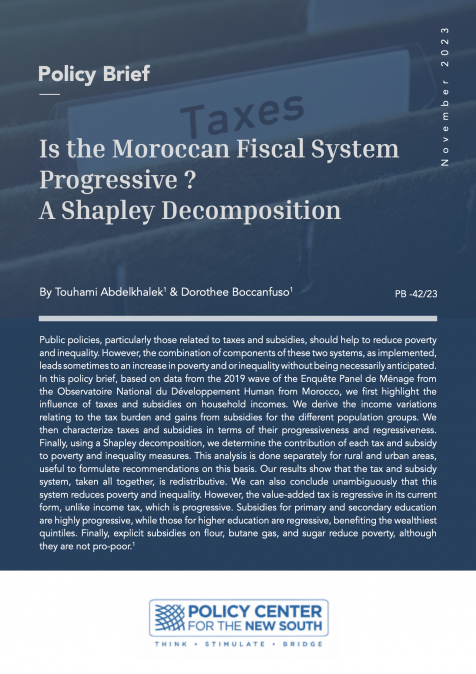
    Public policies, particularly those related to taxes and subsidies, should help to reduce poverty and inequality. However, the combination of components of these two systems, as implemented, leads sometimes to an increase in poverty and or inequality without being necessarily anticipated. In this policy brief, based on data from the 2019 wave of the Enquête Panel de Ménage from the Observatoire National du Développement Human from Morocco, we first highlight the influence of taxes ...
  • Authors
    November 2, 2023
    Le 1er octobre 2023 a marqué le début de la phase transitoire du Mécanisme d'Ajustement Carbone aux Frontières (CBAM en anglais) de l'Union européenne (UE). L'objectif de cette initiative est d'instaurer une tarification du carbone sur les biens importés qui soit équivalente à celle appliquée aux biens produits au sein de l'UE, visant ainsi à réguler les émissions de carbone. Cette démarche implique la mise en place d'un ensemble d'obligations de déclaration et de conformité pour le ...
  • Authors
    Ali Elguellab
    Elhadj Ezzahid
    November 1, 2023
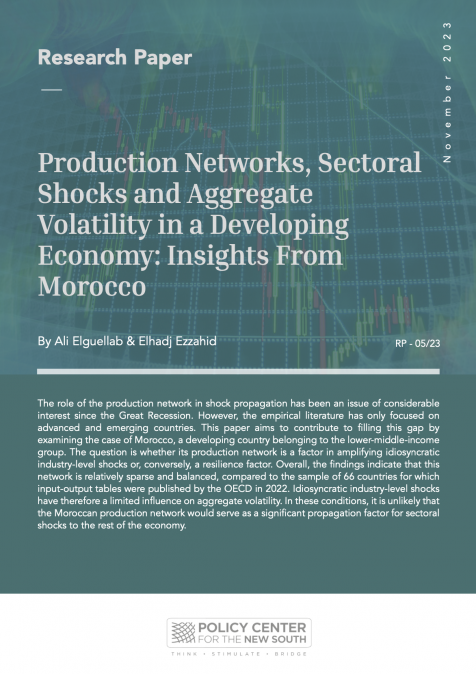
    The role of the production network in shock propagation has been an issue of considerable interest since the Great Recession. However, the empirical literature has only focused on advanced and emerging countries. This paper aims to contribute to filling this gap by examining the case of Morocco, a developing country belonging to the lower-middle-income group. The question is whether its production network is a factor in amplifying idiosyncratic industry-level shocks or, conversely, ...