The global economy is on a two-way track

October 7, 2025

Global economic growth has been more resilient than expected, as the artificial intelligence-led growth seems to be compensating for the negative impacts of trade conflicts. Overstretched asset values and slowing jobs growth may be signaling that the balanced crossing of those two paths will be challenged.

Speakers

Otaviano Canuto
Senior Fellow
Senior Fellow at the Policy Center for the New South, Affiliate Professor at Mohammed VI Polytechnic University and Non-Resident Senior Fellow at Brookings Institute. Former Vice President and Executive Director at the World Bank, Executive Director at the International Monetary Fund (IMF) and Vice President at the Inter-American Development Bank. ...

RELATED CONTENT

  • Authors
    August 19, 2025
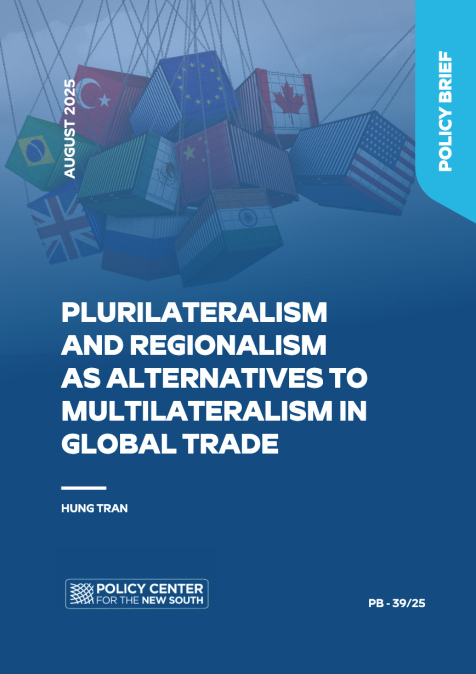
    The multilateral, rule-based trading system underpinned by the World Trade Organization (WTO) has been undermined by the unilateral imposition of U.S. tariffs. Crucially, the foundational principle of non-discrimination among WTO members has been abandoned. While many countries have attempted to negotiate with the U.S. to resolve tariff disputes, they have simultaneously sought to deepen trade ties with each other through plurilateral and regi ...
  • Authors
    Sergio Queiroz
    Nicholas Vonortas
    August 18, 2025
    This Paper was originally published on springer.comBrazil went from a quite impressive economic performance during much of the twentieth century to a period of mediocre growth from 1980 onwards. This shift has positioned the country as a textbook case of the “middle-income trap”. This paper aims to demonstrate how certain transformations in the international economy since the 1980s—notably the globalization of firms and industries—combined with a set of domestic challenges, disrupte ...
  • Authors
    August 4, 2025
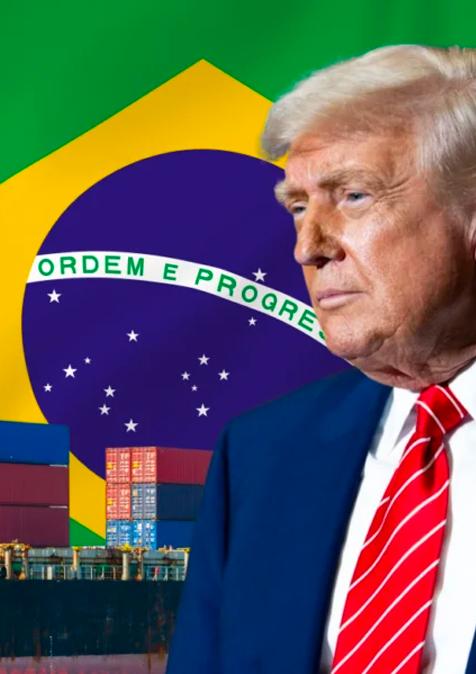
    An Executive Order issued on July 30 by President Donald Trump hiked United States tariffs on imports from Brazil by 40%, in addition to the 10% established on April 2—the so-called ‘Liberation Day’ when Trump set out ‘reciprocal tariffs’ on countries around the world.The decree came with a long list of exemptions for Brazilian exports. For a number of product lines, the 10% April 2 tariff will continue to apply. These include air transport equipment, orange juice, furniture, fuel, ...
  • April 23, 2025
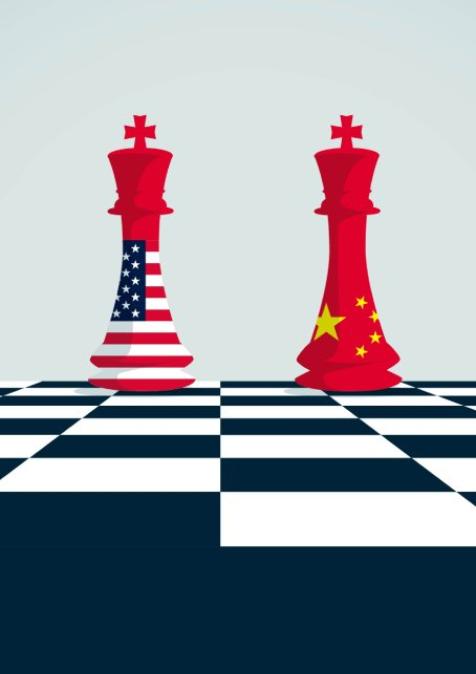
    The United States is at a critical juncture, facing a pivotal dilemma: preserving global leadership in a world it no longer fully controls. While it proclaims its primacy in the liberal international order, its actions tell a different story—one marked by tariffs, reshoring policies, and an open attempt to contain China’s rise. This strategy is driven less by long-term vision than domestic political calculus, underscoring the urgent need for strategic recalibration. ...
  • April 10, 2025
      Marcus Vinicius De Freitas Professor, China Foreign Affairs University Senior Fellow, Policy Center for the New South The Chinese government’s white paper, ‘China’s Position on Some Issues Concerning China-US Economic and Trade Relations,[1]’ issued on April 9, 2025, in response to the escalating tariffs imposed by President Donald Trump, is not just a diplomatic response to the escalating tensions with the United States. It is a meticulously crafted strategic document th ...
  • Authors
    Antonio Jorge Martins
    October 9, 2024
    The road to decarbonizing the planet runs through the energy transition, which includes the shift from fossil-fueled cars to renewable energy vehicles. This automotive transition is unfolding as a true revolution in the industry. The evolution toward electric and hybrid vehicles has come in tandem with the ascent of Chinese producers. In the current context of geopolitical and technological rivalries, the automotive transition has been marked by an intense trade war, with implicati ...
  • Authors
    September 27, 2024
    This paper examines the implications of the U.S.-China trade war for developing countries, particularly in light of the 2024 U.S. presidential election. The study traces the origins and escalation of the trade conflict, analyzing its multiple impacts on global trade patterns and economic growth. While some developing countries have benefited from trade diversion and supply-chain shifts, others, especially resource-exporting nations and the least-developed countries, have faced signi ...