AES 2023 - Session 4 : Industrial Policy for Innovation and Technology Upgrading in Africa

September 22, 2023

After decades of market-oriented free-trade policies supposed to efficiently allocate resources across industries in a way that reflects consumer preferences and technological possibilities, industrial policy is making a strong comeback. Such “Laisser-Faire” policies have undoubtedly acted as a catalyst for income catch-up and contributed significantly to poverty reduction across developing countries but were certainly not without blemish. There is some evidence that the set of economic policies prescribed by the Washington Consensus led to the demise of certain infant industries, limited the creation of local value-added, and trapped these developing countries in a technological dependency. Consequently, government intervention in designing the industrial policy is today more than justified to address the different market imperfections. As far as the African continent is concerned, there is a real need to foster innovation and approach the technological frontier. Africa cannot rely solely on FDI to develop its domestic industries and foster economic growth overall. Besides, African policymakers should also learn lessons from the failure of previous import-substitution policies, that didn’t ensure a rise of competitive local industries.

- How can Africa best negotiate this new turn to industrial policy design?

- What should be done to ensure that the next industrial policy will foster innovation and encourage intellectual protection?

- How can the African continent make the best use of its comparative advantage in terms of population, to re-skill the human capital?

Chair: Abdelkhalek Touhami, Full Professor, Mohammed VI Polytechnic University (Morocco)

Speakers: Andy McKay, Professor, University of Sussex (UK) Mustapha Kamel Nabli, Senior Associate, Economic Research Forum (Tunisia) Thierry Warin, Professor, HEC Montréal (Canada)

RELATED CONTENT

  • Authors
    Taoufik Abbad
    July 5, 2017
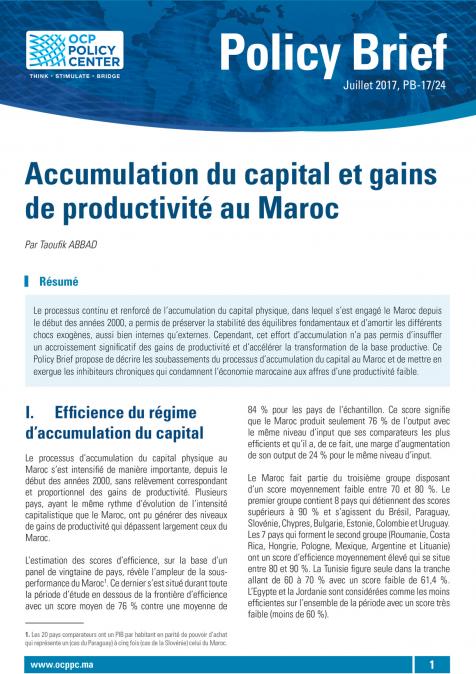
    Le processus continu et renforcé de l’accumulation du capital physique, dans lequel s’est engagé le Maroc depuis le début des années 2000, a permis de préserver la stabilité des équilibres fondamentaux et d’amortir les différents chocs exogènes, aussi bien internes qu’externes. Cependant, cet effort d’accumulation n’a pas permis d’insuffler un accroissement significatif des gains de productivité et d’accélérer la transformation de la base productive. Ce Policy Brief propose de décri ...
  • June 21, 2017
    Ce podcast est présenté par Moubarack Lo. Il y analyse l’apport de l’adhésion marocaine à la CEDEAO suite à l’accord de principe donné par ses membres au 51e sommet de Monrovia le 4 juin ...
  • Authors
    Eliot Pence
    May 19, 2017
    U.S. Africa policy has tended to shift over time and has lacked a clear overarching strategic vision. The Trump administration’s approach in Africa should articulate a limited set of principles that clarifies and solidifies a more sustainable framework that is better suited to address fundamental drivers of Africa’s future. These principles include prioritizing key countries and rationalizing resources, creating an “Investment- First” policy in Africa, and more clearly communicating ...
  • Authors
    Onasis Tharcisse A. Guedegbe
    December 23, 2016
    L'intégration commerciale est une condition de réussite de tout projet d’intégration économique. Les facteurs entravant cette intégration commerciale sont donc un goulot d’étranglement au projet d’intégration économique des pays de la Communauté Economique des Etats de l’Afrique de l’Ouest (CEDEAO), projet qui constitue un moyen efficace de faire face à la forte expansion de la demande alimentaire sous régionale. Cet article vise à mettre en lumière les facteurs contraignant la flui ...
  • Authors
    Edité par
    Idriss El Abbassi
    Lahcen Oulhaj
    Aziz Ragbi
    November 28, 2016
    Le présent ouvrage se propose d’apporter quelques éléments d’appui supplémentaires aux policy-makers pour une meilleure identification des défaillances des marchés au Maroc et une mise en place d’une stratégie de diversification et une politique industrielle efficientes, sans toutefois tomber dans la situation inverse où une stratégie mal définie et des outils mal choisis peuvent se traduire par une défaillance des politiques publiques. L’appréhension des difficultés qu’éprouve l’é ...
  • Authors
    Karim EL Mokri
    October 13, 2016
    Morocco is now more than ever threatened by the trap of middle-income economies. On one hand, it is caught between increased competition from low-income countries in low productivity and labor-intensive sectors and, on the other hand, the difficulty of accelerating its pace of structural transformation towards activities with higher value added and higher technological content. International experience shows that few countries have managed to climb to the status of an advanced econo ...
  • Authors
    Michael L. Lahr
    Dina N. Elshahawany
    Moisés Vassallo
    October 13, 2016
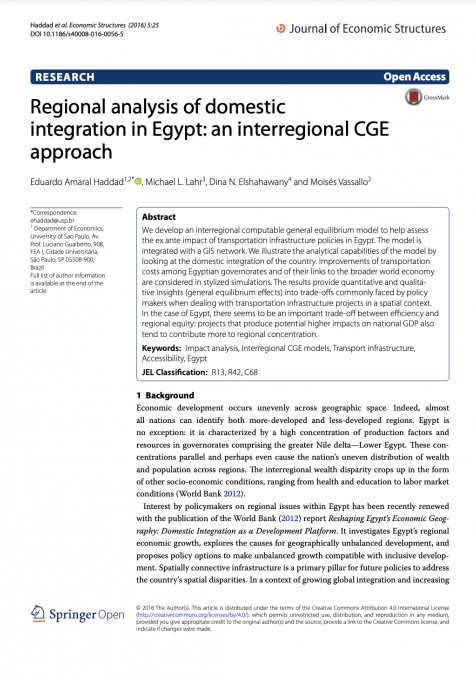
    We develop an interregional computable general equilibrium model to help assess the ex ante impact of transportation infrastructure policies in Egypt. The model is integrated with a GIS network. We illustrate the analytical capabilities of the model by looking at the domestic integration of the country. Improvements of transportation costs among Egyptian governorates and of their links to the broader world economy are considered in stylized simulations. The results provide quantitat ...
  • Authors
    Under the Supervision of
    Philippe Chalmin
    July 4, 2016
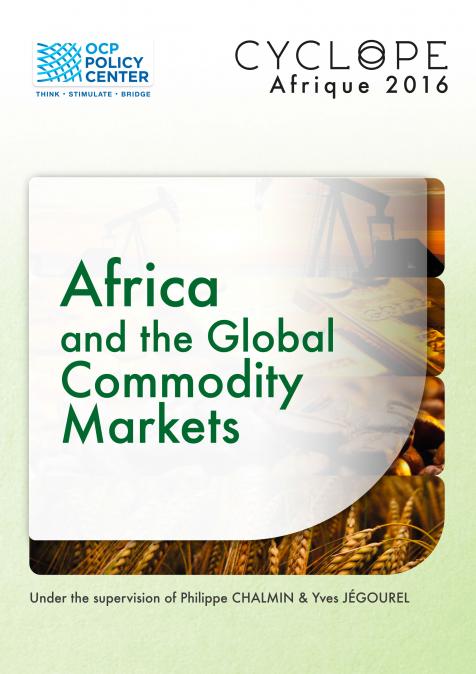
    Guinea’s bauxite, Moroccan phosphates, Nigerian Bonny Light, Zambian copper, Côte d'Ivoire’s cocoa, Ethiopian coffee or Madagascar’s vanilla: all are examples demonstrating that raw materials have a dimension that is as global as it is local. Global by the markets on which they are traded, local by their quality, a key element of their price, and their macroeconomic impact, particularly for Africa. In line with the 2016 CyclOpe report, which celebrates three decades of existence thi ...
  • Authors
    Russel Dinh
    January 27, 2016
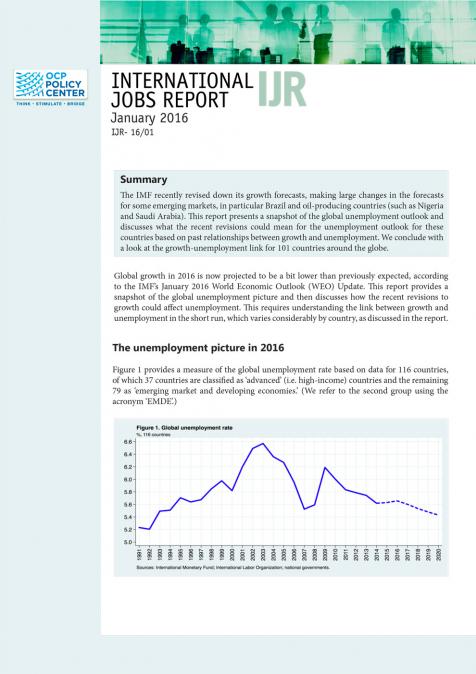
    The IMF recently revised down its growth forecasts, making large changes in the forecasts for some emerging markets, in particular Brazil and oil-producing countries (such as Nigeria and Saudi Arabia). This report presents a snapshot of the global unemployment outlook and discusses what the recent revisions could mean for the unemployment outlook for these countries based on past relationships between growth and unemployment. We conclude with a look at the growth-unemployment link f ...
  • Authors
    Nisrine Ouazzani
    January 6, 2016
    The economic growth of the African continent and its positioning as an emerging force is a reality no longer questioned. Optimism surrounding the Africa rising narrative is supported by a growing young workforce, an expanding middle class, new discoveries of natural resources and minerals, relative political stability and infrastructure developments. Economic and international financial actors now recognize the potential that the continent represents for the world economy, consider ...