Publications /
Paper in Academic Journals
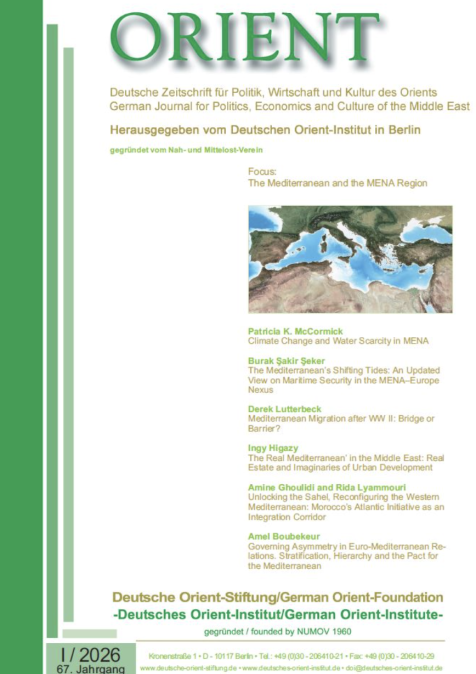
This Paper was originally published on orient-online.com
The Western Mediterranean’s exposure to the Sahel is usually framed in terms of security spillovers and crisis management. This paper argues that this framing misreads how Sahelian access conditions now shape Mediterranean integration. Morocco’s Atlantic Initiative is a state-led corridor strategy combining Atlantic port infrastructure, inland transit routes, and energy systems to connect landlocked Sahelian economies to maritime access through Moroccan territory. Examining this initiative, the paper shows how Sahelian access conditions now shape routing decisions, risk pricing, and gateway hierarchies inside the Western Mediterranean itself. The Atlantic Initiative functions not as a development scheme or a basin institution, but as a corridor architecture designed to reduce the structural penalty of landlockedness and convert hinterland access into Mediterranean-relevant trade and energy flows. Its credibility rests on three elements: a scale-setting Atlantic gateway anchored at Dakhla, transit governance through Mauritania as a non-bypassable hinge, and demonstrable Sahel-side demand for diversified external access. Where these elements align, corridor reliability alters planning horizons and competitive dynamics well before trade volumes visibly rebase. The paper concludes that Mediterranean integration is increasingly produced through corridors that originate beyond the basin and re-enter it through gateway states.