Publications /
Policy Paper

Back
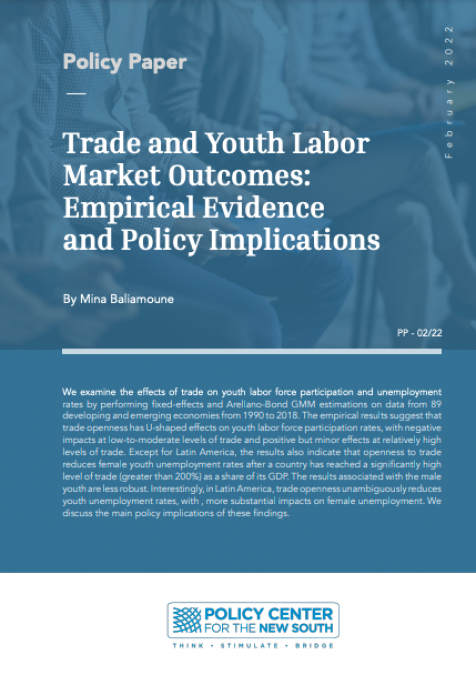
Trade and Youth Labor Market Outcomes: Empirical Evidence and Policy Implications
Authors
February 1, 2022

We examine the effects of trade on youth labor force participation and unemployment rates by performing fixed-effects and Arellano-Bond GMM estimations on data from 89 developing and emerging economies from 1990 to 2018. The empirical results suggest that trade openness has U-shaped effects on youth labor force participation rates, with negative impacts at low-to-moderate levels of trade and positive but minor effects at relatively high levels of trade. Except for Latin America, the results also indicate that openness to trade reduces female youth unemployment rates after a country has reached a significantly high level of trade (greater than 200%) as a share of its GDP. The results associated with the male youth are less robust. Interestingly, in Latin America, trade openness unambiguously reduces youth unemployment rates, with , more substantial impacts on female unemployment. We discuss the main policy implications of these findings.


RELATED CONTENT

  • Authors
    Ahmed Ouhnini
    December 5, 2025
    L’« uberisation », terme né du nom de l’entreprise américaine Uber au début des années 2010, désigne initialement un modèle économique fondé sur la mise en relation directe entre offre et demande via des plateformes numériques. Rapidement popularisé, le concept s’est élargi, avec Airbnb dans l’hébergement, puis à une multitude d’autres secteurs : livraison de repas, services à domicile, commerce en ligne, voire des métiers traditionnellement régulés ou corporatistes. Ce néologisme t ...
  • Authors
    Ahmed Ouhnini
    December 5, 2025
    “Uberization,” a term derived from the American company Uber in the early 2010s, initially refers to an economic model based on directly matching supply and demand through digital platforms. Rapidly popularized, the concept has expanded with Airbnb in accommodation, and then to a wide range of other sectors: food delivery, home services, e-commerce, and even traditionally regulated or corporatist professions. This neologism thus reflects a transformation of economic and social relat ...
  • Authors
    December 3, 2025
     Global GDP growth has proven resilient in 2025, despite the shocks caused by the trade policies implemented by United States President Donald Trump in the first year after his return to office. The gloomy projections offered by multilateral and private institutions in the first quarter of 2025 have given way to revised levels mostly in the 2.5% to 3% range for the year. ...
  • November 25, 2025
    This Policy Paper analyses the Fourth Industrial Revolution (4IR) through the critical lens of technological colonialism. It argues that the fusion of physical, digital, and biological technologies is not merely a technical phenomenon but a civilizational shift reshaping the foundations of global power. The article traces a historical continuum from previous industrial revolutions, demonstrating how patterns of inequality and extraction persist, now transposed into the digital realm ...
  • Authors
    Lahcen Oulhaj
    November 19, 2025
    La modélisation classique de la croissance repose sur des outils – notamment la fonction de production agrégée et la comptabilité de la croissance – dont les incohérences logiques et les ambiguïtés épistémologiques sont connues depuis la Controverse de Cambridge et les travaux d’Anwar Shaikh. Pourtant, ces failles continuent d’alimenter des raisonnements fallacieux dans le débat économique et les discours institutionnels. Cet article montre que la nature tautologique de ces outils n ...
  • Authors
    Arkebe Oqubay
    November 17, 2025
    Morocco has emerged as one of Africa's success stories, achieving significant progress in economic transformation and the green transition over the past 25 years. Continuing and deepening this transformation is essential to reach the country’s goal of becoming a high-income economy in the coming decades. Significant challenges include managing the risk of the middle-income trap, addressing demographic pressures, promoting inclusive growth, ensuring environmental sustainability, and ...
  • Authors
    Jorge Arbache
    October 9, 2025
    Conventional wisdom holds that the United States has undergone massive deindustrialization in recent decades, with the country's manufacturing sector supposedly withering as it lost ground to China. This narrative has fueled debates about industrial policy, economic nationalism, and the reshoring of manufacturing production. But what if this story is only partially true? What if, instead of disappearing, American industry simply changed its address?  ...
  • October 3, 2025
    In this episode, we explore Africa’s industrial challenges and opportunities, showing how AfCFTA-driven integration, green sectors, and inclusive policies for women, youth, and SMEs can foster sustainable growth, resilience, and domestic value capture. ...
  • Authors
    Edited by
    July 14, 2025
    Available soon on livremoi. The 2025 edition of the African Economic Report continues in the spirit of previous versions. It presents a broad overview of the continent’s economic evolution and offers insights into Africa’s relationship with the rest of the world. In other words, it explores how Africa navigates the effects of global fragmentation within its regional spaces while pursuing its ambition of continental integration. ...