Publications /
Policy Brief
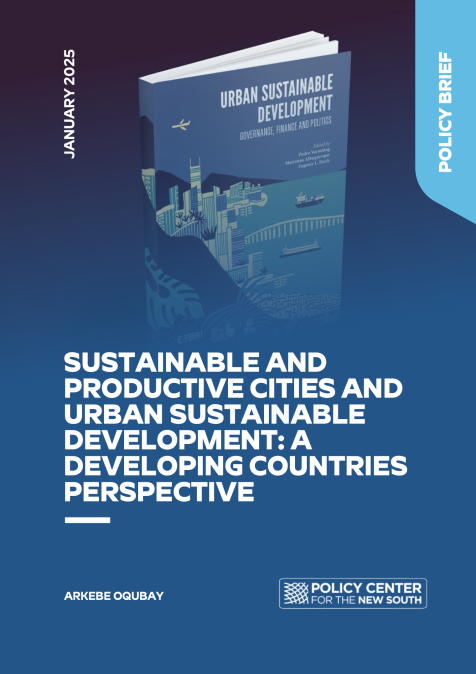
This paper, included in the report "Urban Sustainable Development: Governance, Finance and Politics.", was originally published on:https://cebri.org/en/doc/356/cebri-and-rio-g20-committee-publish-urban-sustainable-development-governance-finance-and-politics
© Vormittag, Pedro, Marianna Albuquerque & Eugénie Birch (Eds.). 2024. Urban Sustainable Development: Governance, Finance and Politics. Rio de Janeiro: CEBRI.
The article discusses the role of sustainable and productive cities as drivers of global transformation. Cities, as the heart of human civilizations, not only propel economic development and serve as technological and innovation hubs but also inspire hope and optimism for the future. They contribute over 80 percent of the global economy and nearly 100 percent to all scientific and technological breakthroughs. Rapid urbanization has been a primary force in the demographic shift that impacts global transformation. With their unparalleled resilience and innovation ability, cities are also at the forefront of significant global challenges, such as the COVID-19 pandemic and climate change, finding sustainable solutions. Cities are not just essential to the 2030 Agenda for Sustainable Development and the Paris Climate Agreement, endorsed by all United Nations member countries, but are the subject and primary actors in implementing it. By recognizing the importance of making “cities and human settlements inclusive, safe, resilient and sustainable” (Goal 11), the 2030 Agenda underscores the importance and impact of cities in shaping the future.
However, in shaping global transformation, cities face significant challenges in releasing their full potential, including financial, governance, and political constraints. A G20 Summit in Rio de Janeiro led by Brasil could be instrumental in promoting city transformation and urban sustainable development as essential components of the development agenda, empowering cities to take charge of their transformation. The objectives of the paper are: (1) to present urbanization and urban transformation as a framework; (2) to explain why and how cities should strive to be not only productive but also sustainable to promote their national development strategies, to achieve Sustainable Development Goals (SDGs) and the net zero agenda; (3) to further discuss the dynamics of city transformation with a focus on Addis Ababa’s transformation as a case study; and (4) to learn from city leadership experiences. The article will explore critical questions: What specific strategies can cities implement to become productive and sustainable cities? What examples of successful city transformation and leadership experiences can be learned from? Given the urbanization wave, population growth, and the lagging structural transformation, these questions have significant implications for cities in emerging and developing economies or the Global South.
This article is enriched by the author’s over three decades of experience in development policymaking and transformation, including serving as the former mayor of Addis Ababa and former minister of urban development. This unique perspective, combined with extensive scholarly and research work drawing from development economics, urban development, and international political economy, provides a comprehensive understanding of the issues at hand. The paper is structured into four sections covering the above mentioned themes, supplemented by an introduction and conclusion. The author’s unique perspective is a critical element that makes this paper a valuable resource for understanding urban transformation.