Publications /
Policy Paper

Back
The State of China-European Union Economic Relations
Authors
Marta Domínguez-Jiménez
Tianlang Gao
November 26, 2019

China and the European Union have an extensive and growing economic relationship. The relationship is problematic because of the distortions caused by China’s state capitalist system and the diversity of interests within the EU’s incomplete federation. More can be done to capture the untapped trade and investment opportunities that exist between the parties. China’s size and dynamism, and its recent shift from an export-led to a domesticdemand- led growth model, mean that these opportunities are likely to grow with time. As the Chinese economy matures, provided appropriate policy steps are taken, it is likely to become a less disruptive force in world markets than during its extraordinary breakout period.

This working paper was originally published on Bruegel website.

RELATED CONTENT

  • Authors
    October 29, 2026
    Wars are decided by those who hold military power, but their costs are increasingly borne by those who have little or no voice in the decisions that start them. The US–Iran war shows this imbalance very clearly. Its economic consequences have gone far beyond the battlefield and have disrupted energy markets, trade routes, food supplies, public finances and investment in the Gulf, Europe, Africa and Asia. The most striking feature of the conflict, however, is not only the size of the ...
  • October 14, 2026
    في ظل التوترات الجيوسياسية المتصاعدة، تتغير طرق التجارة العالمية وتتبدل معها موازين الممرات الاستراتيجية. تفتح هذه الحلقة من «حديث الثلاثاء» النقاش حول التقاء المسارات البحرية والبرية داخل هذه الممرات، والعوامل التي تتحكم في طبيعة السلع التي تعبرها. وتبحث كذلك في ما يمكن للمغرب أن يجنيه...
  • Authors
    Paul Isbell
    October 9, 2026
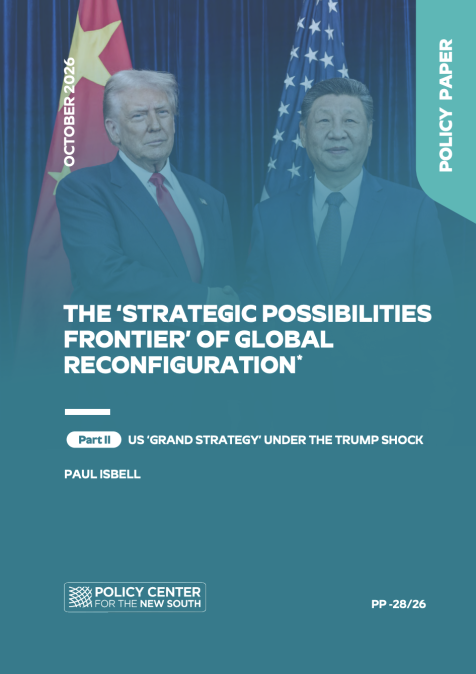
    In the first seven Policy Briefs of this ongoing series of analysis on Pan-Atlanticism: The Atlantic Basin in a Multipolar-Transnational World, we developed the argument that the strategic significance of the Atlantic Basin is on the rise for a range of international actors (states, regions and non-state agents) and from distinct political or ideological perspectives. In addition, in the most recently published Policy Brief -- “The U.S. and the Current International Reconfiguration: ...
  • Authors
    July 13, 2026
    On “marinetraffic.com”, thousands of triangles fill a map of the world’s ports and oceans, each representing the active location and destination of a ship, reported the “McGill International Review” (April 16, 2026) adding,” suspicious tankers are plentiful among them.” One of these vessels, marked by a red triangle, appears, zoomed, as “Monique”, a twenty-year-old vessel, aka Tokyo, Phuket and Elysia. Its old age and the frequent name change, suspects reporter Julnar Alzuki, “indic ...
  • Authors
    February 12, 2026
    Divergent regulatory regimes for data, driven by different motivations, ranging from privacy protection in the European Union to information control in China, could eventually produce distinctively different, and possibly contradictory, bodies of data. Artificial-intelligence models trained on those datasets could produce differing and possibly even conflicting outputs. To the extent that AI outputs start to shape human perception and to influence decisions, in governments and ...
  • Authors
    August 29, 2023
    At the August 22-24 BRICS summit in Johannesburg, the leaders of Brazil, Russia, India, China and South Africa said they wanted to use more of their national currencies for cross-border payments, which are currently dominated by the U.S. dollar and other global convertible currencies. Like China and the other BRICS, several other countries have also sought to develop alternative external payment mechanisms. Pairs of countries have agreed to settle commercial and financial transactio ...