
Publications /
Policy Brief
University campuses across the MENA region consume significant amounts of energy but lack the tools to anticipate and optimize their demand. Current monitoring systems are descriptive and reactive: they record what has already happened but provide no forward-looking intelligence. Meanwhile, commercial building management systems remain financially out of reach for most institutions in developing countries, with costs exceeding $10,000 per building.
A validated framework combining artificial intelligence and low-cost Internet of Things infrastructure now demonstrates that this gap can be closed. Tested on a Moroccan university campus over a full academic year, a hybrid AI forecasting model achieved prediction accuracy exceeding 96%, outperforming every conventional method evaluated [1]. The supporting IoT platform was deployed across six buildings at less than one-twentieth the cost of commercial alternatives.
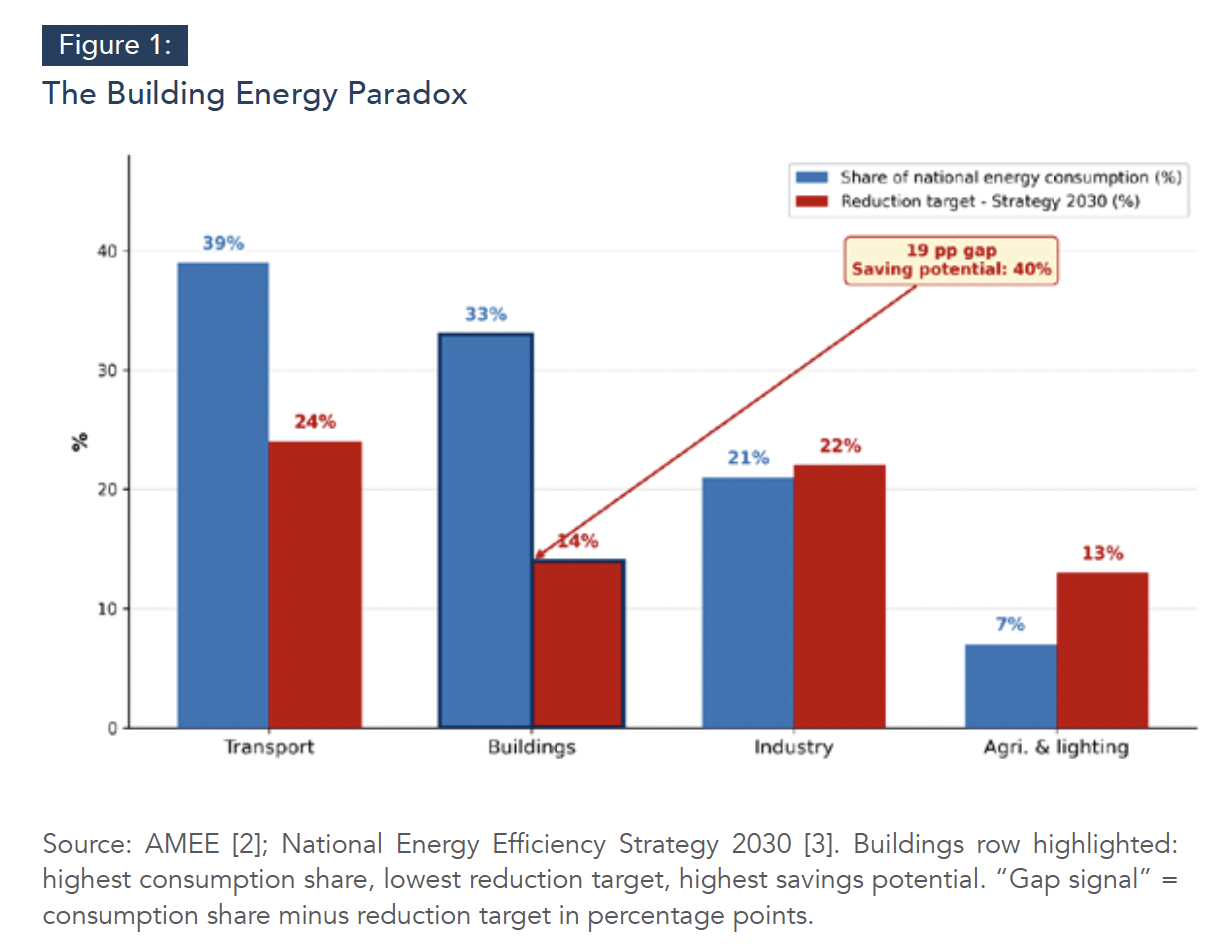
Yet the sector with the highest energy savings potential in Morocco, buildings at 33% of national consumption, receives the lowest policy reduction target at only 14%, and universities have no sector-specific efficiency measures [2][3]. This brief argues that scaling predictive energy management across university campuses represents a high-impact, low-cost opportunity that current policy frameworks are not capturing.
1. The Problem: Why university campuses are energy blind
Buildings account for approximately 30% of global final energy consumption and 26% of energy-related greenhouse gas emissions [4]. Within this sector, higher education institutions represent a particularly complex challenge. They combine teaching spaces, research laboratories, administrative offices, dormitories, and communal facilities under a single operational umbrella, each with distinct usage patterns and energy signatures [5].
In Morocco, the building sector consumes 33% of national energy, with 26% from residential buildings and 7% from commercial and institutional buildings [2]. The Moroccan Agency for Energy Efficiency estimates that this sector holds a savings potential of 40%, the highest of any sector [2]. Despite this potential, most university campuses in the MENA region operate without any form of predictive energy management. Monitoring systems, where they exist, are purely descriptive: they display current consumption but offer no capacity to anticipate demand peaks, detect anomalies before they escalate, or optimize energy purchasing strategies.
Three structural barriers explain this gap. First, commercial building management systems are prohibitively expensive for institutions in developing countries. Second, high-resolution energy data from MENA-region universities remains scarce, limiting the development and validation of forecasting models adapted to local conditions [6]. Third, the research literature on campus energy forecasting is overwhelmingly concentrated in developed-country settings, where climate conditions, building standards, and operational patterns differ substantially from those found in North Africa and the Middle East [5].
The consequence is a significant blind spot: the sector with the greatest savings potential is also the one with the least predictive capability.
2. What the evidence shows: Lessons from the INPT campus
The” Institut National des Postes et Télécommunication” (INPT) campus in Rabat, Morocco, provided the testing ground for a comprehensive data-driven approach. High-resolution power data was collected from metering units at 15-minute intervals over one full academic year, covering buildings with diverse functions including classrooms, laboratories, administration, and dormitories [1][7].
The first finding challenged a common assumption in energy literature. In campus environments dominated by cooling loads, weather is typically assumed to be the primary driver of demand. At INPT, statistical analysis revealed that academic scheduling, not weather, is the dominant factor. Clustering analysis identified five distinct consumption regimes aligned with recognizable phases of the academic calendar: full-session teaching, moderate activity, weekends, examination periods, and vacations. This regime structure means that a single forecasting model trained on undifferentiated data will inevitably perform poorly, because the underlying patterns are fundamentally different from one period to another.
Building on this regime-aware characterization, an AI forecasting model was developed that can simultaneously read short-term signals (hour-to-hour changes within a day) and longer-term trends (patterns spanning days and weeks). The system automatically adjusts its focus depending on the type of period it is operating in [1].
The results are significant. The hybrid model achieved prediction accuracy ranging from 92.7% to 96.4% across all tested meters, outperforming every baseline method evaluated, including classical statistical approaches, standalone deep learning models, and recent architecture reported in the 2024-2025 literature. Importantly, the model generalized across buildings of different types without requiring any building-specific recalibration.
A six-layer IoT platform was designed and deployed across the campus to ensure that predictive accuracy translates into operational value. The platform relies entirely on open-source, off-the-shelf components, with no proprietary software or licensing fees [8]. It covers six buildings with over 14 sensing nodes. The total hardware cost came to less than $500 per building, compared to more than $10,000 for commercial building management systems. Data quality management is embedded at every layer, ensuring that the forecasting model receives clean, continuous input even in conditions of intermittent connectivity.
Estimated Impact
The INPT campus consumes approximately 2,800 MWh per year. Based on international benchmarks for predictive energy management in institutional buildings, savings of 5 to 10% are achievable through peak shaving, load shifting, and tariff optimization. Applied to INPT, this translates to 140 to 280 MWh saved annually, equivalent to 100 to 200 tonnes of CO2 avoided. At current institutional electricity tariffs, estimated savings reach 140,000 to 280,000 MAD per year, for a one-time infrastructure investment of approximately 30,000 MAD across six buildings. Scaled to Morocco's 200+ higher education institutions, the aggregate potential reaches 28,000 to 56,000 MWh and 28 to 56 million MAD in annual savings.
3. Why this matters for MENA energy policy
Morocco has set one of the most ambitious renewable energy targets in the region: 52% of installed electricity capacity from renewable sources by 2030, with a long-term target of 80% by 2050 [9]. The National Energy Efficiency Strategy complements this supply-side ambition with a demand-side target of 20% reduction in national energy consumption by 2030 through approximately 80 measures across the main sectors [3].
However, the distribution of effort across sectors reveals a significant imbalance. The national strategy sets sector-specific reduction targets: 24% for transport, 22% for industry, but only 14% for buildings [3], even though buildings represent the largest single consumer at 33% of national energy [2]. Within the building sector, no measures target higher education institutions specifically, even though Morocco has more than 200 university campuses and educational institutions, each functioning as a small-scale microgrid.
This asymmetry matters because university campuses offer unique advantages as sites for energy optimization. They are large enough to generate meaningful savings, institutionally coherent enough to implement changes, and academically positioned to serve as living laboratories for the next generation of energy engineers. The Times Higher Education SDG 7 rankings already assess universities on their energy commitments, with over 1,100 institutions ranked globally [10], but the infrastructure to act on those commitments is largely absent in the MENA region.
Morocco's updated Nationally Determined Contribution under the Paris Agreement sets a conditional target of 45.5% emissions reduction by 2030, with sectoral strategies covering buildings explicitly [11]. Scaling predictive energy management across university campuses could contribute directly to this commitment, while generating immediate operational savings for institutions that are often constrained by tight public budgets.
4. The barriers to scaling
Four categories of barriers currently prevent the scaling of predictive energy management in MENA university campuses.
Most universities outside major capitals lack in-house expertise in data science, machine learning, and IoT system integration. The technical profiles needed to deploy and maintain predictive energy platforms are scarce and concentrated in the private sector. Without targeted capacity-building, even low-cost technology remains inaccessible in practice.
High-resolution energy data is a prerequisite for regime-aware forecasting, yet most MENA-region campuses lack the metering infrastructure to produce it. Where meters exist, they are often disconnected from any centralized data pipeline. The absence of standardized data collection protocols across institutions further limits the potential for cross-campus learning and model transfer.
University energy management typically falls between administrative and technical services, with no single unit responsible for predictive optimization. Budget cycles are rigid, procurement processes are slow, and the operational culture in many public institutions favor established suppliers over open-source alternatives. The result is a structural bias toward expensive commercial solutions that are rarely deployed, rather than affordable alternatives that could be implemented incrementally.
On the regulatory side, Morocco's Thermal Building Regulation (RTCM), in force since 2015, sets minimum performance standards for new construction but does not address operational energy optimization in existing institutional buildings [2]. There are no efficiency benchmarks specific to higher education, no mandatory energy audits for universities, and no incentive mechanisms to reward campuses that invest in predictive management. The National Energy Efficiency Strategy identifies buildings as a priority sector but does not differentiate between residential, commercial, and educational institutions [3].
5. Pathways for action
The evidence from the INPT campus, combined with the broader policy landscape, suggests four actionable directions.
A network of five to ten university campuses across Morocco, selected to represent different climate zones, building types, and institutional sizes, could serve as demonstration sites for predictive energy management. The INPT deployment demonstrates that the technology stack is mature, affordable, and replicable. A structured pilot would generate the performance data needed to justify broader institutional investment and would create a reference framework for other MENA countries. The World Bank's recent analysis of Morocco's energy transition highlights the need for precisely this kind of targeted, evidence-generating intervention [12].
Each pilot campus should include a training component that builds in-house capability to operate and maintain the predictive platform. This goes beyond one-time workshops: it requires integrating energy data science into existing engineering curricula, creating student research opportunities around campus energy optimization, and establishing a peer network through which technical teams across campuses share operational experience. UNEP's United for Efficiency program, which has supported over 80 developing countries on energy efficiency standards, provides a model for how international technical assistance can accelerate local capacity-building [13].
The current regulatory framework treats all buildings uniformly. Universities, however, have distinctive energy profiles driven by academic calendars, laboratory equipment, and variable occupancy. Sector-specific benchmarks, adapted from the data-driven approach validated at INPT, would provide institutions with actionable targets and enable meaningful comparison across campuses. These benchmarks could be integrated into university accreditation criteria, linking energy performance to institutional quality assessment.
The IoT platform deployed at INPT relies entirely on open-source components such as InfluxDB, Grafana, MQTT, and ESP32 hardware. This architecture avoids vendor lock-in, enables local adaptation, and keeps costs at a level compatible with public university budgets. Policy frameworks should explicitly encourage open-source solutions for institutional energy management, and should support the creation of shared datasets, allowing AI models proven on one campus to be adapted to another with only a few weeks of local data.
6. Looking ahead
The technology validated at INPT addresses one campus. The opportunity is continental. Africa alone has thousands of university campuses, the vast majority operating without any form of predictive energy intelligence. As renewable energy capacity grows across the MENA region and the continent, the ability to forecast and optimize demand at the building level becomes not a luxury but a necessity for grid stability and resource efficiency.
Three technical developments could accelerate this transition in the near term. First, the integration of forecasting models with automatic control systems, moving from monitoring and alerting to fully automated energy optimization. Second, transfer learning protocols that allow a model trained on one campus to be adapted to a new site with as little as a few weeks of local data, dramatically reducing the barrier to entry for new institutions. Third, the extension to multi-energy systems that co-optimizes electricity, heating, cooling, and on-site renewable generation.
The tools to transform university campuses from passive energy consumers into intelligent, adaptive microgrids already exist, have been validated, and are affordable. What remains is the institutional will to deploy them and the policy frameworks to support their scaling. Morocco, with its ambitious energy targets and its track record of regional leadership on climate action, is well positioned to lead this transition, starting with its own university system.
The framework validated at INPT is not limited to universities. Any institutional building with variable occupancy, whether hospitals, government offices, or commercial facilities, can benefit from the same approach with minimal adaptation. Universities serve as an ideal proving ground because they concentrate technical expertise and high-quality data, but the strategic objective is broader: a technology proven on campus today can serve the entire building sector, which accounts for 33% of national energy consumption, tomorrow.
References
[1] I. Hajjaji, A. Ait Mansour, and H. Dahmouni, “AI-driven energy optimization in university microgrid: A hybrid LSTM-RNN forecasting consumption patterns approach,” Energy Reports, vol. 15, 109023, 2025.
[2] AMEE, “Energy Efficiency in Buildings,” Agence Marocaine pour l’Efficacité Énergétique, Rabat, 2020.
[3] Kingdom of Morocco, “National Energy Efficiency Strategy, Horizon 2030,” Ministry of Energy, Mines and Environment, Rabat, 2020.
[4] IEA, “Buildings, Energy System,” International Energy Agency, Paris, 2024.
[5] R. Silva, M. Dutra et al., “Benchmarking energy consumption in universities: A review,” Journal of Building Engineering, vol. 83, 108378, 2024.
[6] IRENA, “Renewable Energy in the Arab Region: Overview of Developments,” International Renewable Energy Agency, Abu Dhabi, 2019.
[7] I. Hajjaji, H. El Alami, R. El Alami, and H. Dahmouni, “Energy Consumption Characterization in University Campus Microgrid Based on Power Data Analysis,” 9th Int. Conf. Future Internet of Things and Cloud (FiCloud), pp. 107-112, 2022.
[8] A. Rhesri, F. Aabadi, R. Bennani, Y. Ben Maissa, A. Tamtaoui, and H. Dahmouni, “Development of a Low-Cost Internet of Things Platform for Three-Phase Energy Monitoring in a University Campus,” IoT, vol. 6, no. 2, p. 27, 2025.
[9] IEA, “Morocco Renewable Energy Target 2030,” International Energy Agency, Paris, 2015.
[10] Times Higher Education, “University Impact Rankings for UN SDG 7: Affordable and Clean Energy,” London, 2025.
[11] NDC-ASPECTS, “Transition Pathways for Morocco, Country Report,” European Commission, 2024.
[12] World Bank, “The Disruptive Energy Transition and Opportunities for Job Creation in MENA: Case Study, Morocco,” Washington, DC, 2024.
[13] UNEP, “United for Efficiency (U4E): Supporting Developing Countries on Energy Efficiency Standards,” United Nations Environment Programme, 2023.
[14] H. El Hafdaoui, A. Khallaayoun, and K. Ouazzani, “Activity and efficiency of the building sector in Morocco: A review of status and measures in Ifrane,” AIMS Energy, vol. 11, no. 3, pp. 454-485, 2023.
[15] Kingdom of Morocco, “Nationally Determined Contribution under the UNFCCC,” Updated submission, 2021.

