Publications /
Policy Brief

Back
Policy options for food systems transformation in Africa - from the perspective of African universities and think tanks
Authors
Fadi Abdelradi
Assefa Admassie
John Asafu Adjaye
Miltone Ayieko
Ousmane Badiane
Katrin Glatzel
Sheryl Hendriks
Mame Samba Mbaye
Racha Ramadan
Tol Fadi Abdelradi
Assefa Admassie
John Asafu Adjaye
Miltone Ayi
May 25, 2021

Within the context of the United Nations Food Systems Summit taking place in September 2021, this brief discusses key drivers of food systems in Africa, as well as the challenges and opportunities for transformation. It concludes with specific policy options that could considerably accelerate progress towards the transformation of food systems across the continent. Specifically, this policy brief makes five recommendations: it recommends that investment in research and development for the transformation of food systems in Africa be significantly increased. To do so, it proposes the development of an African funding base to support supranational research activities as well as the creation of policy labs that allow for innovation and experimentation and learning from past failures. Secondly, the policy brief suggests that governments more proactively support the development and use of new technologies, including ICTs and biotechnology. Specifically, digital innovation hubs could provide the innovation ecosystem that is needed to spur the digital transformation of food systems, while research centers can play an active role in the evaluation and impact assessment of specific technologies and e-services in rural areas to ensure that digital applications and services meet quality standards. Thirdly, investment in strong vocational training and skill development at scale as well as integrating the concept of food systems into teaching and curricula will be crucial to harness Africa’s youth dividend and ensuring the next generation of African researchers has a deep understanding of the interconnectedness of the different disciplines that constitute food systems. The fourth recommendation made by this brief is to place more emphasis on post-harvest technologies, especially in food processing. Not only do these technologies reduce loss and waste, they add value to crops, make foods more convenient and nutritious, and expedite the commercialization of farmers’ production. Finally, the brief recommends that countries commit to strengthening the capacities within institutions and to mutual accountability mechanisms. The CAADP Biennial Review and the joint sector reviews hereby constitute best practice approaches that could be built upon to encompass all elements of a food systems transformation.

RELATED CONTENT

  • Authors
    April 21, 2022
    For the second time, Côte d'Ivoire is known for being a "miracle economy" –high aggregate GDP growth of 8% per year since 2012. Despite this achievement, its food systems are unable to deliver food security to most Ivoirians. These systems are being undermined by several structural factors, which include broad-based low productivity and limited diversification of its agri-food sector; the high numbers of extremely poor, some 30% of the population; and the vulnerable who are millions ...
  • March 1, 2022
    Known for being a climate change hotspot, Morocco is at the forefront of a climate disaster. Consequences are already being felt, whether in the form of increasing temperature or a downward trend in precipitations, which directly threaten the water security and, by extension, the social-ecological systems of the country. The systems by which food, energy, and water are produced, distributed, and consumed heavily depend on one another. Their implicit feedbacks and links are not linea ...
  • Authors
    December 10, 2021
    Addressing the increasing demands for water, energy, and food requires a coherent methodology to ensure that  societies have access to them and that conflict over them is avoided. For example, agriculture and food production  require water and energy; energy production also requires water and, in some instances, agricultural products.  Water distribution and treatment can be very energy intensive. Therefore, the benefits of approaching the Water- Energy-Food (WEF) nex ...
  • Authors
    Fadi Abdelradi
    Assefa Admassie
    John Asafu Adjaye
    Miltone Ayieko
    Ousmane Badiane
    Katrin Glatzel
    Sheryl Hendriks
    Mame Samba Mbaye
    Racha Ramadan
    Tol Fadi Abdelradi
    Assefa Admassie
    John Asafu Adjaye
    Miltone Ayi
    May 25, 2021
    Within the context of the United Nations Food Systems Summit taking place in September 2021, this brief discusses key drivers of food systems in Africa, as well as the challenges and opportunities for transformation. It concludes with specific policy options that could considerably accelerate progress towards the transformation of food systems across the continent. Specifically, this policy brief makes five recommendations: it recommends that investment in research and development f ...
  • Authors
    Paola Maniga
    Yassine Moustanjidi
    February 15, 2021
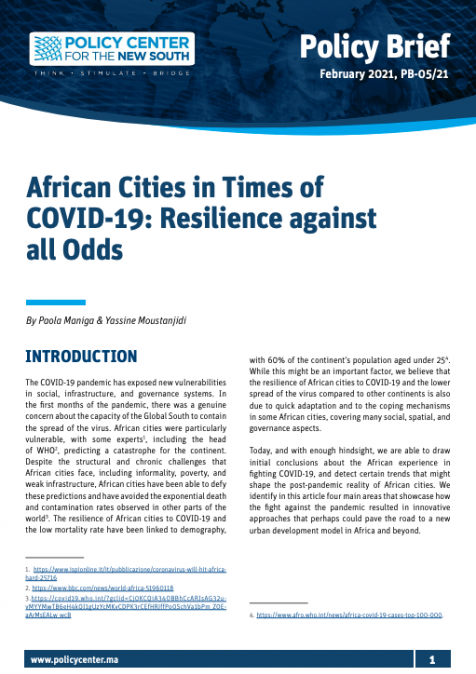
    The COVID-19 pandemic has exposed new vulnerabilities in social, infrastructure, and governance systems. In the first months of the pandemic, there was a genuine concern about the capacity of the Global South to contain the spread of the virus. African cities were particularly vulnerable, with some experts1, including the head of WHO2, predicting a catastrophe for the continent. Despite the structural and chronic challenges that African cities face, including informality, poverty, a ...
  • February 04, 2021
    Ensuring food security for a growing population is one of the major challenges of the coming decades. The scarcity of natural resources, the negative impact of climate change on agricultu ...
  • Authors
    November 26, 2020
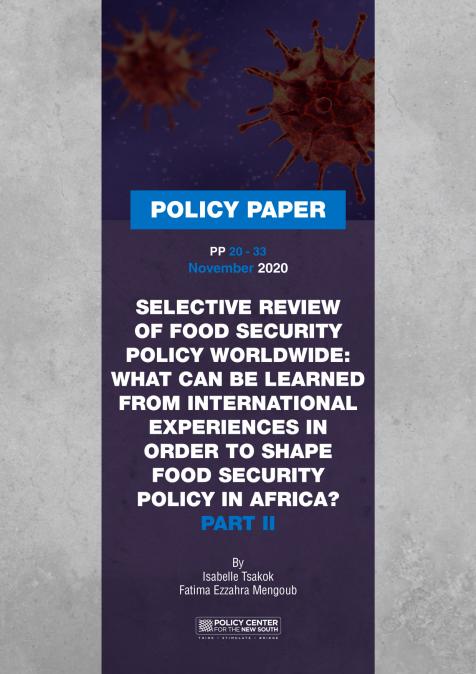
    Food security for all requires (i) sustained productivity growth and competitiveness, not only of agriculture but of the entire economy; (ii) a social safety net; and (iii) resilience in the face of periodic shocks. This is the central message of this review. Two popular concepts in food security for all are food self-sufficiency (FSS) and food sovereignty (FSY). While countries have pursued different policies to achieve FSS, the common element in their approaches is the misguided ...
  • Authors
    Sang-Hyun Lee
    Amjad T. Assi
    Bassel Daher
    October 5, 2020
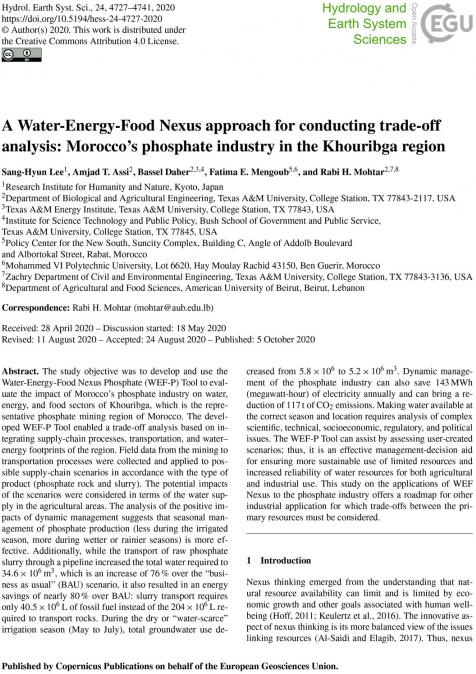
    Our Senior Fellow Rabi Mohtar has co-authored with our economist, Fatima Ezzahra Mengoub along other researchers a research paper entitled « A Water-Energy-Food Nexus approach for conducting trade-off analysis: Morocco’s phosphate industry in the Khouribga region » in Hydrology and Earth System Sciences Journal (Volume 24, Issue 10). The study objective was to develop and use the Water-Energy-Food Nexus Phosphate (WEF-P) Tool to evaluate the impact of Morocco’s phos ...
  • Authors
    September 4, 2020
    South Africa shows that being food self-sufficient is a far cry from being food secure when poverty is extensive, the majority of people suffer from the “quadruple burden of disease”1 , the economy is highly unequal, and when improving the quality of the public health infrastructure remains a major challenge despite successive governments’ efforts. The major factors that undermine food security and health in South Africa are directly or indirectly due to the long history of social ...
  • Authors
    June 25, 2020
    We are living through unprecedented times. The COVID-19 pandemic threatens not only our health, but the very foundation of life itself: our food security. Now more than ever, we are forced to rethink our food security as we witness the widespread dislocations to our food system, forcing millions to beg for food for the first time. During normal times, our world produces enough nutritious food for all but millions still go hungry every day. Why does this happen and what can be done t ...