Publications /
Policy Paper

Back
Mobilizing Resources for a More Sustainable World: The Role of Subnational Development Banks
Authors
Sergio Gusmão Suchodolski
Cinthia Helena de Oliveira Bechelaine
Adauto Modesto Junior
November 13, 2020

The effective implementation of the 2030 Agenda requires a greater level of capital mobilization and new institutional arrangements that guarantee the better allocation of these funds. Based on concrete results from the experience of the Development Bank of Minas Gerais, in Brazil, this paper argues that Subnational Development Banks (SDBs) can be powerful players within development finance institutions’ networks, as their local expertise can bring efficiency and effectiveness to the implementation of development programs. Acting in partnership with larger national and multilateral institutions, SDBs can help better channel available financial and technical resources to promote local impact by adapting sophisticated governance and operational requirements to practical and pragmatic approaches that are suited to their local environments.

RELATED CONTENT

  • Authors
    October 4, 2016
    Brazil has been suffering from anemic productivity growth. This is a major challenge because in the long run, sustained productivity increases are necessary to underpin inclusive economic growth. Without them, increases in real labor earnings tend to conflict with global competitiveness; collecting taxes in order to fund government expenditures on infrastructure and social policies becomes a heavy burden; returns to private investment becomes harder to achieve; and ultimately c ...
  • Authors
    July 21, 2016
    The pace of global growth has tapered off since the crisis and the ensuing rebound. The concept of ‘secular stagnation’ was first used in 1938 by Alvin Hanson in reference to the American economy during the Great Depression. It refers to a situation where growth is slow over a protracted period, underemployment prevails and inflation is low. In such situations, the propensity to save tends to increase as a result of uncertainty and pessimism, and liquidity – which depends on interba ...
  • Authors
    Under the Supervision of
    Philippe Chalmin
    July 4, 2016
    Guinea’s bauxite, Moroccan phosphates, Nigerian Bonny Light, Zambian copper, Côte d'Ivoire’s cocoa, Ethiopian coffee or Madagascar’s vanilla: all are examples demonstrating that raw materials have a dimension that is as global as it is local. Global by the markets on which they are traded, local by their quality, a key element of their price, and their macroeconomic impact, particularly for Africa. In line with the 2016 CyclOpe report, which celebrates three decades of existence thi ...
  • Authors
    Russel Dinh
    January 27, 2016
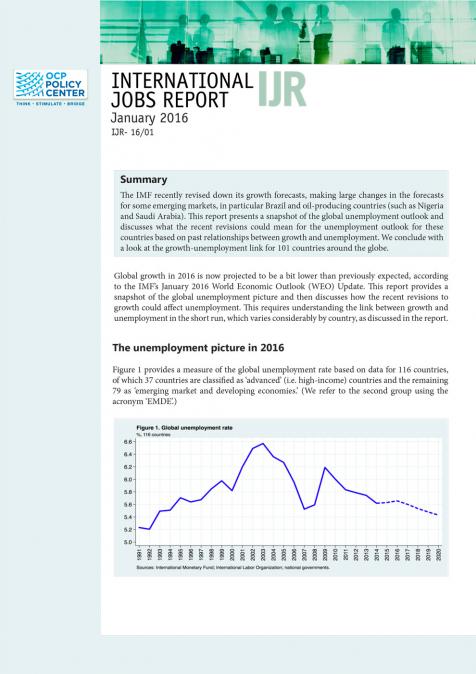
    The IMF recently revised down its growth forecasts, making large changes in the forecasts for some emerging markets, in particular Brazil and oil-producing countries (such as Nigeria and Saudi Arabia). This report presents a snapshot of the global unemployment outlook and discusses what the recent revisions could mean for the unemployment outlook for these countries based on past relationships between growth and unemployment. We conclude with a look at the growth-unemployment link f ...