Publications /
Policy Paper

Back
Le Covid-19, une menace à la paix et la sécurité internationales ?
March 27, 2020

Le virus Corona a laissé l'humanité désarmée et impuissante à y faire face. Les Etats y ont réagi en rangs dispersés, sans aucune coordination, et les Organisations internationales se sont limitées à alerter les Etats et à les inciter à prendre les mesures nécessaires pour faire face à la pandémie. Si le Secrétaire général de l’ONU a été parmi les premiers à “déclarer la guerre” a ce virus, le Conseil de Sécurité a brillé par son absence, alors qu’auparavant, il avait adopté des résolutions qualifiant le VIH et Ebola de menaces à la paix et à la sécurité internationales. Cette crise rappelle la nécessité de mettre en place un dispositif mondial de riposte aux crises en matière de santé globale.

RELATED CONTENT

  • Authors
    August 11, 2026
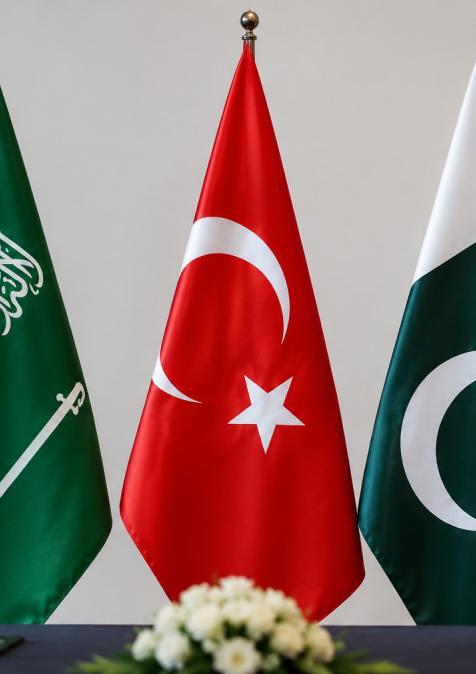
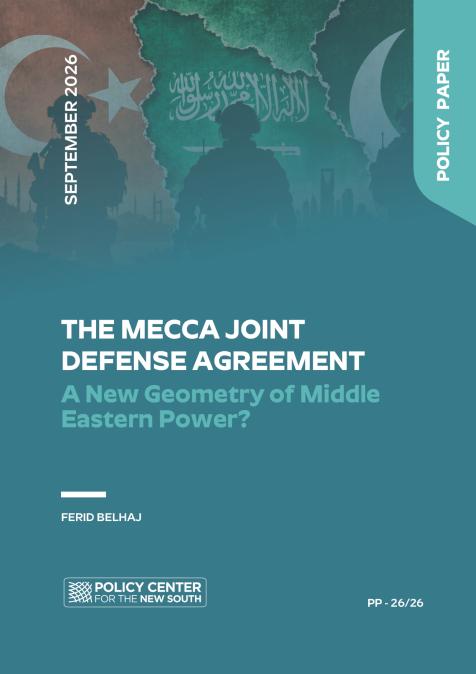
    The Mecca Agreement: A First Step Towards a New Regional Security Architecture? On 7 August, Saudi Arabia, Türkiye and Pakistan signed the Mecca Agreement, a trilateral defense pact aimed at strengthening collective security and defense cooperation between the three countries. At its core lies a collective defense commitment under which an attack on one member is considered an attack on all three. While many details concerning its practical implementation remain unclear, the agreeme ...
  • Authors
    August 7, 2026
    THE END OF AN ERAThe US-Israeli war on Iran, a 'little excursion' envisaged to be over within a matter of weeks, has entered its fourth month. Shock waves ripple across the globe. This war is just one in a series of recent crises which have fractured the international community, making the decades of the 2020's among the most disruptive in recent history. Each crisis compounds the deleterious effects of those which came before. The war in Iran is no exception. It abruptly stalled ec ...
  • Authors
    July 27, 2026
    Is Europe Prepared for War?European public opinion is moving from treating a major conflict as unthinkable to regarding it as a possibility for which governments must prepare. Attention is increasingly focused on Russian hybrid operations, vulnerabilities in critical infrastructure and the risk of fragmentation within NATO. European defence policy is consequently undergoing a rapid transition from post-Cold War complacency towards preparations for high-intensity warfare. Recent ...
  • Authors
    July 15, 2026
    We Are Watching You In April 2026, the UK Ministry of Defence revealed that it had tracked a covert Russian submarine operation apparently intended to map critical undersea cables and pipelines in the North Atlantic and the North Sea. A Russian attack submarine and two specialised intelligence vessels operated by the Main Directorate of Deep-Sea Research, commonly known as GUGI, were reportedly monitored for four weeks by the Royal Navy, including HMS St Albans and P-8 Poseidon ...
  • Authors
    July 6, 2026
    We take the 2026 G7 Summit in Évian-les-Bains as a case study for understanding how a leading existing multilateral organisation adapts to a more fragmented, technologically inflected, and multipolar world. We argue that the significance of Évian lies less in the summit agreements themselves than in what the summit reveals: a qualitative shift in governance away from exclusive summit diplomacy and towards more selective coalition-building, broader engagement with non-state actors, a ...
  • June 26, 2026
    Three years after the adoption of the first National Action Plan (NAP) on the Women, Peace and Security (WPS) Agenda, Morocco has made real institutional progress, but implementation is still inadequate. The extension of the NAP opens a window of opportunity to prepare a second, more ambitious and operational cycle.This Policy Brief identifies four persistent obstacles: a virtually stagnant female employment rate of 19.1%, less than 3% female representation in peacekeeping contingen ...
  • April 9, 2026
    Trois ans après l'adoption du premier Plan d'Action National (PAN) sur l'Agenda Femmes, Paix et Sécurité (FPS), le Maroc affiche des avancées institutionnelles réelles mais une mise en œuvre encore insuffisante. L'extension du PAN ouvre une fenêtre d'opportunité pour préparer un second cycle plus ambitieux et opérationnel.Ce Policy Brief identifie quatre obstacles persistants : un taux d'activité féminine de 19,1% en quasi-stagnation, une représentation des femmes inférieure à 3% da ...
  • Authors
    March 30, 2026
    This essay examines the establishment of the Board of Peace as a test case in contemporary peace governance and hegemonic experimentation. While the Board, politically activated in early 2026 and formally anchored in a resolution of the United Nations Security Council, benefits from derivative legality under the UN Charter, its legal foundation remains constitutionally fragile, its mandate ambiguously constrained, and its accountability architecture underdeveloped, notwithstand ...
  • January 6, 2026
    La création de l’Alliance des États du Sahel (AES) symbolise une rupture politique et géostratégique majeure, appuyée sur un discours souverainiste et anti-occidental. Deux ans après, Mali, Burkina Faso et Niger peinent à assurer leur intégrité territoriale, à stabiliser leur sécurité intérieure et à bâtir une gouvernance solide. L’intégrité territoriale est un problème commun aux trois États, car dans ces pays, la cohésion de l’État et le contrôle du territoire sont directement men ...
  • Authors
    Nizar Messari
    December 19, 2025
    The U.S. military buildup in the Caribbean—the most significant since the Cuban Missile Crisis—comes at a moment when a new world order is taking shape, its contours still unclear, and in which the U.S. seeks to be more assertive in the Western Hemisphere. This disposition toward South America and the Caribbean was underscored by the recent publication of the new U.S. National Security Strategy, in which the Monroe Doctrine is explicitly invoked. This Policy Brief situates the devel ...