Publications /
Research Paper

Back
Jus Cogens and the Right to Self-Determination - Falsifiability of Tests -
Authors
September 21, 2020

The right to self-determination was recently posited as one possible jus cogens norm. However, more than fifty years after jus cogens emerged in 1969, a standard test for identifying a norm as jus cogens has yet to be adopted. In 2019, the International Law Commission adopted the Draft Conclusions on jus cogens, together with the list of possible jus cogens norms . If the possibility of being shown to be false is not admitted when identifying a jus cogens norm, however, the identification would not be justified. For that matter, the test of non-derogation and modification clauses for identifying a norm as jus cogens can be falsified. Nevertheless, the text did not apply the test to the right to self-determination when it included the right in the jus cogens list. If tests are not falsifiable, there would be no means to rebut jus cogens claims for selfish purposes. Until falsifiable tests are established and shared, jus cogens should not be applied. In this way, negotiations for finding a political solution based on compromise affecting the entirety of jus cogens norms should not be discouraged by jus cogens claims. Finally, a fundamental problem regarding the legal ground for the binding force of international law, raised by the emergence of jus cogens that may be in contravention with the grundnorm of pacta sunt servanda, will be addressed. Under that grundnorm, ironically, a non-consensual jus cogens norm would lose its binding force at the very moment it is applied, because at that moment the legal ground of its binding force is denied.
RELATED CONTENT

  • Authors
    January 15, 2020
    The challenges against Morocco’s sovereignty over natural resources in Saharan districts will be thoroughly examined and criticized. First, the inaccurate interpretation by the EU court of the phrase “a status separate and distinct from an administering State” in the Declaration on Friendly Relations. Second, the unreasonable concept of a ‘de facto’ administering State in the decisions of the EU courts and the warlike concept of ‘military occupation’ over the territory under ceasefi ...
  • Authors
    February 6, 2019
    Ce papier examine la plainte initiée par la Turquie devant l’Organisation mondiale du commerce (OMC) contre le Maroc au sujet des droits antidumping appliqués aux produits d’acier laminés à chaud. La plainte de la Turquie constitue à la fois un précédent et une opportunité. Un précédant d’abord, car jamais le Maroc n’a été impliqué, ni en qualité de partie plaignante ni en qualité de partie défenderesse, dans une affaire devant le GATT ou l’OMC. Une opportunité ensuite, par ce que l ...
  • May 25, 2018
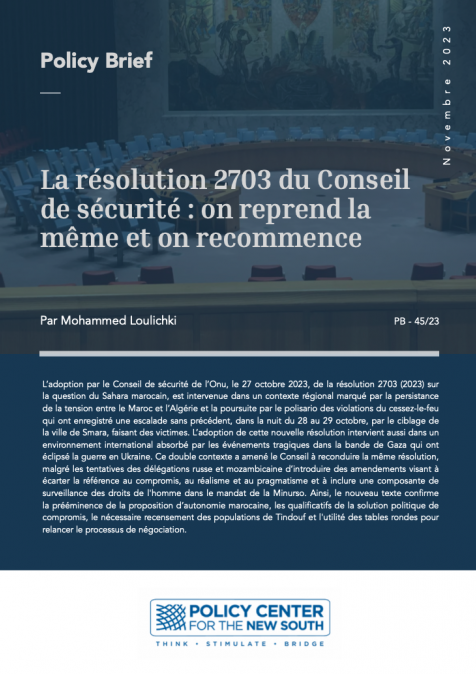
    Is it possible to reasonably reflect and analyze the Sahara conflict without taking into account, on the one hand, the relevance of both legal and extra-legal factors, and on the other hand, the interplay between the different stakeholders involved ? This intensely complex topic requires taking into consideration not only regulations of international law, but also the geopolitical, anthropological, and security aspects intertwined in the matter ...