Publications /
Opinion

Back
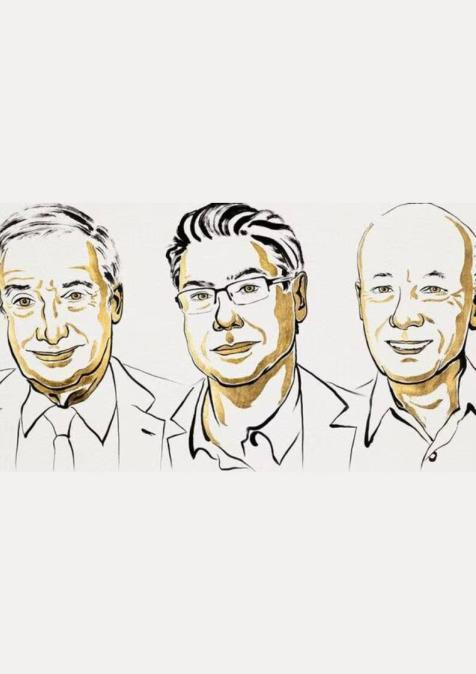
Joel Mokyr, Philippe Aghion et Peter Howitt consacrés Prix Nobel d’Économie 2025
October 15, 2025

Depuis que l’économie a été reconnue par les Nobel, en1969, c’est à cette discipline qu’il revient de clore les cérémonies annuelles d’attribution des Prix aux lauréats. Pour cette année 2025, c’est le 13 octobre que  l’Américano-Israélien, Joel Mokyr, le Français, Philippe   Aghion, et le Canadien, Peter Howitt, ont été consacrés Prix Nobel de l’Économie.

Joel Mokyr, historien de l’économie américaine, à qui a été attribuée la moitié du Prix, est Professeur à l’université Northwestern  et dont les travaux vont bien au-delà de l’analyse des chiffres et des tendances. Entre autres publications, il a à son actif un ouvrage de référence, publié en 2016 :’’ A culture of Growth :The Origins of the Modern Economy ‘’ (Princeton University Press ). Dans cet ouvrage, le lauréat postule que la révolution industrielle est le résultat des cultures et des institutions. Sa capacité à tisser des liens entre l’économie, la science et la culture s’exprime aussi dans  ‘’ the Lever of Riches ‘’ publié en1990 ( Oxford University Press) et dans ‘’ The   Gifts of Athena ‘’, publié en 2002 (Princeton University Press), ouvrages dans lesquels il développe une analyse originale des mécanismes d’innovation, mettant en lumière le rôle central des idées et des connaissances dans les révolutions industrielles. Pour Mokyr, l’histoire  économique ne saurait se limiter aux ressources et à l’accumulation du capital, soutenant que la révolution industrielle britannique est profondément ancrée dans une culture des lumières. L’Américano-israélien  soutient aussi que la fragmentation politique, que l’on retrouve en Europe avec un nombre important d’États européens, permet aux   idées hétérodoxes   de   se développer.  Leurs auteurs, si nécessaire, pouvant, en cas de nécessité, trouver refuge dans un État voisin où ils pourront continuer à les développer.  ses travaux, Joel Mokyr nous rappelle, enfin, que la prospérité ne se mesure pas seulement en PIB, mais aussi en richesse 

intellectuelle et culturelle. En distinguant Joël Mokyr, le jury Nobel a tenu à  souligner l’importance de travaux « ayant identifié les conditions nécessaires à une croissance durable par le progrès technologique », où l’optimisme l’emporte, si on veut ne pas oublier que c’est le capital culturel de l’Europe, davantage que les matières premières, qui a permis aux sociétés européennes de prendre une avance technologique sur le reste du monde.

Philippe Aghion, économiste français, et Peter Howitt, économiste canadien : deux économistes post schumpétériens distingués par le jury Nobel pour « leur théorie de la croissance soutenue par la destruction créatrice ». P. Aghion et P. Howitt, qui se partagent l’autre moitié du Prix, publient en 1992 ‘’ A Model of Growth Through Creative Destruction ‘’ (Econometrica Vol.60 N2 p.323-351), suivi, en 1998, d’un livre ‘’ The Endogenous of Gowth theory’’  (Cambridge MIT Press ). 

Leur approche, caractérisée par la prise en compte du concept schumpétérien de « destruction créative », rappelle que les innovations rendent obsolètes les anciennes technologies, créant des rentes de situation, lorsqu’elles sont trop importantes, permettant d’établir des barrières à l’entrée de nouvelles firmes sur le marché. Ce qui risque de pénaliser toute motivation, conduisant alors à un ralentissement de la croissance. C’est le paradoxe de la destruction créatrice. Paradoxe qui souligne que le progrès n’est jamais définitivement acquis, ce qui oblige la société à rester constamment ouverte au changement, à la recherche d’innovations   technologiques   majeures.  

Dès l’annonce du Prix, Philippe Aghion a tenu à rappeler que « l’ouverture est un moteur de croissance, et que tout ce qui entrave l’ouverture est un obstacle à la croissance ». À un moment où les États-Unis continuent de relever leurs droits de douane, ce rappel est aussi une mise en garde à l’Europe qui ne doit pas laisser les États-Unis et la Chine avoir le monopole des technologies majeures. C’est, aussi, un constat, celui d’une Europe qui n’a pas su, ou n’a pas pu, mettre en œuvre des innovations majeures, se contentant d’innovations technologiques moyennes. C’est, enfin, l’occasion de déplorer   un écosystème   financier européen peu propice à l’innovation.

Aujourd’hui, la mondialisation est remise en cause, le retour au protectionnisme avec des droits de douane américains disparates, atteignant des taux records en témoigne dans un monde économique de plus en plus fragmenté. C’est pourquoi, le choix des Nobel d’Économie 2025 nous paraît particulièrement pertinent.  Comme l’an dernier, ce sont   trois économistes qui ont été privilégiés. Ils ont en commun d’être diplômés d’universités nord-américaines   prestigieuses : Harvard / P ;Aghion, North western / P .Howitt, Yale /J. Mokyr. Trois chercheurs incontestés dans leur domaine et reconnus par leurs pairs, qui succèdent à : Daron Acemoglou (MIT), Simon Johnson (MIT), James A . Robinson (Université de Chicago).
 

RELATED CONTENT

  • Authors
    February 9, 2022
    The geographic position of Morocco and its history makes it a strategic country when it comes to matters of international migration. Having long been considered as a country of origin, the fast paced growing development of Morocco soon brought it from being merely a sending country to becoming a transit and destination to migrants from other parts of Africa. This change in the migratory context of Morocco has led to the adoption of a series of policies and governmental actions to ta ...
  • Authors
    February 9, 2022
    Energy markets have experienced significant disruptions since the outbreak of COVID-19. In late 2021, soaring natural gas prices triggered a new crisis, leading to risks of energy supply shortages worldwide and propelling the issue of energy security to the forefront. Africa will not be spared the repercussions of this crisis, which could further increase energy inequality, which is in turn linked to other forms of inequality. Indeed, in a context of persistent inflation, the lack o ...
  • Authors
    February 3, 2022
    COVID-19 has ravaged nearly every country in the world, with the globalization of recent decades intensifying its spread. As of mid-2021, the world had spent $16.5 trillion—18% of global GDP—to fight the disease. And that amount does not even include the most important losses such as deaths, mental health effects, restrictions on human freedom, and other nonmonetary suffering. Nearly 90% of this spending was by developed economies, with the rest by emerging market and developing eco ...
  • Authors
    February 1, 2022
    We examine the effects of trade on youth labor force participation and unemployment rates by performing fixed-effects and Arellano-Bond GMM estimations on data from 89 developing and emerging economies from 1990 to 2018. The empirical results suggest that trade openness has U-shaped effects on youth labor force participation rates, with negative impacts at low-to-moderate levels of trade and positive but minor effects at relatively high levels of trade. Except for Latin America, the ...
  • January 31, 2022
    According to the Oslo Manual, innovation can be defined as “the implementation of a new or significantly improved product (good or service), or process, a new marketing method or a new organisational method in business practices, workplace organisations or external relations” (OECD, 2005, p. 46). For today’s middle-income countries in Africa, innovation is essential to sustain growth and promote the transition to high-income status. This paper begins by providing a summary of theore ...
  • Authors
    January 31, 2022
    On January 28, both Argentina’s government and the International Monetary Fund staff made announcements about an understanding on new support program. Meanwhile, in addition to the payment of an amortization due on January 28, another payment is also expected in the first week of February. Both payments relate to the previous package, approved in 2018 and substantially disbursed thereafter. Non-payment could sour relations at a critical moment for a new program to be approved by the ...
  • Authors
    Morten Seja
    Charlie Knight
    Hadley Hilgenhurst
    Amlan Banerjee
    Omair Azam
    January 31, 2022
    Setting the Scene for the Current State of Inclusive Green FinanceClimate change is one of, if not the biggest, challenges facing the world. The challenge extends to banking regulators, who, in addition to other responsibilities, are now tasked with ensuring financial inclusion and climate change mitigation. However, central banks realizing how important inclusion and climate change are is only the first step. As part of this process, they need to understand how to define Inclusive ...
  • Authors
    January 26, 2022
    The year began with simultaneous signs of a slowdown in global economic growth and a reorientation toward tightening of monetary policies in advanced economies. In its latest Global Economic Prospects released on January 11, the World Bank forecasts that, after a global growth surprisingly at 5.5% last year, it should moderate to somewhere around 4.1% and 3.2%. % in, respectively, 2022 and 2023. In addition to the effects of omicron at the start of the year, less fiscal support and ...
  • Authors
    January 26, 2022
    COVID-19 has caused serious damage throughout the entire world. As of mid-2021, the global fiscal cost of COVID-19—excluding the most important consequences, such as human lives, mental health effects, restrictions of human freedom, and other non-pecuniary components, have amounted to at least $16.5 trillion, about 18% of world GDP (Dinh 2021). Financial support has varied across countries depending on income level, political willingness, and the extent of the pandemic in each econo ...