Publications /
Book / Report

Back
International Jobs Report: Edition 2015
Authors
January 14, 2015

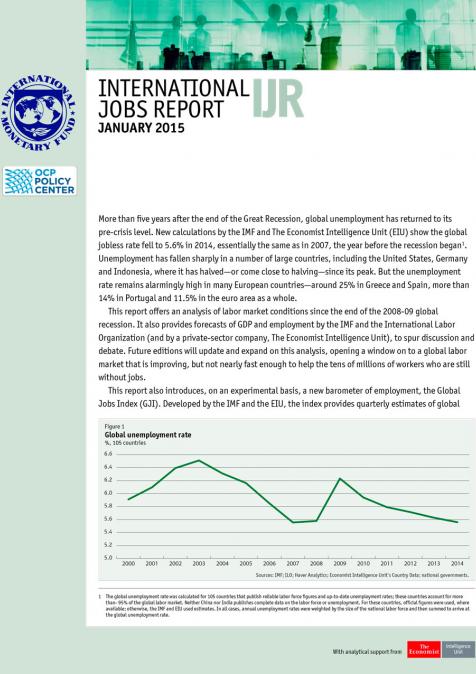
The International Jobs Report offers an analysis of labor market conditions since the end of the 2008-09 global recession. It also provides forecasts of GDP and employment by the IMF and the International Labor Organization (and by a private-sector company, The Economist Intelligence Unit), to spur discussion and debate. Future editions will update and expand on this analysis, opening a window on to a global labor market that is improving, but not nearly fast enough to help the tens of millions of workers who are still without jobs.

This report also introduces, on an experimental basis, a new barometer of employment, the Global Jobs Index (GJI). Developed by the IMF and the EIU, the index provides quarterly estimates of global employment. Although most advanced economies publish monthly employment reports, usually promptly, many emerging markets do not. 

The GJI has been designed to make estimates of employment levels in 64 large economies—including China and India. For countries where quarterly employment data are not available, the employment level is derived by estimating the relationship between national employment and gross domestic product (GDP) in each of the economies. The country estimates are then aggregated into a global total. The forwardlooking features of the GJI will be rolled out later in 2015. 
RELATED CONTENT

  • June 30, 2026
    À l'échelle mondiale, les politiques publiques de jeunesse sont confrontées à un double enjeu : répondre à des défis socio-économiques structurels; chômage, précarité, fractures territoriales, tout en intégrant une demande croissante de participation citoyenne effective. (OIT, 2023 ; Nations Unies, 2020) En Afrique, ce défi revêt une dimension singulière compte tenu du poids démographique de la jeunesse et des fragilités persistantes des démocraties locales. (BAD, 2020 ; Mo Ibrahim ...
  • June 30, 2026
    Globally, public policies for youth face a twofold challenge: addressing structural socioeconomic challenges—such as unemployment, precariousness, and regional disparities—while accommodating a growing demand for effective civic participation. (ILO, 2023; United Nations, 2020) In Africa, this challenge takes on a unique dimension given the demographic weight of the youth population and the persistent fragility of local democracies. (AfDB, 2020; Mo Ibrahim Foundation, 2023)Elections ...
  • June 26, 2026
    Au Maroc, la problématique des jeunes NEETs (Ni en emploi, ni en études, ni en formation) constitue une urgence nationale, alimentée par 300 000 abandons scolaires annuels. Face à ce défi, le modèle de l'École de la Deuxième chance nouvelle génération (E2C-NG) a démontré sa pertinence en affichant un taux d'insertion exceptionnel de 81 %.Cependant, ce succès institutionnel repose intégralement sur un tissu associatif local aujourd'hui fragilisé. L'analyse inédite des donné ...
  • June 26, 2026
    In Morocco, the issue of young NEETs (Not in Employment, Education, or Training) is a national emergency, fueled by 300,000 students dropping out of school each year. In response to this challenge, the “New Generation Second Chance School” (E2C-NG) model has proven its effectiveness by achieving an exceptional employment rate of 81%.However, this institutional success rests entirely on a local network of organizations that is now under strain. A previously unpublished analysis of da ...
  • June 18, 2026
    تتناول هذه الحلقة واقع صناعة الألعاب الإلكترونية في المغرب، في ظل الاهتمام المتزايد بهذا القطاع الواعد وما يتيحه من فرص اقتصادية وإبداعية. كما تناقش التحديات التي تواجه المطورين والمقاولات الناشئة، من حيث التكوين والتمويل والولوج إلى الأسواق، مع تسليط الضوء على الإمكانات التي يمتلكها ال...
  • Authors
    Imad Hajjaji
    June 10, 2026
    Depuis le lancement de GPT-4 en mars 2023, un discours de plus en plus en vogue affirme que « si vous ne maîtrisez pas l'Intelligence artificielle (IA) vous serez dépassé ». On parle de prompt engineering comme s'il s'agissait d'une compétence ésotérique réservée à une élite technologique. Les réseaux sociaux professionnels regorgent de profils qui se présentent comme « experts en IA » après avoir suivi une formation de deux semaines. L'alarmisme fait vendre, et ...
  • Authors
    Karim El Mokri
    Idriss El Abbassi
    June 8, 2026
    Le monde du travail est engagé dans un processus de mutation sans précédent. La quatrième révolution industrielle, portée par l’intelligence artificielle (IA) et la robotisation, a été le point de commencement d’une ère nouvelle où les repères économiques et sociaux se redéfinissent à une vitesse inédite. Ces technologies suscitent un engouement légitime et offrent des perspectives prometteuses, mais requièrent une vigilance accrue face aux incertitudes qui les entourent.Bien que, à ...
  • May 20, 2026
    La participation des femmes au marché du travail au Maroc demeure l'un des défis les plus structurels du développement économique et social du pays. Avec un taux d'activité féminin de seulement 19 % en 2023, contre 69 % pour les hommes (HCP, 2024), le Maroc présente l'un des écarts de genre les plus prononcés parmi les économies en développement (Banque mondiale, 2024). Ce Research Paper propose une analyse économétrique rigoureuse et multiniveaux des déterminants de cette participa ...
  • May 12, 2026
    Why only globally connected, knowledge-intensive services — not local services — can drive long-term development and productivity growth. This Commentary was originally published on stimson.org For decades, manufacturing was considered the indispensable engine of economic development, creating jobs, boosting productivity, and integrating countries into global markets. But automation, robotics, and intensifying global competition have made industrialization far harder for d ...