Publications /
Paper in Academic Journals
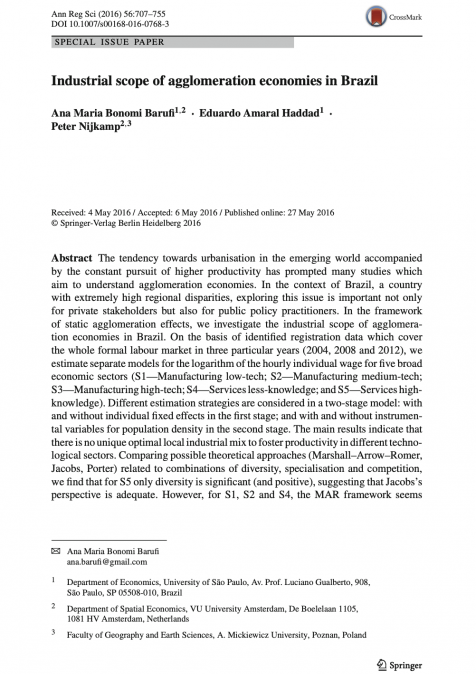
The tendency towards urbanisation in the emerging world accompanied by the constant pursuit of higher productivity has prompted many studies which aim to understand agglomeration economies. In the context of Brazil, a country with extremely high regional disparities, exploring this issue is important not only for private stakeholders but also for public policy practitioners. In the framework of static agglomeration effects, we investigate the industrial scope of agglomeration economies in Brazil. On the basis of identified registration data which cover the whole formal labour market in three particular years (2004, 2008 and 2012), we estimate separate models for the logarithm of the hourly individual wage for five broad economic sectors (S1—Manufacturing low-tech; S2—Manufacturing medium-tech; S3—Manufacturing high-tech; S4—Services less-knowledge; and S5—Services high-knowledge). Different estimation strategies are considered in a two-stage model: with and without individual fixed effects in the first stage; and with and without instrumental variables for population density in the second stage. The main results indicate that there is no unique optimal local industrial mix to foster productivity in different technological sectors. Comparing possible theoretical approaches (Marshall–Arrow–Romer, Jacobs, Porter) related to combinations of diversity, specialisation and competition, we find that for S5 only diversity is significant (and positive), suggesting that Jacobs’s perspective is adequate. However, for S1, S2 and S4, the MAR framework seems better able to explain the underlying patterns. In the case of S3, there are elements from both Marshall’s and Jacobs’s perspective. These results seem to be robust to different specifications and estimation strategies. Finally, the urbanisation economies coefficient appears to be positive and significant for all sectors, ranging from 0.0511 to 0.0940 in different specifications, under the simplest estimation (OLS in the first and the second stages). Ordering these effects between the sectors from the highest to the lowest, we find the following sequence: S3, S1, S5, S4 and S2. This can be considered as evidence that high-tech and low-tech manufacturing sectors benefit more from the urban or metropolitan scale in Brazil, followed by services associated with higher knowledge intensity.