Publications /
Policy Paper

Back
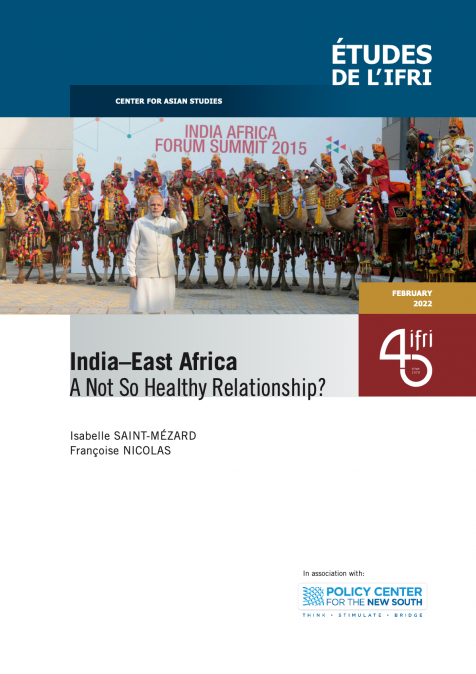
India–East Africa A Not So Healthy Relationship?
Authors
Isabelle Saint-Mézard
Françoise Nicolas
March 7, 2022

Due to historical as well as geographical reasons, India and East Africa have long been close partners. In the recent period however, and even more so since the early 2000s, these ties have tightened as a result of combined efforts by the government of India and its business community. The presence of communities of Indian origin in several East African countries has also acted as a catalyst.

East Africa is perceived as a valuable partner both by Indian authorities and by Indian private companies. Although the two types of Indian players may not explicitly coordinate their actions, their interests dovetail nicely in this particular region.

The health sector sticks out as one major sector on which Indian actors focus in East Africa. It provides a striking example of the multilayered complementarity between India and East Africa, on the one hand, and between public and private Indian players’ interests on the other.

However, India’s activism in the health sector is not necessarily perceived positively by the East African host countries. Despite some technology transfers and efforts by the Indian actors, be they public or private, to promote capacity-building, East African countries find themselves in a situation of dependence as a result of Indian companies exporting and producing drugs, building hospitals, improving hospital management and IT infrastructure, or digitalizing healthcare.

However, the major point of tension pertains to the promotion of medical tourism. Although offshore healthcare comes with many benefits, it is unlikely to be sustainable for the East African economies in the long run. Moreover, the money spent on medical tourism could arguably be used more usefully to develop local medical facilities and competence. The recent developments in the context of the pandemic have made the associated risk very clear.

The challenge in the coming years will be for the two parties to find a way to better balance their relationship and set it on firmer ground – in other words, to make it healthier.
RELATED CONTENT

  • September 16, 2026
    Much of Western debate was revealingly silent on the Shanghai Cooperation Organization (SCO) summit, which took place on August 31 and September 1 in Bishkek, Kyrgyzstan. That relative silence reflects how poorly the organization’s growing significance is still understood. The meeting has not gone unreported. Any gathering of Xi Jinping, Narendra Modi, and Vladimir Putin inevitably attracts&nbs ...
  • Authors
    Joana Ama Osei-Tutu
    September 12, 2026
    The author of this opinion, Joana Ama Osei-Tutu, is a 2017 alumna of the Atlantic Dialogues Emerging Leaders Program.South-South cooperation (SSC) is often presented as an alternative to the hierarchical relationships that have historically characterized international development. In principle, SSC means Global South countries learn from one another, share expertise and resources, and develop solutions grounded in their own experiences, rather than importing models designe ...
  • August 3, 2026
    This policy paper explores how China’s economic development model—rooted in pragmatism, long-term planning, and civilizational renewal—has become its most compelling soft power asset, particularly in the eyes of the Global South. While critically engaging with Joseph Nye’s original conception of soft power as a primarily cultural and normative force, the paper argues that China’s ability to transform itself from an impoverished postimperial state into the world’s largest trading nat ...
  • Authors
    July 14, 2026
    Avec la capitale Pékin comme acteur principal de la politique étrangère chinoise, l’engagement de la Chine en Afrique ne peut plus être appréhendé à travers le seul prisme de l’État central. Suite aux réformes de décentralisation engagées en 1978, les gouvernements provinciaux de l’Empire du Milieu jouent un rôle de plus en plus visible et structurant, en s’affirmant en tant qu’acteurs à part entière de la coopération internationale. Ils interviennent, entre autres domaines, dans le ...
  • July 10, 2026
    For much of the post-war period, the Global South was framed as an object of history, defined by dependency, constrained by structural asymmetries, and confined to the margins of global decision-making. That narrative, once empirically grounded, is now no longer adequate. A profound yet uneven transformation is underway. The Global South is no longer only reacting; it is increasingly shaping rules, institutions, and narratives.This Policy Brief argues that the Global South is thus t ...
  • June 22, 2026
    History devotes considerable attention to the rise and fall of great powers. Scholars have spent centuries analyzing why empires collapse, why nations decline, and why dominant states eventually lose their position. By comparison, relatively little attention has been devoted to a different question: what happens when a country succeeds beyond its own expectations? ...
  • November 18, 2025
    The meeting between Donald Trump and Xi Jinping in Busan, South Korea, was more than an exercise in diplomacy. It was an emblematic performance of a world in transformation. Behind the formalities, the cameras, and the studied smiles lay an unspoken recognition: the world is no longer unipolar. The era of American supremacy, sustained for decades through its economic reach, military presence, and ideological projection, is giving way to a more diffuse, multipolar reality. ...
  • October 23, 2025
    Depuis 2016, le Policy Center for the New South et le Centre de Géopolitique de l’école HEC Paris organisent chaque année deux éditions des « Dialogues Stratégiques ». Cette plateforme d’analyse et d’échange réunit des experts, des chercheurs provenant de différents think-tanks et du mo...
  • July 25, 2025
    This episode explores the evolving relationship between India and Africa, with guest Mr. Mishra from the Manohar Parrikar Institute for African Studies. From historical ties to emerging s ...