Publications /
Policy Paper

Back
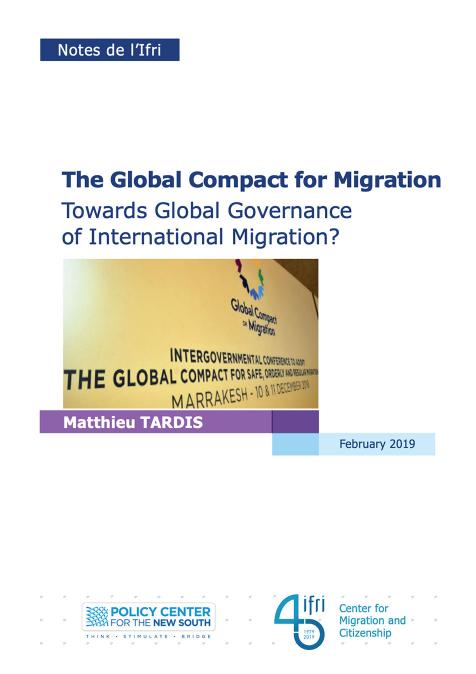
The Global Compact for Migration. Towards Global Governance of International Migration ?
Authors
Matthieu Tardis
February 8, 2019

The “Global Compact for Safe, Orderly and Regular Migration” was adopted in Marrakesh on 10 and 11 December 2018, after 18 months of consultation and negotiation. It is presented as the first United Nations’ agreement on a comprehensive approach to international migration in all its aspects. Although it aims to become the cornerstone of global governance of international migration, sought by the international community, it is however coming up against contradicting national priorities. They are depending on each State’s migration issues; at the mercy of opposition between North and South, the countries of origin and countries of destination.

Furthermore, the Compact illustrates a change in the objectives of global governance of migration, which were originally placed in the post-War context, under the human rights label. At the beginning of the 1990s and the end of communist regimes, migration was perceived as a risk for the stability and security of States. The United Nations then renewed its approach by rather emphasising the positive contribution of migration as a development factor. By highlighting the costs and benefits of migration flows, this approach can reconcile border control policies and the fight against irregular immigration in Northern countries. 

The instruments of global governance of migration illustrate this change. The rights-based approach resulted in the 1990 International Convention on the Protection of the Rights of All Migrant Workers and Members of Their Families. This approach was limited by the refusal of Northern countries to ratify it. Nearly 30 years later, the Global Compact for Migration is pursuing a more pragmatic approach. The agreement is non-legally binding. It reflects a preference for soft law instruments that are able to respond to issues in a more targeted and flexible manner. 

The challenge of the Compact goes beyond mere migration issues and affects the role of the United Nations’ (UN) against a background of questioning multilateralism. The managerial approach to migration promoted by the Compact allows the UN to play a technical support role to States on a voluntary basis. This also leads to a development of different agencies, giving a key role to the International Organisation for Migration (IOM). 
  • Authors
    December 7, 2015
    The Euro-Mediterranean Partnership was initiated with the aim to build a space of shared prosperity and security among all the countries in the region. The achievement of this objective, however, continues to be challenged by several geopolitical, economic and social factors. In such a context, there is now a greater urgency to adapt the approach and the instruments, thus allowing Euro-Mediterranean partners to seize opportunities towards an effective area of shared stability and pr ...
  • November 24, 2015
    This podcast is performed by Eduard Soler. Erdoganism in Turkey: Erdogan has become the President of the Republic and continues to dominate Turkish politics. This briefing will analyze th ...
  • November 5, 2015
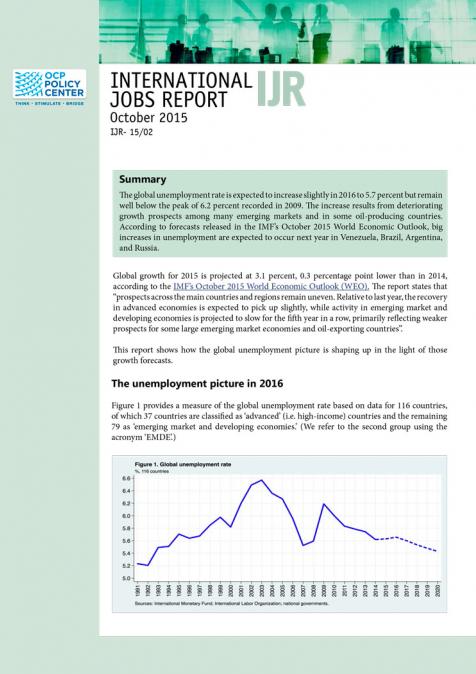
    The global unemployment rate is expected to increase slightly in 2016 to 5.7 percent but remain well below the peak of 6.2 percent recorded in 2009. The increase results from deteriorating growth prospects among many emerging markets and in some oil-producing countries. According to forecasts released in the IMF’s October 2015 World Economic Outlook, big increases in unemployment are expected to occur next year in Venezuela, Brazil, Argentina, and Russia. ...
  • September 22, 2015
    This podcast is performed by Nicolas de Pedro. Narendra Modi completes a year as head of the Indian government with his balance sheet in credit, but the prevailing mood is one of slight d ...
  • August 18, 2015
    OCP Policy Center and the German Marshall Fund of the United States, in partnership with the Fernando Henrique Cardoso Institute, organized an Atlantic Strategy Group conference on June 23rd and 24th, 2015 in São Paulo, Brazil with a focus on trade, energy, food, and Geopolitical System...
  • Authors
    Guillame Xavier-Bender
    August 10, 2015
    This brief seeks to look into how innovation ecosystems in the Atlantic Basin may affect public policymaking, economic development, and the future of commercial and social interactions. It looks more specifically at enabling technologies, which generate networks and increase connectivity. It also explores the transformational role these technologies play on the evolution of strategic industries in the Atlantic. The digital revolution’s full potential indeed lies in its capacity to s ...