Publications /
Opinion
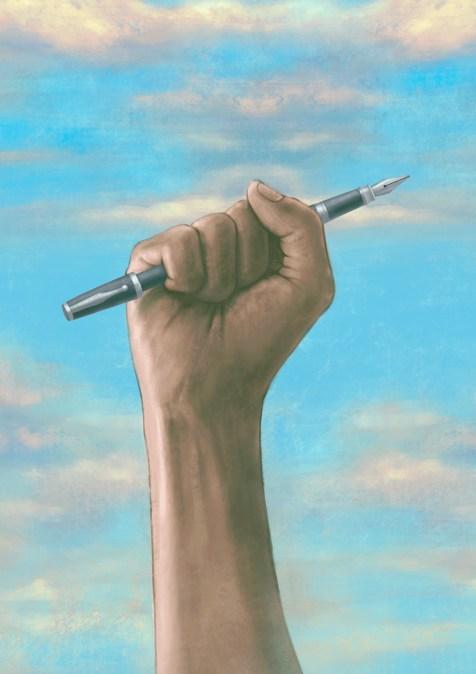
Once upon a time, freedom of the press was a beacon—a defining symbol of democracy, enshrined in the First Amendment to the United States Constitution. Freedom of speech. Freedom of the press. A democracy meant to endure forever. Hail the Constitution and the wise founders who laid the foundation for one of the most democratic powers on the globe.
Hollywood, the image factory, has glorified—or condemned—journalists: the arrogance of the media, the ruthless destruction of careers and dreams by boozing reporters, cynics willing to die in the jungles of Vietnam or on the beaches of Normandy, risking life for a byline or a spot on the front page—the playground of the elite of the printing press. Just the news, and democratic principles.
In 1941, Orson Wells—actor, producer, and director—released a black–and-white film reflecting on the career of William Hearst, a publisher often seen as an early Rupert Murdoch or Henry Luce of Time fame. Hearst was certainly one of the symbols of the profession, with all its manipulations and grand illusions. The Hearst Castle still stands in California, and his news organization remains alive and competitive, contending with social media, digital research, the new frontier of cyberspace and AI-supported headlines.
A different world of journalism indeed—the glory of print media is fading into oblivion. Last year alone, 127 U.S. newspapers closed permanently (2024). The total number of local newspapers, 8,891 in 2005, fell to 5,591 in 2024. This decline fuels worrying conclusions, as suggested by the Committee to Protect Journalists: “Freedom of the press is no longer a given in the United States” (NPR, May 8, 2025).
One reason, as noted by The Conversation, (“Lawsuits, Cancellations and Bullying: Trump is Systematically Destroying Press Freedom,” September 23, 2025), lies in the stark contrast with past challenges to press freedom. Decades ago, others also sought authoritarian power. All the President’s Men, produced as a Hollywood thriller, captured those days of journalistic glory. The Washington Post, after two years of investigative journalism by two of their reporters, revealed a political conspiracy in the White House orchestrated by the President himself and dozens of advisors. Richard Nixon was forced to resign on August 9, 1974 (National Archives Foundation) and several of his closest advisors went to jail—long enough to be haunted by nightmares about the power of the press.
Carl Bernstein and Bob Woodward, determined and relentless in their newsroom, forever supported by publisher Katherine Graham, were true heroes of their profession. They continue writing and critiquing another conservative head of state on talk shows and in bestsellers—Donald Trump, a man who reportedly told more than 30,537 lies in his first four years in office, according to the Washington Post fact-checkers, creating a “tsunami of untruth just keeps looming larger and larger” (July 13, 2020). Bernstein and Woodward famously met their main source in the shadowy depths of a parking lot, a contact known only as “Deep throat,” later revealed to be the Associate Director of the FBI, the most powerful federal law enforcement agency in the United States.
Working like London’s Carriage Horses
The triumph of the Washington Post became history—the courage of its journalists revealed, for the first time, the ruthless world of journalism: at times human, at times cynical, always tense, and constantly driven by the competition for headlines, chasing yet another sensational scoop for the front page. Sensational revelations were delivered by seasoned, incorruptible reporters like Seymour Hersh—a journalist like no other. Incorruptible, stubborn, tireless, imaginative, courageous. His office, without a secretary or even a coffee machine, was next to my bureau in the National Press Building on 14th Street, Washington D.C.
Seymour, father of three children, was part of that cadre of investigative reporters characterized by the press in London as “hacks”—hardworking like London’s carriage horses. Almost religious in his dogged relentlessness, Seymour exposed not only domestic CIA spy activity, revealed torture by U.S. troops in Iraq, and secret U.S. bombings in Cambodia, but shocked the United States with a story proving that U.S. soldiers—these so-called “good old boys”—committed a massacre on March 16, 1968, in the My Lai hamlet in Vietnam: over 500 unarmed villagers, mostly old men, women, and children, were killed.
Following the disaster, high command ordered the mass murder kept secret. Hersh, then a freelance writer, broke the story after interviewing more than fifty witnesses across the U.S., all at his own expense. Look and Life, two influential and glamorous magazines, refused to publish the dramatic story. Yet eventually his work shocked the world—news that changed America’s thinking on Vietnam, even as the conflict continued for another seven years. Hersh was honored with a Pulitzer, the highest award in U.S. media—and, unsurprisingly, received hate mail by from so-called patriots. The price of fame. The dark side of the moon.
This was another world of journalism—an adventure, often with a deadly ending. The journalists of those days were competitors: rude, cynical, and often drunk—how else could one cope with blown-up bodies? Whether in Vietnam, Afghanistan, or Palestine, war correspondents who were allowed to the front lines were close to the action: smelling gas or burned flesh, dodging machine-gun fire or landmines, surviving snipers and hand grenades. Their mission was to uncover all the truth fit to print—not battles carefully staged in manipulated press conferences in Washington or the Elysée Palace in Paris, but struggles endured on the ground. Their dispatches were sent by landline telephone or telegram, as Ernest Hemingway did while reporting from the beaches during the invasion of Normandy in 1944.
This kind of glorified journalism has, for decades, been fading into history, replaced by cyberspace, AI, digital forensics, leaked emails, hacked documents, and computer chats. Magazines and newspapers are suffering from the loss of advertisement revenue, which funds travel, reporting at the source, and interviews with witnesses. Much of today’s information is retrieved from dubious internet sources. News travels at light speed, drama digested in seconds. Reports gathered in Palestine by local journalists—many of them wounded—highlight the dangers: almost 200 media professionals and reporters have been killed, more than 40 while on assignment.
The Spread of Mis- and Disinformation
Reporters without Borders, in its Freedom of the Press Index, classified Israel as a nation without real press freedom, placing it at 112th. In its 2025 report, the organization noted that in 42 nations—harboring over half of the world’s population—the situation is considered “very serious.” In these regions, press freedom is virtually absent, and practicing journalism is considered “particularly dangerous.”
More dramatic: “For the first time in the history of the index, the conditions for practicing journalism are ‘difficult’ or ’very serious’ in over half of the world’s countries, and satisfactory in fewer than one in four.” No question, the rise of online platforms has accelerated the spread of mis- and disinformation, which, over time, erodes public trust in the media and creates a pretext for governments to restrict press freedom. Authoritarian regimes, as in China and Russia, actively promote their own narratives globally (by spreading fake news) while suppressing any critical coverage within their own borders. These regimes realize that a free and independent press is a vital check on power; without it public accountability is lost and authoritarian tendencies are accentuated.
The World Press Freedom Index 2025 noted that Donald Trump’s second term as president brought “a troubling deterioration” in press freedom, reducing the U.S. to 57th place—still above North Korea (179) and Eritrea (180). Three African countries—Uganda (143), Ethiopia (145), and Rwanda (146)—entered the “very serious” category this year. Hong Kong (140) also moved into the red zone for the first time, now sharing the same rating as China (178), down six places, which has joined the bottom three countries. In Central Asia, Kyrgyzstan (144) and Kazakhstan (141) have darkened the region. In the Middle East, Jordan (147) plummeted 15 places, largely due to repressive legislation used against the press. Norway remains the only country in the world to enjoy a “good” rating, holding the top rating spot for the ninth consecutive year.
The erosion of press freedom, wrote “Freedom House,” a Washington based NGO, is both a symptom of and a contributor to the breakdown of other democratic institutions and principles, a fact that makes this especially alarming. Moreover, the President’s public stance on press freedom has had a tangible impact on the global landscape. Journalists around the world now have less reason to believe that Washington will come to their aid if their basic rights are violated.
Sarah Repucci, Senior Director for Research and Analysis, observed that in some of the most influential democracies in the world, populist leaders have overseen concerted attempts to throttle the independence of the media sector, noting that “while the threats to global freedom are real and concerning in their own right, their impact on the state of democracy is what makes them truly dangerous.”
As threats to independent journalism continue to accelerate, Antonio Zappulla, head of the Thomson Reuters Foundation, warns that the law is “being weaponized around the world to compromise journalists’ safety and silence public interest reporting.” The fundamental right to seek and disseminate information is a key component of freedom of information, protected internationally by documents such as the Universal Declaration of Human Rights. This right allows individuals to seek, receive, and impart information and ideas through any media, regardless of borders. Today, this right is under attack. As “Freedom House” argues, “part of the assault has come from an unexpected source—elected leaders in many democracies who should be the staunchest defenders of press freedom but have made explicit attempts to silence critical media voices and bolster outlets that provide favorable coverage.”
Especially Alarming
The trend is linked to a global decline in democracy itself. “The erosion of press freedom is both a symptom of and a contributor to the breakdown of other democratic institutions and principles.” The U.S. media, wrote The Guardian (July 5, 2025), “is now in a deep crisis of the sort that observers of creeping autocracy in places such as Hungary might find familiar.” Although key news organizations remain strong and continue to produce vigorous reporting on those in office, President Donald Trump’s continual vilification of the press has seriously exacerbated an ongoing erosion of public confidence in the mainstream media. Trump, who allegedly has been actively involved in about 4,000 court cases throughout his professional and political career, leaves little doubt about his modus operandi: “The record of litigation reflects how clashes with the media have escalated from public criticism (Axios, July 22, 2025) to courtroom showdowns, with major news organizations increasingly fighting back.”
Most major U.S. media companies have been targeted by Trump this year, along with many individual journalists. “Not many are able to resist Trump’s pressures; some media groups need to maintain positive business relations with the president, who is not shy about challenging those who resist.” The New York Times, for example—one of the most prestigious newspapers in the world, controlled by the Ochs-Sulzberger Family Fund and managed by the family since 1896—documents its journalistic excellence with 145 Pulitzer Prizes, the most recent in May 2025 for its coverage of the civil war in Sudan (New York Times, May 5, 2025).
In September, Trump sued the New York Times, its publisher Penguin Random House, and four journalists for $15 billion—no more, no less. The lawsuit targeted a story portraying his business record as fraudulent. A Federal judge dismissed the case just days later as “improper and impermissible.”
Trump is often hailed by FOX news as an emperor, an entertainer, and a “Make America Great Again” magician. Yet when The Wall Street Journal—one of the most conservative and financially successful U.S. dailies, also owned by Rupert Murdoch—reported new details about Trump’s relationship with financier and convicted sex offender Jeffrey Epstein, including an intimate and suggestive birthday letter signed by Trump, the President responded by going to court in July, seeking $10 billion in damages for defamation (BBC, July 16, 2025).
Patience may be required from plaintiffs, given Murdoch’s power, wealth, and control of FOX Television. Trump, however, is a litigation expert. Last year, he won $15 million in a case against ABC after anchor George Stephanopoulos falsely claimed that Trump had been found civilly liable for raping a New York writer. In fact, the President was found guilty of sexual abuse and defamation.
In another case, Trump claimed to have suffered “mental anguish” after an unauthorized edit of a Kamala Harris interview on CBS’s 60 Minutes. He demanded $20 million in damages from CBS’s parent company, Paramount Global. Since the payment coincided with crucial government approval for a merger, Paramount ultimately paid $16 million—“just keep the change” (Associated Press, September 19, 2025, Timeline on Trump’s fights with the media, including Jimmy Kimmel).
They Are Not Allowed to Do That
The message was hardly difficult to understand—do not mess with the president. Trump is a billionaire and does not fear legal fees. He warned publicly that he would react, and made clear how. “All they do is hit Trump,” the president complained, referring to talk shows and late-night hosts who mock the man who believes he is the greatest president since Lincoln—no, George Washington—and frequently declares his genius in public.
“They are not allowed to do that. I would think maybe their license should be taken away,” Trump said, referring to the federal licenses that allow TV channels to operate. According to his report, his advisors are actively working on this. Trump, as “censor-in-chief?” “Whether cancelling a license would breach the First amendment,” noted Denis Muller in The Conversation, “which protects freedom of speech, is a question that might ultimately come before the Supreme Court. Given the present ideological proclivities of that court, the outcome would be by no means certain.”
Trump has already cut federal funds for National Public Radio (NPR), a liberal and highly reputable radio group. His administration also ended financing for the global Voice of America because it was deemed “anti-Trump” and “radical.” Similarly, Radio Free Europe and Radio Free Asia were taken off the air because of their alignment with NPR.
After assuming office in January 2017, Trump made no secret of his conviction: “The FAKE NEWS media is not my enemy; it is the enemy of the American people.” This statement confirmed that his hostility toward the media in previous years was only the beginning of what he saw as a necessary repression of the “corrupt” media—his antagonism would not end.
Marvin Kalb, 95, who served for decades as a diplomatic correspondent for CBS and moderator of Meet the Press, published a timely book some years ago: Enemy of the People, Trump’s War on the Press, the New McCarthyism and the threat to American Democracy (Brooking Institution Press, 2018). Kalb argues that Trump’s repeated labeling of the Press as “the enemy of the American people” was intended to conquer the American mind. By insisting that news he opposed was “fake,” Trump systematically degraded journalism and its credibility. The goal, Kalb explains, was to “delegitimize the work of the press as ‘fake news’ and create confusion in the public mind about what is real and what isn’t, what can be trusted and what can‘t.” In other words, Trump’s strategy was unmistakable: to undermine the legitimacy of the press and cast it as an adversary of the American people.