Publications /
Opinion

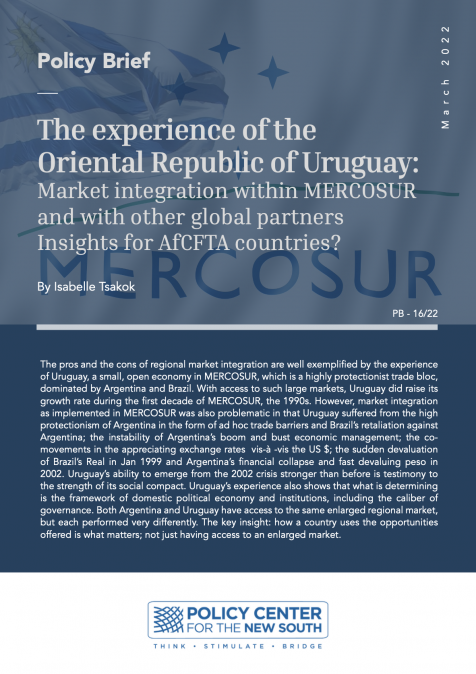
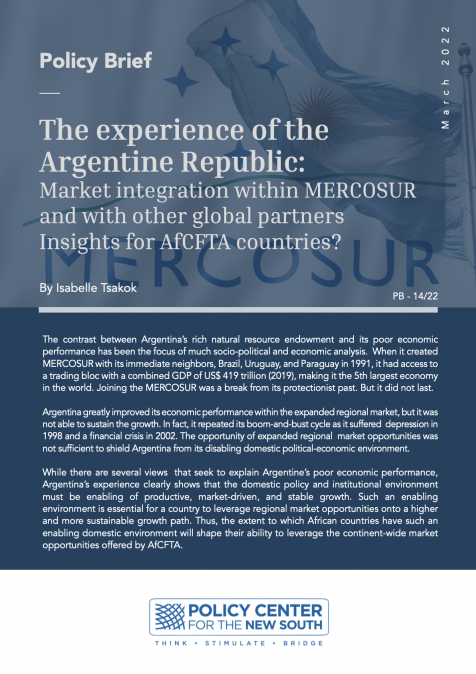
Trade agreements, in earlier eras, were instruments of exchange. In the present one, they have become instruments of order. The EU–Mercosur agreement, after more than two decades of negotiation, reaches a decisive moment—not merely as a framework for tariff reduction, but as a mechanism through which competing visions of economic organization are projected and contested.
Beyond Geography: The Structural Choice Facing Mercosur and the Asymmetry Beneath the Partnership
The age of frictionless globalization has given way to a landscape defined by strategic selectivity. Interdependence persists, but no longer as a neutral condition. It is curated, constrained, and increasingly shaped by power. The fragmentation of supply chains, the securitization of technology, and the emergence of regulatory spheres of influence reveal a system in which access is mediated not only by markets but by standards. In this context, trade policy becomes indistinguishable from geopolitical positioning.
The European Union has adapted to this transformation in a manner both sophisticated and revealing. Confronted with structural constraints—demographic stagnation, limited reserves of critical raw materials, and rising external dependencies—it has refined the exercise of regulatory power as a strategic instrument, projecting its standards beyond its borders to compensate for material limitations and preserve influence within an increasingly contested global landscape.
This model, however, is not neutral in its effects. It generates a subtle yet consequential asymmetry. Europe exports regulation, high-value industrial goods, and technological standards, while Mercosur risks exporting commodities, energy, and raw materials. The language of partnership thus coexists with the possibility of a more intricate mechanism of dependency—one sustained not through coercion, but through disparities in technological capability, access to capital, and the extraterritorial extension of regulatory frameworks.
The European Union’s deforestation regulation offers a revealing example. By imposing stringent traceability requirements on agricultural imports, it establishes standards that are environmentally defensible but economically asymmetric. European firms, endowed with capital, technology, and institutional support, are structurally better positioned to comply, certify, and ultimately capture value. South American producers, by contrast, bear the costs of adaptation without necessarily gaining proportional access to higher-value segments of the supply chain. What appears as environmental governance may, in practice, function as a constraint on industrial upgrading.
Nations Do Not Trade What They Want—They Export What They Are
This dynamic may be more precisely understood as regulatory extraction: a system in which value is defined, structured, and appropriated through standards, while production remains geographically displaced. Compliance, in this framework, does not inherently produce development. More often, it reproduces hierarchy under the appearance of convergence.
A parallel argument frequently advanced is that deeper engagement with Asia—particularly with China—risks entrenching a different form of dependence. Yet this concern rests on a conceptual misunderstanding. Dependence is not a function of geography, but of structure. Brazil’s own history offers a useful corrective. For much of the twentieth century, its trade with the United States accounted for a significant share of total external commerce, at times exceeding 30 per cent. This concentration did not prevent subsequent diversification. On the contrary, it coexisted with—and ultimately gave way to—a broader reconfiguration of economic partnerships as global dynamics evolved.
The critical distinction, therefore, is not between partners, but between patterns of insertion. A country that exports predominantly primary goods will reproduce asymmetries irrespective of destination. A country that develops diversified, high-value production reduces vulnerability even in the presence of concentration. The question is not who one trades with, but what one becomes through trade.
From this perspective, the strategic dilemma facing Mercosur is mischaracterized when framed as a choice between Europe and Asia. The true question is whether the region will remain positioned at the lower end of global value chains or undertake the structural transformation required to ascend them. Without such transformation, diversification remains geographical rather than economic—an illusion of autonomy rather than its substance.
The Quiet Hierarchy: Europe’s Regulatory Power and the New Logic of Dependence
This reorientation is, fundamentally, a domestic challenge. Expanding productive capacity, investing in infrastructure, strengthening technological capabilities, and fostering competitive sectors in manufacturing and services are not complementary ambitions; they are the precondition for sovereignty in an interdependent world. External agreements may facilitate this process, but they cannot substitute for it.
Within this framework, Asia should be understood not as a risk to be mitigated, but as a vector of opportunity. The dynamism of Asian economies—most notably China—offers more than demand. It provides access to industrial ecosystems, financing mechanisms, and pathways to technological upgrading that remain critical for late industrializers. To artificially constrain this engagement in the name of strategic caution would be to misread both the trajectory of global economic gravity and the nature of contemporary development.
None of this diminishes the potential value of the EU–Mercosur agreement. Properly understood, it can serve as an instrument of diversification and a platform for regulatory alignment. Yet its ultimate significance lies not in what it delivers externally, but in what it demands internally. It can anchor transformation—but only if it is treated as a means rather than an endpoint.
The choice confronting Mercosur, therefore, is neither geographic nor diplomatic. It is structural: the choice between remaining a supplier of what others require and becoming a producer of what the world values.
Trade agreements may open doors. Only structural transformation determines whether nations pass through them—or remain defined by what they carry to the threshold.