Publications /
Paper in Academic Journals
Back
Does the Brazilian policy for oil revenues distribution foster investment in human capital?
Authors
May 21, 2020

Our senior fellow, Otaviano Canuto, has contributed to Science Direct academic Journal, with a research paper entitled « Does the Brazilian policy for oil revenues distribution foster investment in human capital? », Volume 88, May 2020, 104760.

This paper assesses the effect of oil revenues on health and education indicators (measures for human capital) in the Brazilian municipalities using exogenous oil price variations. The Oil Law of 1997, apart from to hugely increase the amount of oil revenues distributed to the eligible municipalities due to the withdraw of the internal control price system, broadened its possible uses by the eligible municipalities, including investments in health and education in addition to traditional investments in infrastructure. Since Brazil has decentralized primary education and primary health care provision to themunicipalities, we use the oil price as an external intervention in local economies to identify the effect of the non-renewed natural resources in promoting sustainable growth.We also explore the high inequality in oil revenues distribution among municipalities. Similar to the previous literature, our results point to a small improvement of the human capital indicators in the long run. The contribution of the largest oil revenue recipients, however, is null for these indicators. 

This paper was originally published on Science Direct Journal : https://www.sciencedirect.com/science/article/pii/S0140988320300992

RELATED CONTENT

  • Authors
    Ana Maria Bonomi Barufi
    Peter Nijkamp
    May 27, 2016
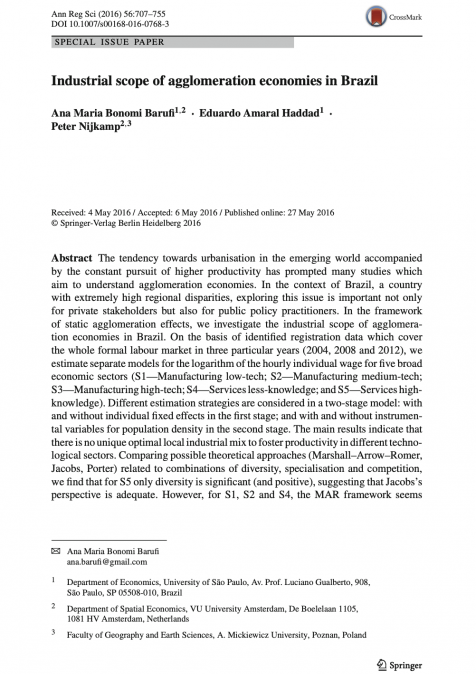
    The tendency towards urbanisation in the emerging world accompanied by the constant pursuit of higher productivity has prompted many studies which aim to understand agglomeration economies. In the context of Brazil, a country with extremely high regional disparities, exploring this issue is important not only for private stakeholders but also for public policy practitioners. In the framework of static agglomeration effects, we investigate the industrial scope of agglomeration econom ...
  • Authors
    Otávio José Guerci SIDONE
    Jesús Pascual MENA-CHALCO
    April 6, 2016
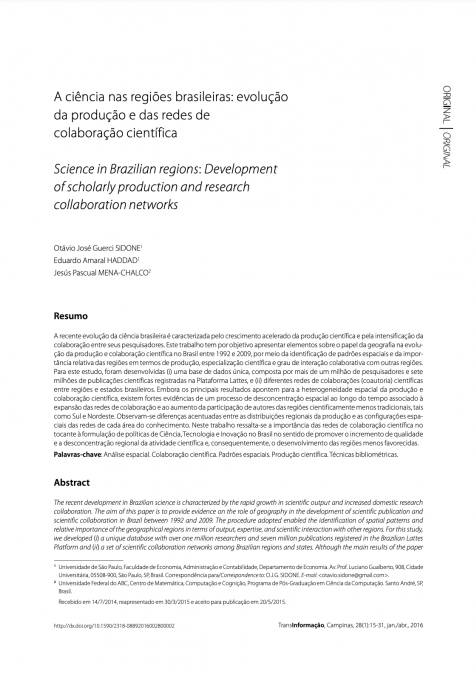
    A recente evolução da ciência brasileira é caracterizada pelo crescimento acelerado da produção científica e pela intensificação da colaboração entre seus pesquisadores. Este trabalho tem por objetivo apresentar elementos sobre o papel da geografia na evolução da produção e colaboração científica no Brasil entre 1992 e 2009, por meio da identificação de padrões espaciais e da importância relativa das regiões em termos de produção, especialização científica e grau de interação colabo ...
  • Authors
    February 10, 2015
    Manufacturing is declining as a share of GDP not only in advanced countries, but in developing countries as well. This new trend, a result of complex forces, should be seen on balance as a reason for development-optimism, not pessimism. In the 21st century economy, manufacturing remains important, but poor countries can attract investment, grow rapidly and diversify away from agriculture on the basis of many possible sources of comparative advantage, without artificially promoting m ...