Publications /
Opinion
This blog was originaly published on orfonline.org.
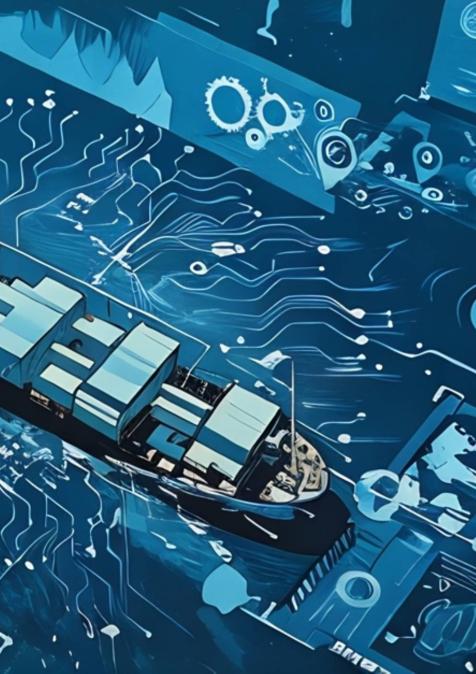
The maritime industry is the lifeblood of global trade, with ships carrying over 90 percent of all merchandise trade, and the global logistics market accounting for 8-12 percent of global gross domestic product (GDP). The smooth functioning of maritime trade and supply chain logistics is integral to economic development and critical to food security and the distribution of essential supplies. In fact, the COVID-19 pandemic has demonstrated that disruptions in maritime logistics can significantly impact supply chains, prices, economic growth, employment, and trade costs. Therefore, adopting digital technologies has become imperative to enhance the resilience and competitiveness of the maritime supply chain. At the heart of the digital transformation is the rapid advancement and integration of various technologies that are reshaping the industry's operations, logistics, communication, asset management, safety, security, and environmental sustainability. However, this growing digital integration also introduces new challenges such as cyberattacks targeting ports and maritime operations, presenting tangible risks to critical infrastructure. As such, the industry must simultaneously pursue digital innovation while implementing robust cybersecurity measures and ensuring workforce readiness through institutional support for the successful implementation of digital technologies.
The smooth functioning of maritime trade and supply chain logistics is integral to economic development and critical to food security and the distribution of essential supplies.
Key technologies shaping the maritime sector
Digital technologies and data-driven solutions are transforming the maritime sector. This shift towards digitalisation aims to enhance efficiency, improve decision-making, and optimise overall performance across various aspects of the industry.
The industry's core function is the efficient global movement of goods and materials. To streamline these processes, the sector has developed and deployed a range of innovative port operations and logistics technologies. For example, autonomous ships and unmanned surface vehicles (USVs) equipped with Artificial Intelligence (AI)-driven algorithms, sensors, and remote-control systems enable navigation with minimal human intervention and enhance operational flexibility. For instance, in Singapore’s PSA International Tuas Port, electrified automated yard cranes and autonomous guided vehicles (AGVs) handle the movement of containers between the yard and the wharf, managed remotely from the centralised Tuas Port control centre.
Similarly, the integration of digital technologies has transformed vessel management and maintenance, ensuring their reliability, longevity, and cost-effectiveness. Advanced sensors embedded in maritime assets—engines, propulsion systems and cargo handling equipment—provide real-time data on parameters like vibration, temperature, and wear, enabling predictive maintenance and proactive repair. For example, the Port of Rotterdam and Port of Antwerp have installed "smart bollards" equipped with sensors to continuously measure and monitor mooring line tension, allowing the ports to safely accommodate larger vessels and optimise berth utilisation. Additionally, digital twin technology has emerged as a transformative tool, providing ship operators with virtual replicas of vessels that allow them to test various operational scenarios, and anticipate the impact of maintenance and upgrades without disrupting real-time operations. The UK’s Port of Dover is preparing to create an advanced digital twin of the port that forecasts tidal patterns and weather conditions, enabling the safe arrival and departure of vessels.
In Singapore’s PSA International Tuas Port, electrified automated yard cranes and autonomous guided vehicles (AGVs) handle the movement of containers between the yard and the wharf, managed remotely from the centralised Tuas Port control centre.
Beyond operational benefits, digitalisation has also fostered greater connectivity and information-sharing within the maritime industry. Singapore’s PSA International Tuas Port has implemented event-driven architecture (EDA)—a software design pattern that enables real-time information exchange between interconnected systems, devices and processes, on events such as vessel arrivals, container movements, and equipment status changes. The Port of Los Angeles has integrated its ecosystem data through Wabtec Corporation’s cloud-based Port Optimizer, using machine learning and domain expertise to monitor and respond to dynamic supply chain conditions. Additionally, the integration of satellite-based communication systems, such as VSAT (Very Small Aperture Terminal) and 5G networks, provides high-speed internet connectivity to vessels. In Singapore, a microsatellite has been developed to improve maritime communications, as well as traffic management and analytics. Moreover, in Tianjin port, one of China's busiest ports, Huawei has used 5G and cloud-based centralised dispatching to optimise its automated horizontal transportation systems.
Cybersecurity challenges
While digitalisation in maritime operations presents numerous opportunities, it also comes with its own set of challenges. Particularly, the industry is increasingly vulnerable to cybersecurity threats, including operational disruptions, data breaches, and safety threats due to compromised navigation systems. For instance, shipowners, ports and other maritime groups faced at least 64 cyber incidents in 2023, especially with the escalation of geopolitical tensions. These disruptions result in considerable financial losses with the average cyberattack cost in the maritime industry more than tripling to US$ 550,000 in 2022.
The first step is to meet the Facilitation (FAL) Committee Convention’s mandatory requirements for electronic data interchange through the implementation of a Maritime Single Window.
The imperative to address these vulnerabilities cannot be overstated, as the consequences of inaction could jeopardise not only individual ports but also the broader maritime supply chain. In this regard, the International Maritime Organization (IMO) set cybersecurity guidelines in 2017 to protect maritime operations from emerging cyber threats, advocating for a framework that prioritises prevention, detection, and response.
Conclusion and policy Recommendations
Digital transformation is no longer an option but a necessity for the maritime industry, promising to enhance operational efficiency, safety and overall global competitiveness. In order to harness the full potential of technological advancements, countries (particularly developing economies) must follow a comprehensive roadmap. The first step is to meet the Facilitation (FAL) Committee Convention’s mandatory requirements for electronic data interchange through the implementation of a Maritime Single Window. Building upon this digital framework, countries must then establish a functional Port Community System to optimise and automate port and logistics processes. This can be complemented by developing a Port Management System to centrally control all port operations digitally. Ports with advanced technical and institutional capabilities should transition towards a "smart port" model that leverages emerging technologies, such as AI, the IoT, 5G networks and digital twinning. Successful implementation of this digital transformation, however, requires sustained political commitment, adequate regulation, public-private collaboration and human capital upskilling. Additionally, the maritime industry must proactively address the heightened cybersecurity risks that accompany increased digitalisation.