Publications /
Policy Brief

Back
The Democratic Republic of Congo's foreign policy under President Tshisekedi: between ambition for reform and diplomatic drive
Authors
April 20, 2022

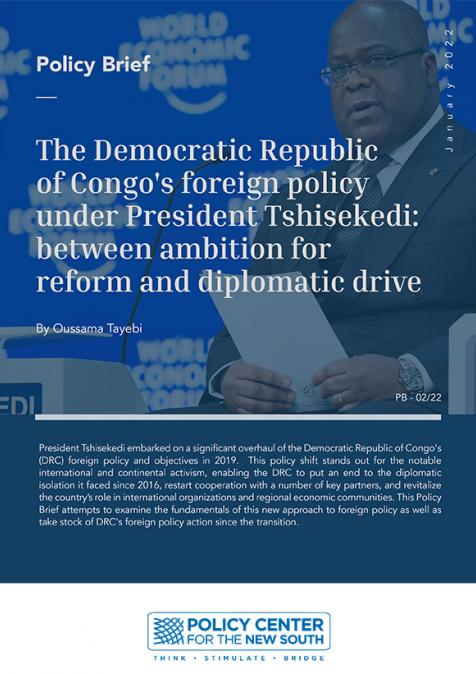
President Tshisekedi embarked on a significant overhaul of the Democratic Republic of Congo's (DRC) foreign policy and objectives in 2019. This policy shift stands out for the notable international and continental activism, enabling the DRC to put an end to the diplomatic isolation it faced since 2016, restart cooperation with a number of key partners, and revitalize the country’s role in international organizations and regional economic communities. This Policy Brief attempts to examine the fundamentals of this new approach to foreign policy as well as take stock of DRC's foreign policy action since the transition.
RELATED CONTENT

  • February 19, 2026
    This Africafe's episode examines Brazil-Africa relations: historical ties shaped by the slave trade and diaspora, Lula’s trade expansion, and competition with China/EU. It explores South-South diplomacy’s potential to reshape global institutions, the role of “South Atlanticism,” and fut...
  • Authors
    Amine Ghoulidi
    February 5, 2026
    This Paper was originally published on orient-online.com  The Western Mediterranean’s exposure to the Sahel is usually framed in terms of security spillovers and crisis management. This paper argues that this framing misreads how Sahelian access conditions now shape Mediterranean integration. Morocco’s Atlantic Initiative is a state-led corridor strategy combining Atlantic port infrastructure, inland transit routes, and energy systems to connect landlocked Sahelian economi ...
  • February 4, 2026
    This article examines the quiet but profound implications of the erosion of U.S.-led hegemony for small and vulnerable states of the New South. While the post-1945 international order was never egalitarian, it offered predictability: power was organized through law, and sovereignty for weaker states rested less on justice than on procedural stability. Davos 2026 marked a turning point in the public acknowledgment of that system’s unraveling. Statements by leading Western figures rev ...
  • Authors
    December 18, 2025
    The return of President Donald Trump to the White House at the start of 2025 was expected to signal an American retreat from international engagement, especially in regions of traditional security interest, such as southern Europe, North Africa, and the Middle East. To the surprise of many observers around the Mediterranean, and perhaps to the dismay of some in the Trump administration’s ideological orbit, this has not happened. If anything, the second half of 2025 has seen a high d ...
  • October 23, 2025
    Depuis plus de trente ans, les relations entre le Maroc et l’Union européenne (UE) se caractérisent par un équilibre entre pragmatisme politique, ouverture économique et convergence stratégique. Le processus de Barcelone de 1995 a marqué le début d’une coopération euro-méditerranéenne renforcée, consolidée par l’Accord du Statut avancé en 2008 et le Partenariat euro-marocain de prospérité partagée, faisant de l’UE le principal partenaire économique du Royaume. Dans un contexte régio ...
  • July 25, 2025
    This episode explores the evolving relationship between India and Africa, with guest Mr. Mishra from the Manohar Parrikar Institute for African Studies. From historical ties to emerging s ...
  • Authors
    Alberto Tagliapietra
    Guilherme Casarões
    May 14, 2025
    Global governance is undergoing a profound transformation, marked by growing polarization, the weakening of multilateral institutions, and the rise of informal, flexible frameworks. As great powers drift from multilateral commitments, and instead prioritize transactional or unilateral actions, middle powers are emerging as key actors in shaping the future of global governance. These countries, ranging from Brazil and South Africa to Poland, Türkiye, and South Korea, navigate the in ...
  • Authors
    September 20, 2024
    Le minilatéralisme, approche flexible et rapide de la coopération internationale, s'avère efficace pour relever des défis communs entre un petit nombre d'États. Inspiré du « Dialogue 5+5 » méditerranéen, ce concept est proposé pour renforcer la coopération euro-africaine dans l'espace atlantique, en créant un forum « 3+3 » réunissant l'Espagne, la France, le Portugal, le Maroc, la Mauritanie et le Sénégal. Ce cadre permettrait de répondre aux enjeux sécuritaires, ...
  • Authors
    October 23, 2023
    Like many countries of the Global South, South Africa espouses an independent, non-aligned approach to foreign policy. This approach has been criticized during the ongoing Russia-Ukraine war as a superficial excuse to be ‘soft’ on Russia. Deeper reflection and analysis however, points to a finely calibrated multi-alignment strategy, which allows South Africa to secure its national interests while carefully balancing relations with the United States (U.S.), European Union (EU) and ot ...