Publications /
Policy Paper

Back
De la transition environnementale à la crise énergétique : le gaz naturel a-t-il un avenir ?
Authors
December 3, 2021

Si le recours aux énergies renouvelables ne peut que croître, doit-on symétriquement considérer que le gaz naturel est, à l’instar du pétrole et du charbon, une énergie du passé ? Cette question simple en apparence, appelant une réponse tranchée et nécessairement positive au regard de l’impératif climatique, de la nécessité de décarboner nos économies, mais également des engagements politiques pris dans ce sens par de nombreuses nations. Le bien-fondé environnemental de ce raisonnement ne peut toutefois faire oublier que des facteurs tant économiques que géopolitiques sont à l’œuvre et qu’ils doivent également être pris en compte pour appréhender le « mix » énergétique de demain. Conjugués aux atermoiements sur le nucléaire qui, jusqu’à récemment, semblait peiner à légitimer son rôle dans cette nécessaire transition environnementale, lesdits facteurs pourraient consacrer le gaz naturel comme une voie médiane, largement insatisfaisante à long terme au regard de la lutte contre le réchauffement climatique mais permettant, à court terme, d’accélérer la sortie du charbon.

RELATED CONTENT

  • October 22, 2026
    Strategic hedging is rational when it preserves a worthwhile choice at a tolerable cost while respecting existing commitments. Drawing on the literature on hedging and Latin American autonomy, this Policy Brief examines contrasting illustrations of that proposition. It distinguishes ambiguity about future alignment from uncertainty about existing obligations and explains how clearly bounded commitments can reconcile autonomy with credibility. The cases reveal different vulnerabiliti ...
  • October 22, 2026
    تتناول هذه الحلقة من «حديث الثلاثاء» تأثير تقلبات أسعار النفط والغاز في الأسواق العالمية على الاقتصاد المغربي، وانعكاساتها على القدرة الشرائية للأسر وتنافسية المقاولات. ونناقش مع ضيفنا السيد أمين سامي كيف تنتقل هذه التقلبات إلى أسعار السلع والخدمات، ولماذا لا تنخفض الأسعار دائمًا مع ترا...
  • October 15, 2026
    The Policy Center for the New South, in partnership with The Asian Network, is organizing a webinar titled “Emerging Powers and the Remaking of Global Order” to examine the growing role of emerging powers and the Global South at a time of profound transformation in the international sys...
  • October 09, 2026
    Can Nigeria’s Dangote refinery help strengthen Africa’s energy security amid disruptions to global supply routes? This discussion considers how expanding local refining capacity can reduc ...
  • Authors
    Pedro Henrique de Christo
    Travis Knoll
    September 18, 2026
    The Brazilian context involving a clean-electricity base, a more balanced lobbying landscape, and mounting climate and social pressure, makes it more difficult for the kind of abrupt and unrestrained energy policy swing seen in Colombia. The trend in Brazil tends to be more economically viable for renewables. However, these structural conditions by themselves will not guarantee the success of the transition. Fruition will depend on whether policymakers use this window to prepare for ...
  • Authors
    August 12, 2026
    La géographie mondiale des hydrocarbures n'est évidemment pas figée. De nouveaux producteurs de pétrole et/ou de gaz naturel apparaissent suite à des découvertes, le plus souvent réalisées par des compagnies pétrolières internationales. On pense notamment au Mozambique, qui produit et exporte du gaz naturel liquéfié (GNL) depuis la fin 2022, au Sénégal, qui est un producteur de pétrole offshore depuis la mi-2024, et au Sénégal et à la Mauritanie, qui sont devenus conjointement expor ...
  • Authors
    August 5, 2026
    This paper addresses the persistent challenge of resource dependence in the world's poorest countries, focusing on the ten poorest African nations where natural- resource rents average 14% of income. It argues that four decades of conventional policy advice, which treated resource dependence primarily as a revenue management problem, have failed to help these countries. While stabilization funds and permanent-income frameworks aim to smooth consumption, they do not answer the fundam ...
  • Authors
    July 2, 2026
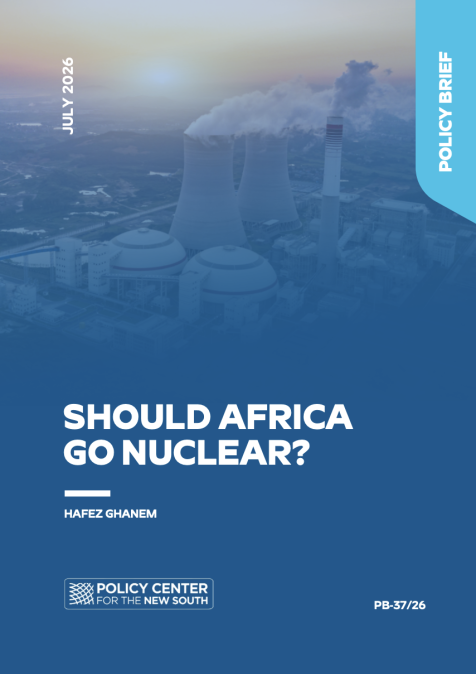
    Africa is facing a massive electricity deficit that is impacting its economic and social development, and its ability to catch up with the rest of the world. It is imperative that the continent increase its electricity production to connect the 600 million people who are currently without access and to improve the quality of service for the millions who are suffering from frequent blackouts and load-shedding. Economic development in the 21st century will crucially depend on the digi ...
  • June 24, 2026
    Africa, Latin America, and the Caribbean have both the potential and the desire to transform their people's lives through Green Industrial Policy. Yet they have long been constrained by structural obstacles embedded in the international system. The current rupture in that system, which ...
  • Authors
    June 8, 2026
    The energy shock caused by the war between the United States and Israel and Iran has highlighted the need for Africa to refine more of its own crude oil. Africa is a net hydrocarbon exporter, but remains stuck in the old colonial economic model: it mostly exports raw materials and imports refined products. Africa exports about 2.6 billion barrels of crude oil every year, and imports about 1.4 billion barrels of refined products. This is a problem for two reasons. First, Africa ...