Publications /
Policy Paper

Back
Commerce et emploi salarial des femmes
Authors
January 9, 2020

Le principal objectif de ce document est d’aborder une question importante qui découle de l’interaction entre une participation accrue au commerce international, aux marchés du travail et l’inégalité de genre, à savoir l’impact de la libéralisation du commerce sur l’accès des femmes aux emplois salariés dans le secteur non agricole. Nous abordons empiriquement cette question en effectuant des estimations à effets fixes et par MMG sur des données de panel obtenues dans un grand nombre d’économies en développement, et en retraçant l’impact du commerce sur l’accès des femmes à l’emploi salarié. Dans l’ensemble, les résultats empiriques indiquent que le commerce a des effets divers sur la participation des femmes à l’emploi salarié et ces effets semblent être non linéaires. En particulier, les résultats semblent être conformes au « paradoxe de l’égalité de genre dans la région MENA ». Nous examinons les implications politiques de ces conclusions.
RELATED CONTENT

  • Authors
    Nuria Boot
    Karim El Mokri
    Simone Tagliapietra
    Karen E. Wilson
    Guntram B. Wolff
    Georg Zachmann
    August 22, 2016
    This joint Bruegel-OCP Policy Center publication comprised of four policy contributions from researchers of both institutions is the result of the establishment of “Platform for Advanced & Emerging Economies Policy Dialogue.” The first edition of this continuous dialogue took place in Rabat on April 1st 2016 under the theme of “Seven Years after the Crisis: Intersecting Perspectives.” In the first paper, “Youth Unemployment in the Mediterranean Region and its Long term Implicat ...
  • Authors
    Russel Dinh
    January 27, 2016
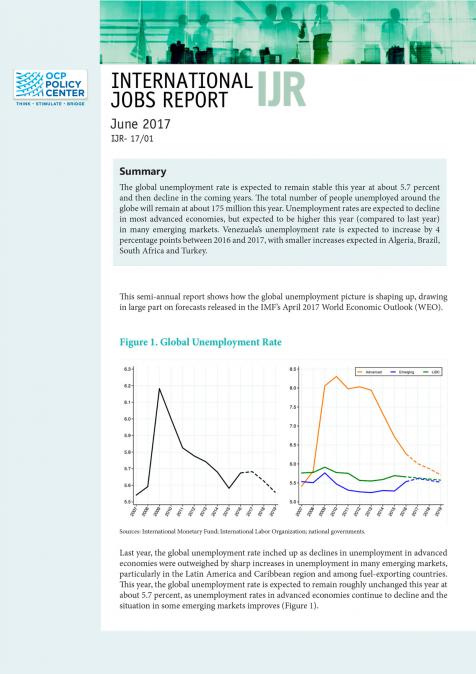
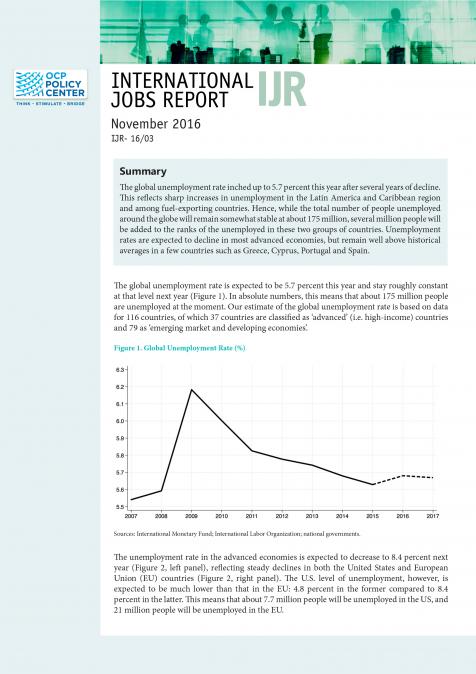
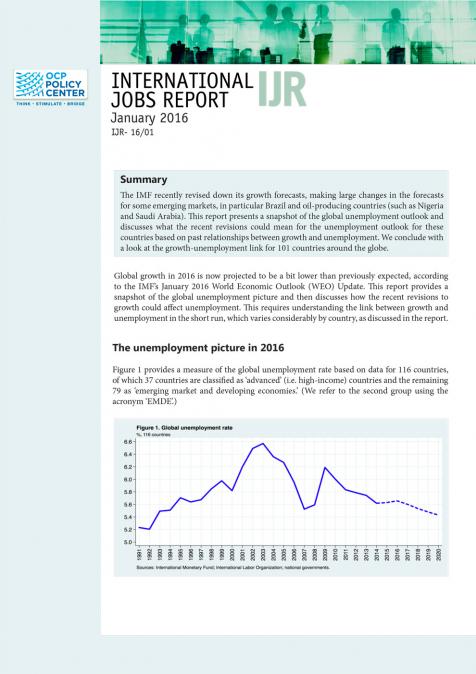
    The IMF recently revised down its growth forecasts, making large changes in the forecasts for some emerging markets, in particular Brazil and oil-producing countries (such as Nigeria and Saudi Arabia). This report presents a snapshot of the global unemployment outlook and discusses what the recent revisions could mean for the unemployment outlook for these countries based on past relationships between growth and unemployment. We conclude with a look at the growth-unemployment link f ...