Publications /
Book / Report

Back
The Colombian Economy and Its Regional Structural Challenges
Authors
Jaime Bonet
Geoffrey J. D. Hewings
August 30, 2023

This Book was originally published on springer.com


This book examines regional structural challenges on Colombia’s path to sustainable social cohesion and regionally inclusive growth. These challenges can be divided into three main groups: (i) those that focus on competitiveness and the supply side, (ii) those that arise from critical business cycle issues on the demand side, and (iii) those concerning environmental sustainability, employment and social inclusion. 

The contributions, written by experts on Latin American economics and regional science, apply quantitative simulations based on a unified general equilibrium framework and address a wide range of topics, including: Colombia’s competitive integration in global markets, human capital profiles, regional economic disparities and public and private mechanisms of interregional income transfer. The challenges entailed by such high-profile and long-term issues as productivity growth and climate change are also analyzed.

In addition, the book positions Colombia’s experiences in an international comparative context. It argues that many other Latin American countries face similar challenges and provide evidence to substantiate this claim. By doing so, it offers valuable policy lessons for Latin American countries with similar difficulties.

RELATED CONTENT

  • Authors
    January 31, 2019
    Without reforms, financial markets’ optimism may crumble – and bring the house down. Judging by the reaction of financial markets, the Brazilian economy started the year at high speed. The real is among the world’s best-performing currencies so far in 2019 and the main stock market index Ibovespa hit a string of record highs leading into last week, when it broke the 97,000-point mark. Future interest rates have fallen sharply.  Foreign investors are buying in as well. The pre ...
  • Authors
    March 7, 2018
    Brazilian conditional cash transfers are small amounts of money the government distributes directly to very poor households on condition that their children attend school and are vaccinated. The money goes to the women of the household, because research undertaken in the 1990s – and later confirmed in other countries – showed an increase in babies' height and weight when women have more control over household income. Greater control over household resources by women can strengthen a ...
  • Authors
    Ana Maria Bonomi Barufi
    Peter Nijkamp
    May 27, 2016
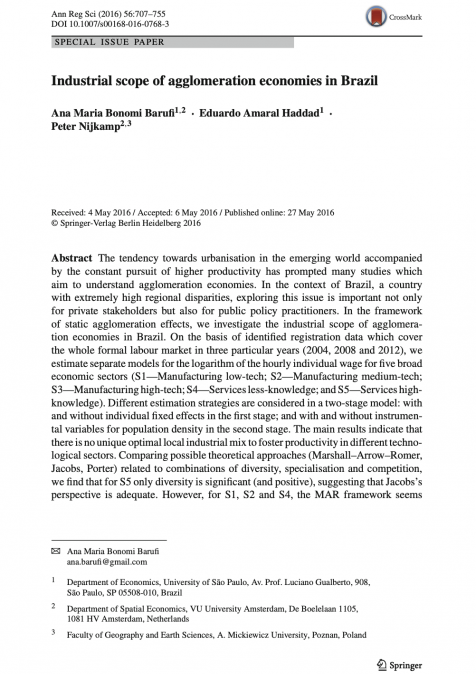
    The tendency towards urbanisation in the emerging world accompanied by the constant pursuit of higher productivity has prompted many studies which aim to understand agglomeration economies. In the context of Brazil, a country with extremely high regional disparities, exploring this issue is important not only for private stakeholders but also for public policy practitioners. In the framework of static agglomeration effects, we investigate the industrial scope of agglomeration econom ...
  • Authors
    Otávio José Guerci SIDONE
    Jesús Pascual MENA-CHALCO
    April 6, 2016
    A recente evolução da ciência brasileira é caracterizada pelo crescimento acelerado da produção científica e pela intensificação da colaboração entre seus pesquisadores. Este trabalho tem por objetivo apresentar elementos sobre o papel da geografia na evolução da produção e colaboração científica no Brasil entre 1992 e 2009, por meio da identificação de padrões espaciais e da importância relativa das regiões em termos de produção, especialização científica e grau de interação colabo ...
  • Authors
    Russel Dinh
    January 27, 2016
    The IMF recently revised down its growth forecasts, making large changes in the forecasts for some emerging markets, in particular Brazil and oil-producing countries (such as Nigeria and Saudi Arabia). This report presents a snapshot of the global unemployment outlook and discusses what the recent revisions could mean for the unemployment outlook for these countries based on past relationships between growth and unemployment. We conclude with a look at the growth-unemployment link f ...
  • Authors
    February 10, 2015
    Manufacturing is declining as a share of GDP not only in advanced countries, but in developing countries as well. This new trend, a result of complex forces, should be seen on balance as a reason for development-optimism, not pessimism. In the 21st century economy, manufacturing remains important, but poor countries can attract investment, grow rapidly and diversify away from agriculture on the basis of many possible sources of comparative advantage, without artificially promoting m ...