Publications /
Book / Report

Back
Climbing a High Ladder - Development in the Global Economy
Authors
February 26, 2021

Economic development analysis must inevitably rely on a double methodological standpoint. On the one hand, it needs to search for common features, those general attributes that might be present in all national experiences of wealth accumulation, poverty reduction, and moving up the income ladder. On the other, in order to be meaningful, it must reckon with time and space. It must consider that those universal development traits will play out in specific historical and geographical circumstances that will condition their unfolding. In this book, we try to follow that dual approach. Although each chapter is written in a way that makes it readable as a standalone piece, there is a tentative common thread: we attempt to understand what has meant to climb the income ladder in the context of the global economy prior to and after the 2007-08 global financial crisis. The overall message of our dual analytical-and-historic approach is single: historic and geographical conditions matter, but ultimately the adoption of appropriate country-specific policies and reforms is what makes the difference.

RELATED CONTENT

  • June 21, 2017
    Ce podcast est présenté par Moubarack Lo. Il y analyse l’apport de l’adhésion marocaine à la CEDEAO suite à l’accord de principe donné par ses membres au 51e sommet de Monrovia le 4 juin ...
  • Authors
    Edité par
    Idriss El Abbassi
    Lahcen Oulhaj
    Aziz Ragbi
    November 28, 2016
    Le présent ouvrage se propose d’apporter quelques éléments d’appui supplémentaires aux policy-makers pour une meilleure identification des défaillances des marchés au Maroc et une mise en place d’une stratégie de diversification et une politique industrielle efficientes, sans toutefois tomber dans la situation inverse où une stratégie mal définie et des outils mal choisis peuvent se traduire par une défaillance des politiques publiques. L’appréhension des difficultés qu’éprouve l’é ...
  • Authors
    October 4, 2016
    Brazil has been suffering from anemic productivity growth. This is a major challenge because in the long run, sustained productivity increases are necessary to underpin inclusive economic growth. Without them, increases in real labor earnings tend to conflict with global competitiveness; collecting taxes in order to fund government expenditures on infrastructure and social policies becomes a heavy burden; returns to private investment becomes harder to achieve; and ultimately c ...
  • Authors
    July 21, 2016
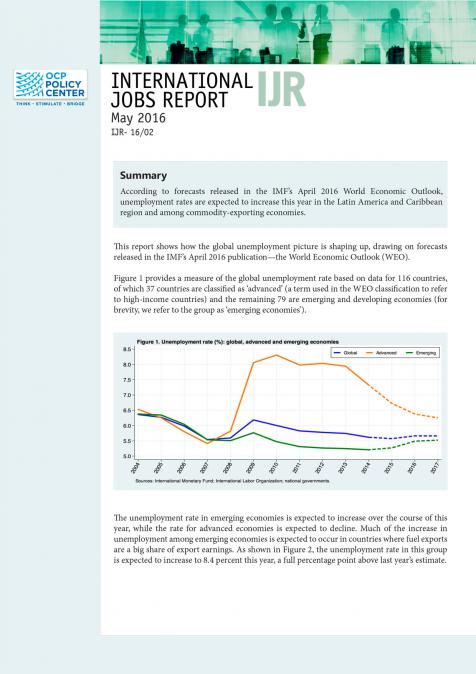
    The pace of global growth has tapered off since the crisis and the ensuing rebound. The concept of ‘secular stagnation’ was first used in 1938 by Alvin Hanson in reference to the American economy during the Great Depression. It refers to a situation where growth is slow over a protracted period, underemployment prevails and inflation is low. In such situations, the propensity to save tends to increase as a result of uncertainty and pessimism, and liquidity – which depends on interba ...
  • Authors
    Under the Supervision of
    Philippe Chalmin
    July 4, 2016
    Guinea’s bauxite, Moroccan phosphates, Nigerian Bonny Light, Zambian copper, Côte d'Ivoire’s cocoa, Ethiopian coffee or Madagascar’s vanilla: all are examples demonstrating that raw materials have a dimension that is as global as it is local. Global by the markets on which they are traded, local by their quality, a key element of their price, and their macroeconomic impact, particularly for Africa. In line with the 2016 CyclOpe report, which celebrates three decades of existence thi ...