Publications /
Policy Brief

Back
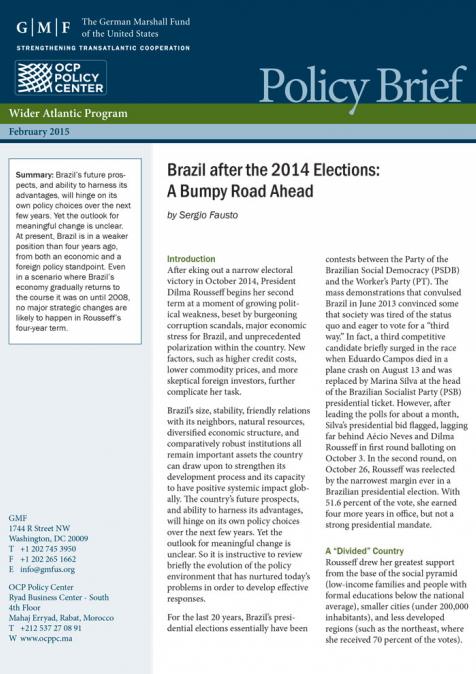
Brazil after the 2014 Elections: A Bumpy Road Ahead
Authors
Sergio Fausto
February 27, 2015

Brazil’s future prospects, and ability to harness its advantages, will hinge on its own policy choices over the next few years. Yet the outlook for meaningful change is unclear. At present, Brazil is in a weaker position than four years ago, from both an economic and a foreign policy standpoint. Even in a scenario where Brazil’s economy gradually returns to the course it was on until 2008, no major strategic changes are likely to happen in Rousseff’s four-year term.
RELATED CONTENT

  • Authors
    March 11, 2022
    The pros and the cons of regional market integration are well exemplified by the experience of Uruguay, a small, open economy in MERCOSUR, which is a highly protectionist trade bloc, dominated by Argentina and Brazil. With access to such large markets, Uruguay did raise its growth rate during the first decade of MERCOSUR, the 1990s. However, market integration as implemented in MERCOSUR was also problematic in that Uruguay suffered from the high protectionism of Argentina in the for ...
  • Authors
    March 8, 2022
    The contrast between Argentina’s rich natural resource endowment and its poor economic performance has been the focus of much socio-political and economic analysis. When it created MERCOSUR with its immediate neighbors, Brazil, Uruguay, and Paraguay in 1991, it had access to a trading bloc with a combined GDP of US$ 419 trillion (2019), making it the 5th largest economy in the world. Joining the MERCOSUR was a break from its protectionist past. But it did not last. Argentina greatl ...
  • Authors
    September 11, 2020
    Latin American and Caribbean economies need help, but organizations like the IDB are also stretched thin. First appeared at Americas Quarterly With Latin America and the Caribbean potentially facing years of difficulties due to the pandemic and related economic crises, attention has shifted to what multilateral institutions like the International Monetary Fund (IMF) might do to help. There’s no doubt they can play a crucial role in preventing another lost decade in the region. But ...
  • Authors
    Seleman Kitenge
    March 30, 2020
    Illicit financial flows (IFFs) have become a serious threat to the attainment of global development goals. On February 28th, 2020, the President of the United Nations General Assembly, Tijjani Muhammad-Bande, and the President of ECOSOC, Mona Juul, have announced a high-level panel on international financial accountability, transparency, and integrity (FACTI) as a means to address this challenge, which inhibits financing for the Sustainable Development Goals. This paper provides an ...
  • Authors
    July 3, 2019
    Twenty years after negotiations began between Mercosur and the European Union (EU), a trade agreement between ministers was reached last Friday in Brussels. Its first phase, from 1999 to 2014, had among the motivations on the European side not to be left behind while the US then pursued a Free Trade Agreement for Latin America (FTAA). Symptomatically, such enthusiasm cooled after FTAA negotiations came to a halt and the United States embarked on bilateral agreements with some c ...
  • June 27, 2019
    Intégration Régionale et Investissements Directs Etrangers: Retour sur les Expériences Brésilienne et Africaines - Sandra Polonia Rios, Directrice, CINDES -- www.policycenter.ma ...
  • December 15, 2018
    Moderator Richard Lui, Anchor, MSNBC / NBC News Speakers Laura Albornoz, Senior Fellow at the Adrienne Arsht Latin America Center, Former Minister of Women's Affairs, Chile Geraldo Alckmin, Governor of São Paulo, Brazil Alfredo G. A. Valladão, Professor at Sciences PO Paris, Senior Fell...
  • December 15, 2018
    Moderator Richard Lui, Anchor, MSNBC / NBC News Speakers Laura Albornoz, Senior Fellow at the Adrienne Arsht Latin America Center, Former Minister of Women's Affairs, Chile Geraldo Alckmin, Governor of São Paulo, Brazil Alfredo G. A. Valladão, Professor at Sciences PO Paris, Senior Fell...
  • Authors
    Sabine Cessou
    October 8, 2018
    « Amérique latine, crises et sorties de crises », telle était la première des deux thématiques des 6èmes Dialogues stratégiques, organisés le 4 avril par HEC Paris (Centre de géopolitique) et OCP Policy Center. Un tableau mitigé a été dressé, avec des signes de reprise et une croissance supérieure à 2 % qui n’empêchent pas des situations de crise comme au Brésil, au Nicaragua ou au Vénézuela. Crise d’un modèle d’oligarchies anti-capitalistes Au Vénézuela, la corruption paraît si e ...
  • Authors
    September 18, 2018
    If I were to synthesize the current situation of the Brazilian economy in one sentence, I would say: “it is suffering from a combination of ‘productivity anemia’1 and ‘public sector obesity2’". On the one hand, the mediocre performance of productivity in Brazil in recent decades has limited its GDP growth potential. On the other, the gluttony for expanding public spending has become increasingly incompatible with such limits in the potential expansion of GDP, particularly since ...