Publications /
Book / Report
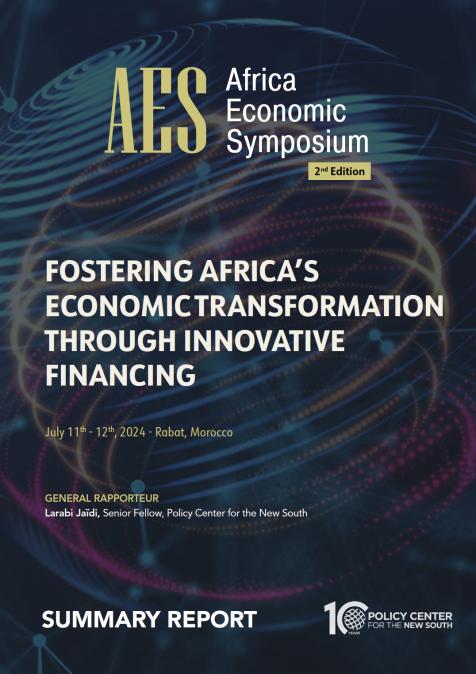
The Africa Economic Symposium (AES) has established itself as a major annual event organized by the Policy Center for the New South, joining the ranks of other flagship conferences such as the Atlantic Dialogues and the African Peace and Security Annual Conference (APSACO). AES aspires to be a continent- wide annual gathering of prominent economists, policymakers, and academics, bringing together global and African perspectives on macroeconomic management challenges and structural transformations that shape the future of Africa’s economic development.
The 2024 edition, held under the theme “Fostering Africa’s Economic Transformation through Innovative Financing”, focused on exploring innovative financial strategies and governance reforms required to bridge the widening financial gaps amidst the continent’s growing development needs. African economies are currently navigating a complex macroeconomic environment marked by geopolitical uncertainties, eroding fiscal stability, and rising pressures for funding infrastructure development, energy transition, and technological advancement. Despite continent-wide efforts to tighten monetary policies in response to entrenched inflation, concerns about fiscal discipline and debt sustainability have intensified, particularly in light of the 2024 electoral cycle in many African countries.
Simultaneously, Africa is facing a critical financial deficit to meet its expanding development needs, ranging from increasing social demands to modernizing infrastructure and supporting technological progress. Effectively addressing these priorities requires an integrated strategy that combines resource mobilization, private investment attraction, and the establishment of robust public-private partnerships (PPPs) within a strengthened governance framework. In this context, AES 2024 sought to define a comprehensive agenda for Africa, aimed at reducing fiscal vulnerabilities while supporting long-term inclusive and sustainable growth.
In the face of unprecedented challenges, public policies must strike a delicate balance between restoring market confidence and supporting the structural transformation of African economies. Short-term budgetary adjustments must be accompanied by deep structural reforms that generate high-quality growth and reduce exposure to future shocks. This requires a strong focus on mobilizing domestic resources, curbing illicit financial flows, and improving fiscal transparency to expand the fiscal space and secure the resources needed to finance development. Moreover, the 2024 edition underscored the critical role of climate finance in Africa’s development. As a continent disproportionately affected by climate change, Africa has the opportunity to redefine its economic priorities around a green energy transition. Discussions highlighted that mobilizing climate finance and integrating green technologies into development strategies offer unique opportunities to enhance the continent’s resilience and support sustainable growth.
Technology emerged as a central lever for Africa’s economic future. Digital transformation, the adoption of new technologies, and innovation have the potential to position Africa as a key player in the global economy—provided that public policies foster a competitive and innovative environment. It is imperative for the continent to rethink its industrial policies, strengthen research and development capabilities, and align education policies with the demands of tomorrow’s labor market.
The Africa Economic Symposium 2024 provided a significant forum to examine the strategic shifts needed for Africa’s economic transformation and to outline a clear path towards inclusive and sustainable prosperity. The recommendations stemming from various thematic sessions and the presentation of the Annual Economic Report on Africa offered concrete guidance on overcoming resource mobilization challenges while strengthening institutional capacity and financial governance across the continent.
The symposium featured seven key panels and the presentation of the Annual Report on the African Economy, each addressing a core theme:
1- Monetary Policy Challenges: Is Inflation Over?
Explored the complexities of persistent inflation, high interest rates, and their impact on monetary policy in Sub-Saharan Africa.
2- Addressing Fiscal Discipline:
Discussed strategies to manage growing debt burdens, the role of international financial institutions, and the need for maintaining fiscal stability.
3- Navigating Financial Resource Limitations Amidst Growing Development Needs
Focused on overcoming financial constraints through strategic resource mobilization and leveraging Africa’s youthful demographic advantage.
4- Innovative Financing Mechanisms for Green Transition
Highlighted the need to scale up climate finance solutions and increase private sector involvement to support sustainable development in Africa.
5- The Role of Development Finance in Addressing Social Challenges
Examined how development finance can support social protection systems, formalize the informal sector, and strengthen social safety nets.
6- Unlocking Domestic Financing Potential
Emphasized the importance of enhancing tax governance, building institutional capacity, and leveraging fintech to boost domestic resource mobilization.
7- The Role of International Financing in Africa’s Development
Addressed the interplay between domestic and international financing and the need for rethinking financial models to meet Africa’s evolving needs amid global crises.
8- Report Presentation: Annual Report on the African Economy