Podcasts

Back

Youth Leadership - A View from South America

16
May 2025
Florencio Venté and Helmut Sorge
Related topics: 

In this podcast, we speak with Florencio Venté, Co-director of the Migration Youth and Children Platform and a global advocate for displaced youth. From starting civic activism at age 12 to founding Glocals, Florencio connects migrants and local communities through dialogue. He shares insights on youth leadership, peacebuilding, and shaping international policy. A compelling story of impact, resilience, and global change.
RELATED CONTENT

  • Authors
    March 8, 2022
    The contrast between Argentina’s rich natural resource endowment and its poor economic performance has been the focus of much socio-political and economic analysis. When it created MERCOSUR with its immediate neighbors, Brazil, Uruguay, and Paraguay in 1991, it had access to a trading bloc with a combined GDP of US$ 419 trillion (2019), making it the 5th largest economy in the world. Joining the MERCOSUR was a break from its protectionist past. But it did not last. Argentina greatl ...
  • Authors
    December 29, 2021
    Après une longue période de prix atones, le café a vu ses cours se raffermir au cours de l’année 2020 et du premier trimestre 2021, avant de flamber durant l’été et l’automne. Il renouait alors avec des plus hauts niveaux depuis 2011, date de la fin du dernier « super-cycle des matières premières (2002-2011). Tandis que la demande progresse structurellement, l’offre s’est repliée, pénalisée par une conjonction de facteurs climatiques, géopolitiques et, bien évidemment, sanitaires en ...
  • Authors
    Gerson Javier Pérez Valbuena
    Diana Ricciulli
    Jaime Bonet
    Inácio Araújo
    Fernando Perobelli
    December 28, 2021
    This paper analyses the regional economic differences in the impact of lockdown measures to prevent the spread of COVID-19 ordered by Colombia’s national gov­ernment. Using an input-output model, we estimate regional economic losses by extracting a group of formal and informal workers from different sectors of the economy. Results show regional differences in the impact of lockdown measures on their labour markets, local economies, and productive sectors. We also find that periphera ...
  • Authors
    Renato S. Vieira
    Inácio F. Araújo
    Silvio M. Ichihara
    Fernando S. Perobelli
    Karina S. S. Bugarin
    November 23, 2021
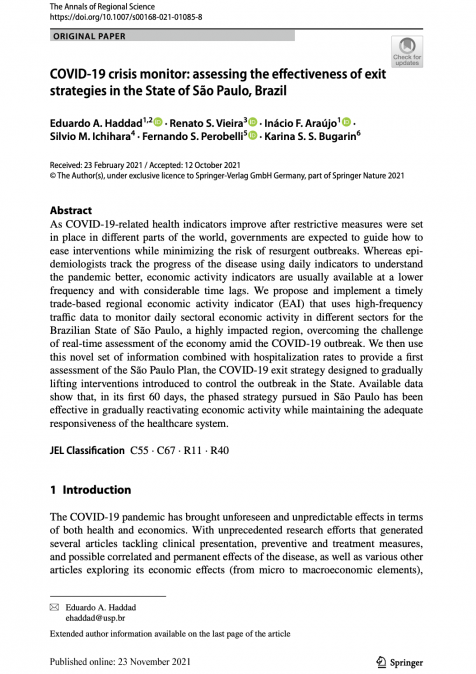
    As COVID-19-related health indicators improve after restrictive measures were set in place in different parts of the world, governments are expected to guide how to ease interventions while minimizing the risk of resurgent outbreaks. Whereas epidemiologists track the progress of the disease using daily indicators to understand the pandemic better, economic activity indicators are usually available at a lower frequency and with considerable time lags. We propose and implement a timel ...
  • Authors
    November 4, 2021
    The rhythm of samba is being replaced by funeral hymns. Almost 560,000 Brazilians (608,000 as of October 31,2021) have succumbed to COVID-19, the world’s second highest death toll, and no end is in sight. There have been “Staggering losses”, as the BBC reported (on July 8), provoking Medecins sans Frontières to warn of a “humanitarian catastrophe” in Brazil. Supplies of drugs and oxygen, confirmed British publication The Lancet, “are running short”. Yet, Jair Bolsonaro, president o ...
  • Authors
    March 3, 2021
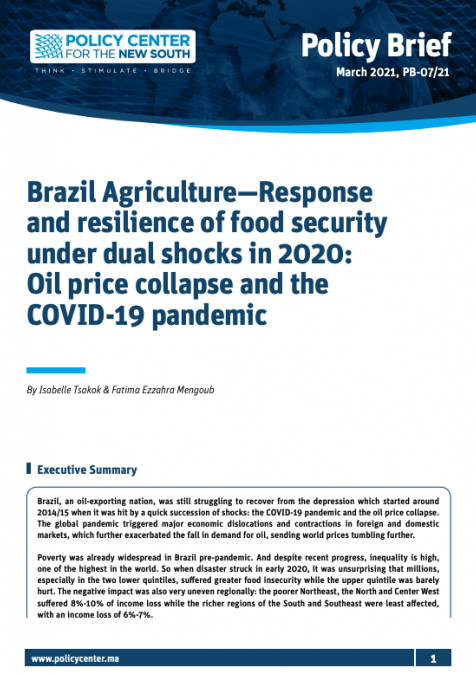
    Brazil, an oil-exporting nation, was still struggling to recover from the depression which started around 2014/15 when it was hit by a quick succession of shocks: the COVID-19 pandemic and the oil price collapse. The global pandemic triggered major economic dislocations and contractions in foreign and domestic markets, which further exacerbated the fall in demand for oil, sending world prices tumbling further. Poverty was already widespread in Brazil pre-pandemic. And despite recen ...
  • Authors
    December 23, 2020
    This article was originally published on Bruegel  A recovery from the COVID-19 recession is underway though the suffering is far from over, especially for the most vulnerable. Inequality is both a consequence of the pandemic and a cause of its severity. Many countries need comprehensive policy change to address its worst effects. At the end of a tragic year marked by pandemic and increased poverty, the miraculously rapid arrival of vaccines stirs great hope. The COVID-19 ...
  • Authors
    Márcio Issao Nakane
    December 17, 2020
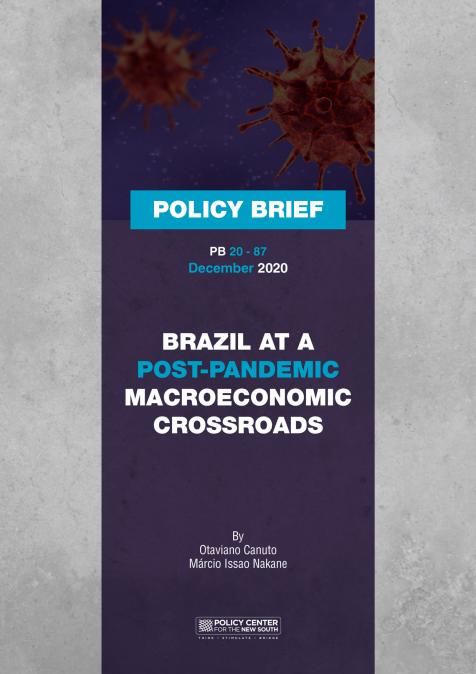
    Brazil is one of the countries hardest hit by COVID-19. Apart from the dramatic health implications, COVID-19 will also scar the Brazilian economy, including through a jump in its already high public-sector debt-to-GDP ratio in 2020. Moving forward—or not—with structural reforms aimed at lifting private investment will define whether a sustainableor unsustainable—growth-cum-debt trajectory will prevail in the next decade. The extent to which Brazil regains its attractiveness for for ...
  • Authors
    September 11, 2020
    Latin American and Caribbean economies need help, but organizations like the IDB are also stretched thin. First appeared at Americas Quarterly With Latin America and the Caribbean potentially facing years of difficulties due to the pandemic and related economic crises, attention has shifted to what multilateral institutions like the International Monetary Fund (IMF) might do to help. There’s no doubt they can play a crucial role in preventing another lost decade in the region. But ...
  • Authors
    Jaime Bonet-Morón
    Diana Ricciulli-Marín
    Gerson Javier Pérez-Valbuena
    Luis Armando Galvis-Aponte
    Inácio F. Araújo
    Fernando S. Perobelli
    July 29, 2020
    The aim of this paper is to assess the regional economic impact of the lockdown measures ordered by the national government to prevent the spread of COVID-19. Using an input–output model, we estimate the economic loss of extracting groups of formal and informal workers from different economic sectors. Results show monthly economic losses that represent between 0.5% and 6.1% of national GDP, depending on the scenario considered. Accommodation and food services, real estate, administr ...