Publications /
Opinion

In 1999, Hugo Chávez won the presidential elections in Venezuela with 56% of the votes, starting the historical period known as the “Bolivarian Republic of Venezuela”.
Helped with the rise of oil prices, a true social revolution started, with a new constitution and the implementation of socialist policies. Millions of people left poverty and became members of an increasing middle class, gaining access to housing, food, health, and education.
When Chávez died in 2013, his Vice-President Nicolás Maduro took office and continued Chavist policies. However, when the oil prices decreased, the public expenditure was at a very high level, and inflation, poverty, and social violence arose in the country. Food became scarce, and millions of Venezuelans started fleeing the country.
In 2018, Nicolás Maduro was elected for a second term in office, but the elections were marked as illegitimate and rigged by a great part of the Venezuelan society. For this reason, Juan Guaidó, the head of the National Assembly of Venezuela, following article 233 of the Constitution, took oath as interim president.
Today, Venezuela has two presidents. Each of them is supported by different Venezuelan groups and foreign countries, and a legitimacy problem has been added to the already existent political and humanitarian crisis.
The United States, a large number of European nations, and most of the Latin American governments (represented by the Lima Group) have already recognized Guaidó as the legitimate President of Venezuela; while Russia, China, Cuba, and some Caribbean and Latin American countries keep supporting Maduro, claiming that Guaidó is currently performing a coup d’état.
There is an intermediate position in the continent, represented by Mexico and Uruguay, calling for a summit to find a peaceful solution for the Venezuelan situation.
This process is extremely complex, and a peaceful resolution heavily depends on the following factors:
A global issue
With Brazil facing a deep internal crisis, and Mexico still struggling with its new President, the events in Venezuela are showing us, again, the lack of influence that other Latin American countries have in their own region, compared to the major global players.
Along with the Chinese and Russian geopolitical interests in the region, moved by their need to keep a close eye over their investments in Venezuela, the United States government said that “every strategy to solve Venezuelan crisis (including a direct invasion) is still on the table.”
The involvement of the international community is increasing the impact and stakes of the domestic standoff to the level of regional and global confrontation. Therefore, South America is, once again, the playground of major foreign players disputing geopolitical interests.
A divided society
Another component that led to this complex situation is the role of Venezuelan opposition leaders. Guaidó is different from other opposition leaders, like Henrique Capriles and Leopoldo López. He comes from a poor family, and not from the “oligarchy.” Therefore, factions of the working classes feel represented by Guaidó, and he has been able to unify the opposition in a way that other leaders could not do before.
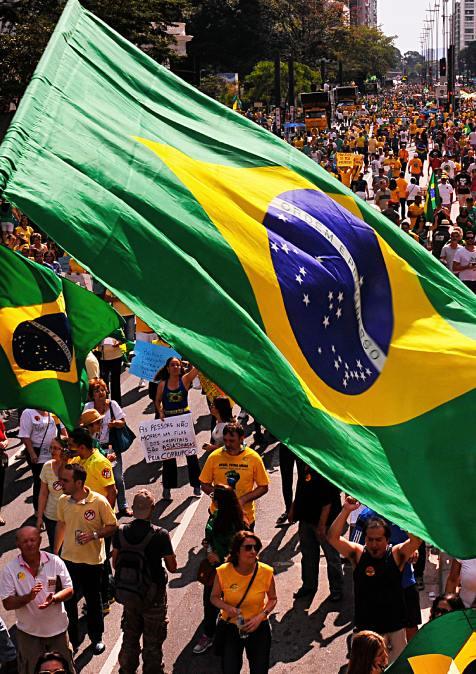
However, Venezuelan society is still deeply divided, and street rallies for and against Maduro are equally massive. Social violence is increasing daily, and Venezuelan leaders must avoid it at all costs.
Moreover, the millions of exiled Venezuelans are causing political and economic problems in the neighboring countries. Colombia and Brazil (but also Argentina and Chile) are struggling with the consequences this massive migration is causing. And there are still millions of people inside Venezuela, with almost no food, water nor medical supplies.
The military
The military is a key player, and its pivot may change the country’s political scenario.
While the highest commanders have clearly stated their support to Nicolás Maduro, there is an increasing displeasure among the military establishment, especially amid low and mid-rank officers. This division can create the conditions for a split within the institution.
And that’s because there is a substantial difference between these groups. Whereas the commanders have been accused of corruption and seem to have no economic problems, the low-and-mid-rank soldiers’ families are struggling for food and medical supplies, like most of the Venezuelan community.
There have been signs of fracture, desertions and pronouncements by military members against the regime. Moreover, Juan Guaidó, trying to make the military flip, has stated he is committed to sign a general amnesty for those soldiers accused of human rights violations and other crimes.
The cost of exit
Time is an important factor. The longer Maduro stays in office, the likelier it is that he can control the public’s energy and the demand for change. Some analysts argue that he is waiting for an opposition misstep, or for Guaidó’s “moment” to pass, to retake the public confidence.
Nevertheless, the international involvement can make time become a threat for Maduro’s ambitions. American officials are confident that the most likely outcomes for Maduro are a voluntary and negotiated exit, or an exit through violent means.
That depends in large part on the military, whether they keep their loyalty to Nicolás Maduro or flip to support Juan Guaidó. An amnesty or negotiated exit might be Guaidó’s key to earn the support of the armed forces, which he desperately needs.
The outcome also depends on the geopolitical chess and its potential effects. Negotiations in the UN Security Council are in a deadlock due to the antagonistic positions between the United States, and the China / Russia positions. On the other hand, Pope Francis is starting a series of negotiations to sit the two leaders together and try to find a peaceful resolution to this problem.
As mentioned, a dialogue group will summit in Uruguay to find common ground for an electoral exit, and, mainly, to coordinate humanitarian aid for millions of Venezuelans.
The only certainty is that Venezuelans do not deserve to suffer from political and ideological violent disputes that threaten their everyday lives. They deserve to leave in peace and prosperity.
Julián Colombo is a 2018 Atlantic Dialogues Emerging Leader (ADEL) alumnus and politician in Argentina.