Publications /
Opinion

The author of this blog, Ibraheem Sanusi, is an alumnus of the 2018 Atlantic Dialogues Emerging Leaders program.
Over 84 million Nigerians are expected to participate in the upcoming general elections, the fifth election since the country returned to democratic rule in 1999. The Presidential and National Assembly as well as the Governorship and State Houses of Assembly elections scheduled for the 16th of February and the 2nd of March respectively, have attracted 23,316 candidates eyeing the 1,558 legislative seats and executive offices. By far, the spotlight is on the Presidential contest of 73 candidates as announced by the Independent National Electoral Commission (INEC), Nigeria’s Electoral Management body. Nonetheless, based on Nigeria’s Federal System, keen Governorship contests will be expected in about 30 States across the country.
Presidential Battle Royale
In 2015 when Nigerians went to polls, it was mainly a referendum on the perceived lackluster performance of the then President, Goodluck Jonathan. Security challenges, pervasive corruption and increasing frustration of the citizens weary of the arrogance of the then ruling party, provided a fertile ground for the coalition that eventually swept the Goodluck Administration out of office, and ushered in the Buhari Administration. To put it into context, the All Progressives Congress (APC) party that won the presidential elections in 2015, as well as majority in both the senate and House of Representatives, did not even exist in 2011. Four years later, opinions are sharply divided on the performance of President Muhammadu Buhari. For instance, the Buhari Administration campaigned on the basis of three cardinal programmes; security, economy, and anti-corruption. Opposition parties and many political analysts argue that the Buhari Government has been quite slow and uninspiring. However, supporters of the ruling party – All Progressives Congress (APC) – disagree. They argue that the President inherited 16 years of ‘rudderless’ leadership of the People’s Democratic Party (PDP) and thus require time to make significant changes.
Dissimilar of 2015, when there was a clear bifurcation in the voting pattern between the North and South, the chances of a landslide victory for any of the leading candidate in the upcoming elections, are narrow. Traditionally, President Buhari’s base has been in the North West and North East region of the country. However, this time, he will be battling to win the North West region due to key defections by loyalists in Kano and Sokoto States coupled by the divided opinion on his general performance across the country. Further, facing off with an opposition candidate from the North East, the region will be a major battleground for votes. The North Central region that has been plagued with farmers and pastoralists crisis, presents another stirring scenario on how the ruling party will fare in these elections. The other major battleground will be the South West region where both the ruling APC and the opposition PDP have a history of fierce contest. The opposition is optimistic it will maintain its hold on the South East and South South regions, but the ruling party argues with great conviction, that its performance in the two regions will earn it more votes in the polls.
Major Campaign Issues
Addressing the security scourge, boosting the economic fortunes, and fighting corruption, remain top campaign promises for the 2019 elections. The Buhari administration argues that it has made progress in addressing the Boko Haram and Niger Delta crisis. However, political analysts have queried the sluggish response of the administration to the farmers and pastoralists crisis which has resulted in thousands of deaths in the middle belt area of Nigeria. On the economy front, several years of inadequate investment in the diversification of the Nigerian economy and the initial delay by the Buhari administration to put in place an economic plan, culminated in an economic recession in 2016. Though the country has recovered from the recession and has recorded year on year GDP growth since 2017, the growth rate remains low for Africa's largest economy. A pointer to this would be the rising rate of unemployment in Nigeria despite investments in social programs targeted at creating jobs for the teeming youth. While the Buhari administration has concentrated on the Government’s role in creating jobs, the opposition candidate, Atiku Abubakar touting his numerous private sector investment, has argued that his policy will focus on the private sector led growth as well as creating jobs. Another contentious area has been the fight against corruption. President Buhari rode into office primarily, on the perception that he is incorruptible, and would deal with the scourge ruthlessly. Indeed, his administration has instituted some reforms including the implementation of a Treasury Single account (TSA), aimed at consolidating revenues in the Federation account as against previous practice where Government agencies were at liberty to open numerous accounts, thereby creating challenges with oversight and transparency. Perhaps, a major recognizable success of the Buhari administration is what it has been described as a “single-minded commitment: to upgrading and developing Nigeria’s transport, power and health infrastructure.” Many of these abandoned projects date as far back as 2000.
Further to this, additional reforms have resulted in the clean-up of the Government’s payroll, unearthing thousands of ghost workers. Despite these measures, the inability of the administration to combat corruption close home, remains a challenge. A few of the President’s associates have been accused of one form of corrupt act or the other, including the former Secretary to the Government of the Federation who is now facing charges following intense pressure from the civil society, the media and the opposition.
Nonetheless, the Buhari Government continues to argue that it has kept to its promises but has had to contend with cumulative failures of the PDP in the preceding 16 years. This is the baggage Atiku Abubakar carries into this election. As Vice President of Nigeria between 1999 and 2007, Atiku cannot be absolved from the successes and failures of the 16 years of PDP. However, his role in the privatization of public enterprises, as well as the indictment in a United States Senate Report which mention him and one of his wives in bribery and corruption cases, remain controversial. Though not convicted by any court of law both in Nigeria or the United States, Atiku had been unable to visit the United States for over 12 years on account of the indictment until recently when the United States issued him a visa in January 2019. Yet, he continues to plead his innocence and maintains he is the right candidate to ‘get Nigeria working again.' His much-touted business acumen, political sagacity, financial manpower and cosmopolitan outlook remain his unique selling points going into this election.
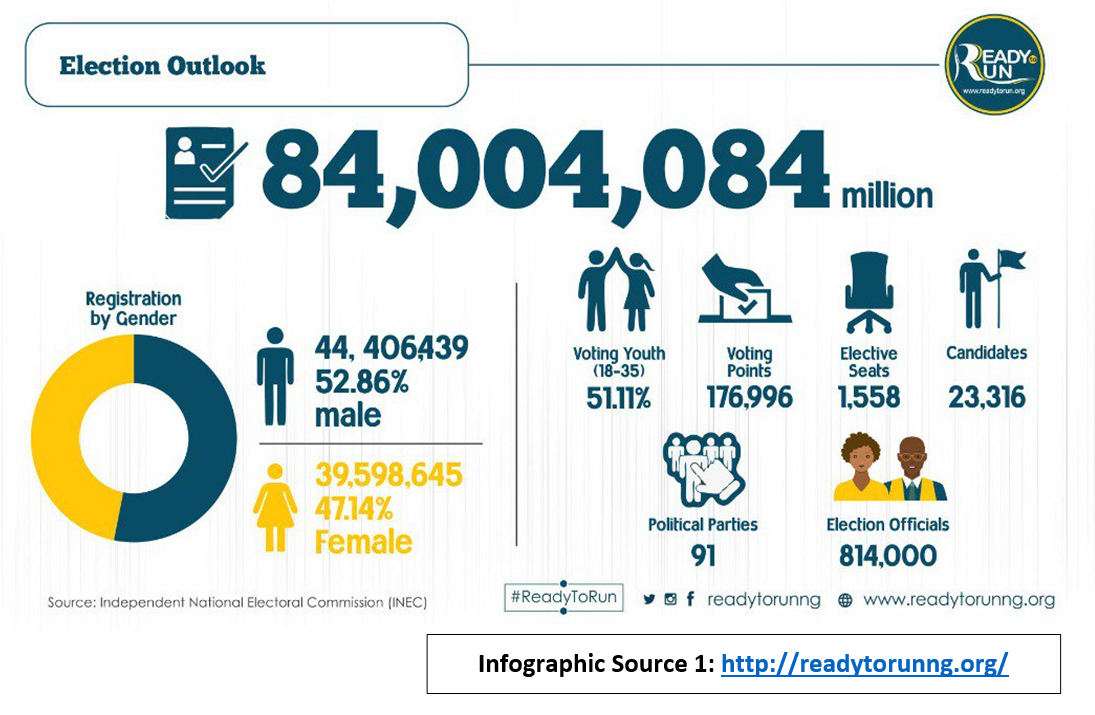
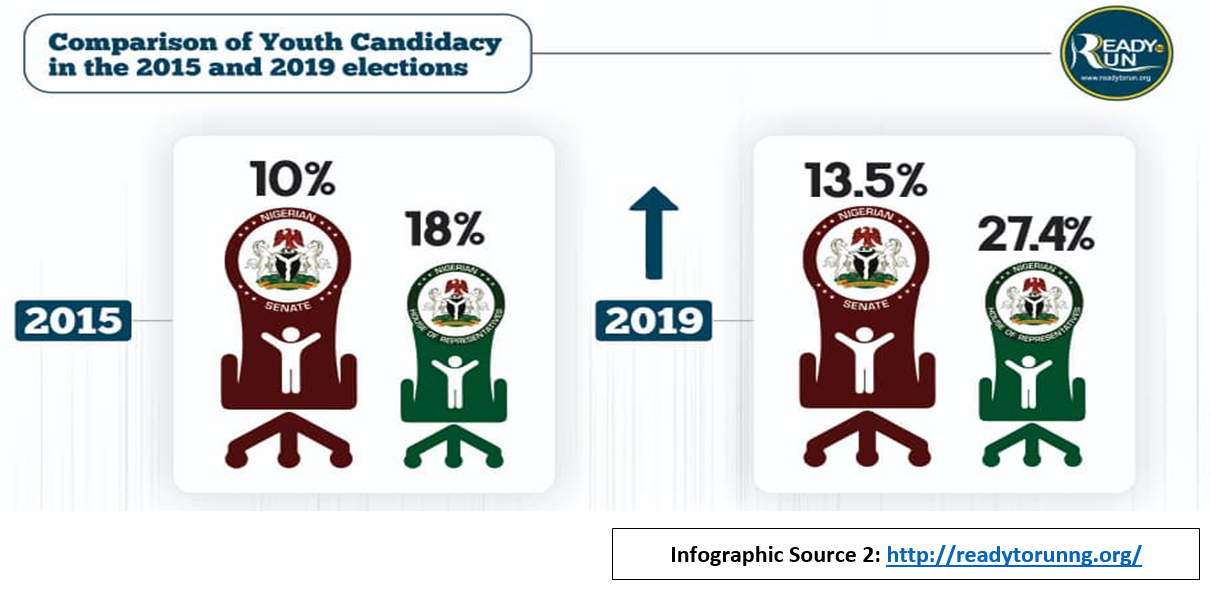
Analysis of the figures released by INEC shows that 51.11% of the voters will be young people between the ages of 15 and 35 (Infographic Source 1). Many of these will be voting for the first time since 1999. Far more significant is the number of young people running for office in the 2019 elections. In comparison to the number of young people who ran for office in 2015, the 2019 election is witnessing an impressive number of young people vying for elective positions (See Table 2). This is attributed, mainly, to the signing into law of the Not Too Young Run Act. The Act, a product of several years of youth mobilization and call for the removal of age impediment, has enabled the meaningful participation of the youth in electoral processes in Nigeria. Explicitly, the Act guarantees that young Nigerians between the ages of 18 to 35, (in line with the African Youth Charter), can vie for all categories of elective offices at all levels (See Table 3). Based on the age qualification addressed by the Not Too Young To Run Act, two young persons; Chike Ukaegbu (35) and Nsehe Nseobong (33) are running for President out of 73 Presidential candidates. Also, youth candidates for the upper and lower legislative houses increased by 3.5% and 9.4% respectively, compared to the 2015 elections. Despite this modest progress, limited internal party democracy, high costs of nomination forms and campaigns continue to hinder youth participation in Nigeria’s electoral processes.
Another potential impact of young people in the coming elections is in the overall voter turnout. In 2015, about 45% of registered voters took part in the polls. With an increase in the number of registered voters by 21%, it is projected that this will have a positive impact on the overall voter turn-out in 2019. Several voter education efforts have been undertaken by INEC, political parties and civil society organisations to encourage electorates to turn out in numbers. Also, there has been significant use of social media by various election stakeholders in the lead up to the election to mobilize citizens to exercise their civic duty. Equally important to note is the thousands of National Youth Service Corps (NYSC) members who will servicing the election as electoral officers.
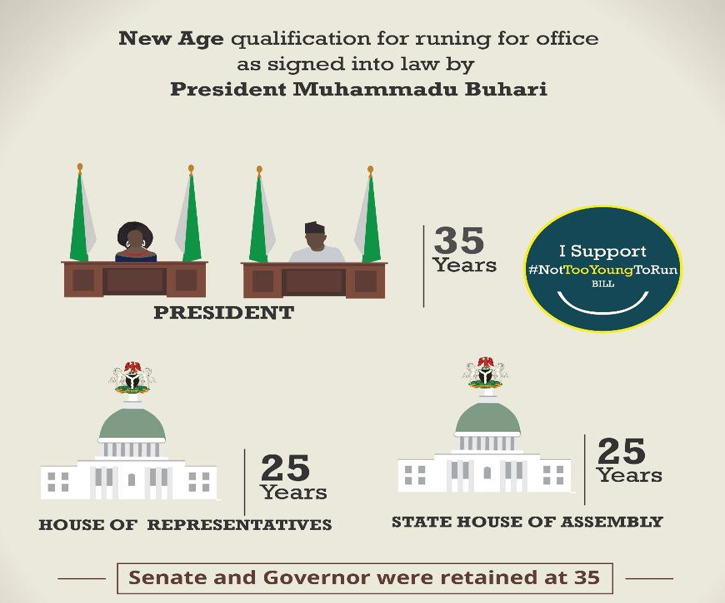
Source: http://readytorunng.org/
There is no doubt this is yet, another important election for Nigeria. This general election provides an opportunity to consolidate on two decades of democratic practice, deepen electoral democracy and foster inclusive participation in Africa's largest democracy. Whoever wins the Presidential election will be faced with the urgent and arduous task of poverty eradication, job creation and improvement of the general wellbeing of the people. This is in addition to addressing the state of insecurity and the plight of internally displaced persons in crisis-affected states of the country. Nigerians have a choice to make, and it is not a straightforward one, particularly between the two leading candidates.