SecureFarmer by Seyi Oyenuga, Nigeria - ADEL 2017

June 18, 2021

The SecureFarmer project helped develop sustainable farming communities by deploying the most applicable mechanical and digital technologies in Nigeria. The project hinged on three main areas to maximize farmer productivity in maize and cassava farming: First, it aggregated farmers for crop cultivation. Then, it provided input supply and services on credit to farmers. Lastly, it made site-specific data accessible to farmers. SecureFarmer had a great impact on Nigerian farmers, specifically those participating in the block-farming program. It was able to provide them with a Secure Farmer digital app which gives them actionable data and farm activity tracking. Among other achievements, the project also created training materials for farmers, aggregated 25 farmers and prepared 50 hectares of land for cassava (a woody plant commonly called manioc) cultivation and provided credit for high quality input and mechanization for cassava farmers. About Seyi: Seyi Oyenuga is an industrial entrepreneur with over 12 years’ experience working in America and Nigeria. He serves as Executive Director and Head of Agriculture Division of ATMANCorp, a vertically integrated agriculture and food processing company based in Nigeria. The company leverages innovative technology and processes to enhance productivity through a mainly youth workforce and smallholder farmer network. Seyi’s efforts have led to the introduction of precision agriculture methods through remote monitoring and drone remote sensing to increase efficiency. Previously, he founded an infrastructure contracting company based in Washington, DC. He actively participates as a mentor with Grooming Leaders For Agriculture (GLA), an agricultural incubator empowering the youth to reach their highest career goals through education, hands-on training, mentoring, leadership and entrepreneurship. Seyi is a graduate of the University of Chicago with a degree in economics.

Speakers

RELATED CONTENT

  • Authors
    Onasis Tharcisse A. Guedegbe
    Mohammed Rachid Doukkali
    March 31, 2017
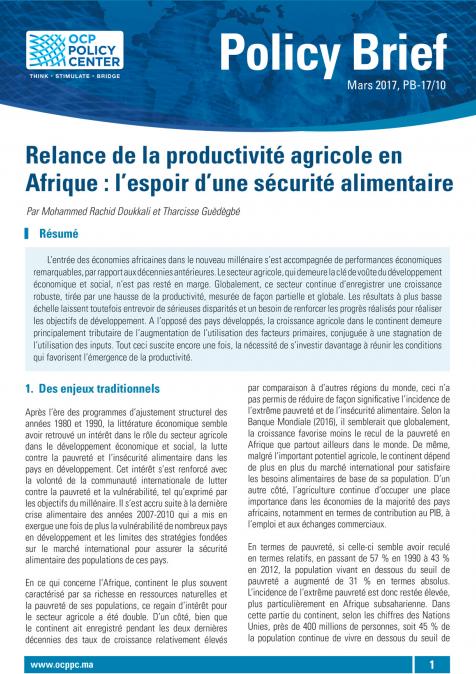
    L’entrée des économies africaines dans le nouveau millénaire s’est accompagnée de performances économiques remarquables, par rapport aux décennies antérieures. Le secteur agricole, qui demeure la clé de voûte du développement économique et social, n’est pas resté en marge. Globalement, ce secteur continue d’enregistrer une croissance robuste, tirée par une hausse de la productivité, mesurée de façon partielle et globale. Les résultats à plus basse échelle laissent toutefois entrevoi ...
  • Authors
    Onasis Tharcisse A. Guedegbe
    December 23, 2016
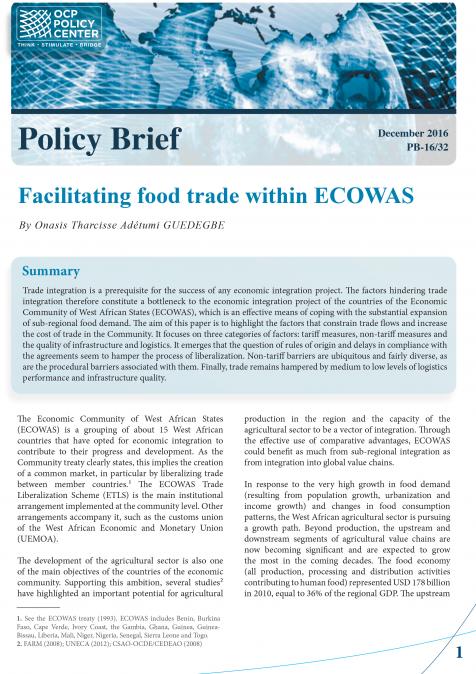
    Trade integration is a prerequisite for the success of any economic integration project. The factors hindering trade integration therefore constitute a bottleneck to the economic integration project of the countries of the Economic Community of West African States (ECOWAS), which is an effective means of coping with the substantial expansion of sub-regional food demand. The aim of this paper is to highlight the factors that constrain trade flows and increase the cost of trade in the ...
  • Authors
    Edité par
    Idriss El Abbassi
    Lahcen Oulhaj
    Aziz Ragbi
    November 28, 2016
    Le présent ouvrage se propose d’apporter quelques éléments d’appui supplémentaires aux policy-makers pour une meilleure identification des défaillances des marchés au Maroc et une mise en place d’une stratégie de diversification et une politique industrielle efficientes, sans toutefois tomber dans la situation inverse où une stratégie mal définie et des outils mal choisis peuvent se traduire par une défaillance des politiques publiques. L’appréhension des difficultés qu’éprouve l’é ...
  • Authors
    Under the Supervision of
    Philippe Chalmin
    July 4, 2016
    Guinea’s bauxite, Moroccan phosphates, Nigerian Bonny Light, Zambian copper, Côte d'Ivoire’s cocoa, Ethiopian coffee or Madagascar’s vanilla: all are examples demonstrating that raw materials have a dimension that is as global as it is local. Global by the markets on which they are traded, local by their quality, a key element of their price, and their macroeconomic impact, particularly for Africa. In line with the 2016 CyclOpe report, which celebrates three decades of existence thi ...
  • Authors
    May 11, 2016
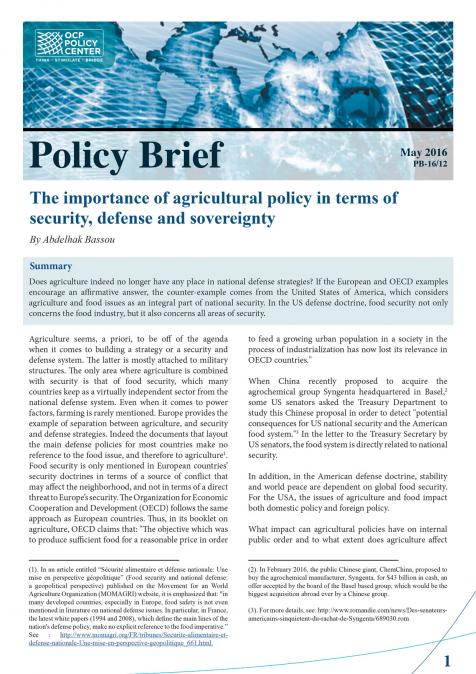
    Does agriculture indeed no longer have any place in national defense strategies? If the European and OECD examples encourage an affirmative answer, the counter-example comes from the United States of America, which considers agriculture and food issues as an integral part of national security. In the US defense doctrine, food security not only concerns the food industry, but it also concerns all areas of security. ...
  • Authors
    Ezana Bocresion
    May 9, 2016
    Ultimately, the question we need to ask ourselves is what sort of investment approach or model best addresses the challenges to the growth of the African Agribusiness Industry. The macro variables around African Agribusiness point to an excellent investment opportunity. The combination of low cost of entry, low production cost, opportunity to increase productivity, and high local prices suggest an attractive return profile. However, the opportunity exists because of basic market f ...
  • Authors
    April 15, 2016
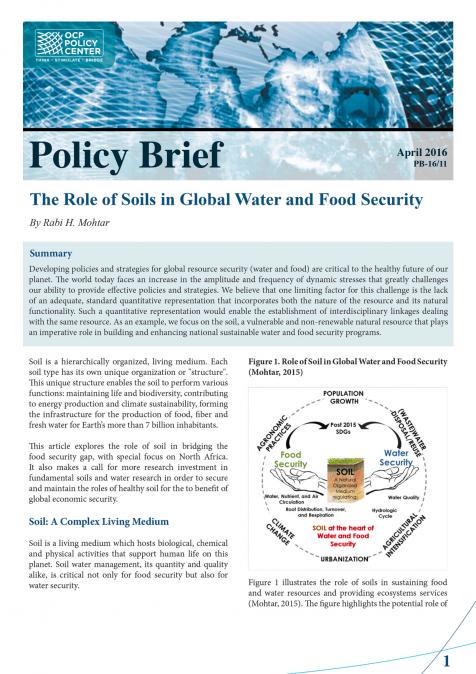
    Developing policies and strategies for global resource security (water and food) are critical to the healthy future of our planet. The world today faces an increase in the amplitude and frequency of dynamic stresses that greatly challenges our ability to provide effective policies and strategies. We believe that one limiting factor for this challenge is the lack of an adequate, standard quantitative representation that incorporates both the nature of the resource and its natural fun ...
  • Authors
    Onasis Tharcisse A. Guedegbe
    February 17, 2016
    The Food and Agriculture Organization (FAO) consecrated the year 2015 as the International Year of Soils (IYS). Therefore, it has been a year intended to raise the consciousness of humanity about the importance of this resource (soil) and the need to preserve it to ensure sustainable and shared prosperity. The various stakeholders in the management and use of this resource, particularly those of the agricultural sector have been called to enhance their consideration of this fragile ...
  • July 21, 2015
    The 16th Annual Global Development Conference has been dedicated this year to the theme of ‘Agriculture for Sustainable Growth: Challenges and Opportunities for a New ‘Green Revolution’.  One of the sub-themes that has been addressed during this event is related to the design of the optimal agricultural policy supposed to lead towards development, especially in low-income countries. The objective of this blog is to cover the key elements that make an agricultural policy su ...