
Launched in November 2023, Morocco’s Atlantic Initiative aims to provide landlocked Sahel countries with strategic access to the Atlantic Ocean through major infrastructure investments in ports, roads, and rail. Anchored in regional integration, the initiative supports economic growth, connectivity, and energy cooperation across the continent. Projects like the Dakhla deep-water port and the $25 billion Nigeria–Morocco gas pipeline form key pillars of this strategy. Amid a complex regional context marked by political realignments and instability, the initiative offers a forward-looking model to strengthen trade corridors, boost competitiveness, and foster long-term prosperity and cooperation.
RELATED CONTENT
-
 December 15, 2018Moderator Lourival Sant’Anna, Foreign Affairs Reporter and Analyst, O Estado de Sao Paulo newspaper and CBN radio, Speaker and Author Speakers Luis Osvaldo Hurtado Larrea, Former President, Republic of Ecuador Federico Ramón Puerta, Former President and current Ambassador to Spain, Repu...
 -
 December 13, 2017Le rapport Atlantic Currents 2017 sort en marge de la 6ème édition des Atlantic Dialogues, conférence de haut niveau organisée annuellement au Maroc par l’OCP Policy Center et ayant comme mission de promouvoir le dialogue transatlantique entre toutes les parties prenantes de cet espace géostratégique (Afrique, Caraïbes, Europe, Amérique latine et États-Unis), un dialogue devenu nécessité vu les changements rapides survenus de tous les côtés de l'Atlantique au cours des dernières ann ...
 -
 December 13, 2017As a significant complement to the Atlantic Dialogues conference, the Atlantic Currents publication allows a deeper and further extension of the analytic contribution provided by the “Dialogues”.The goal being to enlarge the discussion pertaining to economic, political and security dimensions of a wider Atlantic area, favoring a new geopolitical construction of this strategic region. OCP Policy Center is proud of the role it has played in extending the transatlantic debate to embrac ...
 -
 March 13, 2015Le 2 décembre 2014, l’Institut français des relations internationales (Ifri) et l’OCP Policy Center ont organisé un séminaire intitulé « Des émergents au défi du retour de la géopolitique : regards croisés économiques et géopolitiques » à Rabat. Intervenants et experts se sont réunis pour discuter du rapport entre émergence et puissance à travers plusieurs études de cas: Chine, Russie, Turquie et Maroc. Chine : une puissance qui peine à s'assumer Après la crise ...
 -
 February 13, 2014Launched with great fanfare at the G20 summit last June, the Transatlantic Trade and Investment Partnership (TTIP) has alternately been proclaimed the historic joining of the world’s two largest economies and ridiculed as a desperate lifeline being thrown to the same two economies. By most economic measurements, TTIP should be seen as a clear winner on both sides of the Atlantic. And greater economic cooperation could forge stronger political links leading to greater political, dipl ...
 -
 June 24, 2013This policy paper examines the importance of cities as global policy actors, innovators, and collaborators. While a global phenomenon, the authors of this paper identify specifically how the evolution of the importance of cities as global policy actors, innovators, and collaborators unfolds in the cities of the Northern Atlantic Basin versus the cities in the Southern Atlantic Basin. Despite the important differences between the cities of the Atlantic Basin, technology and the impa ...
 -
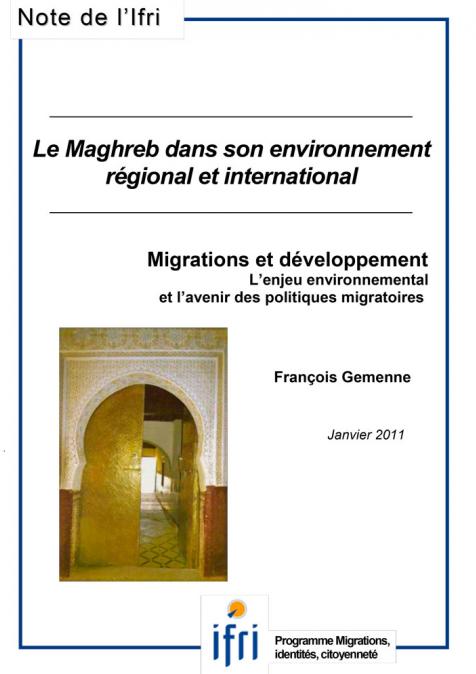 March 1, 2011This paper analyzes the future of migrations related to climate changes and environment degradations. He shows how the dominant public reasoning remains inappropriate for addressing these issues, because of the Western/Northern countries' misconception of the relation between migration and environmental changes, including the cultural and political biases these countries show in the solutions they propose. The discrepancy between public policies and the actual reality of climatic an ...

