L’aéronautique au Maroc : les secrets d’une ascension industrielle (Partie 2)

July 7, 2026

Dans ce second épisode, Hamid Benbrahim El Andaloussi met en lumière le rôle central du capital humain dans le développement de l'industrie aéronautique marocaine. Il revient sur les efforts déployés pour former des compétences hautement qualifiées, renforcer l'adéquation entre formation et besoins industriels, et accompagner la montée en gamme du secteur. L'entretien explore également les perspectives d'avenir de l'aéronautique marocaine, entre innovation, souveraineté industrielle et création de davantage de valeur ajoutée locale.

Speakers
Abdelaaziz Ait Ali
Head - Research in Economics
Abdelaaziz Ait Ali is a principal Economist and head of the Research Department at the Policy Center for the New South. He joined the Center in 2014 after five years of experience at the Central Bank of Morocco. He worked as an economist in the International Studies and Relations Department and was analyzing the real estate price index and financial asset prices for monetary policy and financial stability purposes. Since then, Abdelaaziz has focused on cyclical and structural issues of the Moroccan economy, including macroeconomic management and industrial policy design. He has published articles on the reform of the exchange rate regime in the Moroccan economy and its implications for macroeconomic regulation, as well as on the evolution of the macroeconomic framework over th ...

RELATED CONTENT

  • Authors
    Karim El Mokri
    Idriss El Abbassi
    October 23, 2024
    This paper was originally published on cambridge.org   This paper explores the (de-)routinisation of employment structure in developing countries, through the case of Morocco. We investigate employment (de-)routinisation from an often-overlooked perspective, aiming to elucidate the interplay between the dynamics of occupational employment composition by the level of routine tasks intensity and two structural aspects: premature deindustrialisation and the prevalence of in ...
  • Authors
    Zakaria Elouaourti
    September 13, 2024
    This Paper was originally published on emerald.com   Purpose This paper examines the dynamics of structural transformation in Morocco since 1970 by analyzing input-output tables expressed in terms of employment and output levels across 24 sectors. Design/methodology/approach This study employs a twofold methodological approach. Firstly, it examines the evolution of sectoral employment shares over time using World Bank data. Secondly, it utilizes Input-Output analysis to ex ...
  • Authors
    Ilham Najib
    January 29, 2024
    Morocco is positioned as a new global hub of the automotive industry in an increasingly volatile international context, with various emerging countries competing intensively to gain the best returns on openness and globalization. The Moroccan automotive industry’s recent performance shows it to be the most dynamic sector in the economy: from 2014 to 2019, value-added in the automotive sector increased by almost 70% while the overall national value-added increased by only 15%. In the ...
  • Authors
    Ali Elguellab
    Elhadj Ezzahid
    November 1, 2023
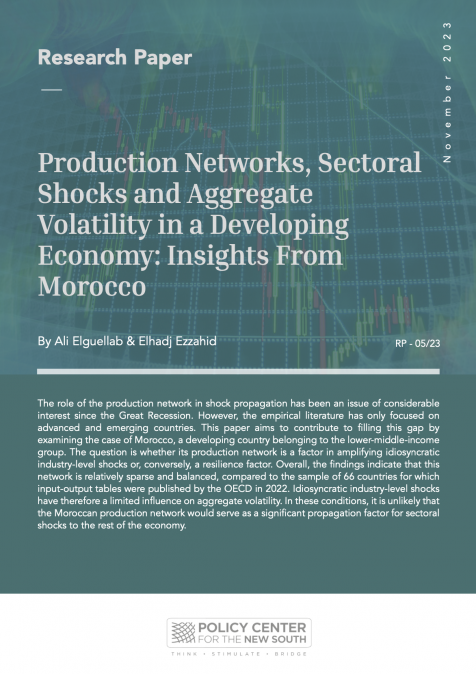
    The role of the production network in shock propagation has been an issue of considerable interest since the Great Recession. However, the empirical literature has only focused on advanced and emerging countries. This paper aims to contribute to filling this gap by examining the case of Morocco, a developing country belonging to the lower-middle-income group. The question is whether its production network is a factor in amplifying idiosyncratic industry-level shocks or, conversely, ...
  • August 28, 2023
    Le secteur informel joue un rôle crucial dans le développement économique et social du Maroc en tant que filet de sécurité pour de nombreux travailleurs. Cependant, sa concentration dans de petites entreprises qui manquent de moyens de production sophistiqués peut entraver la croissance...
  • July 18, 2023
    Le secteur informel est une composante essentielle de l'économie marocaine, employant une large partie de la population, mais nuisant à la productivité, aux recettes fiscales de l’État et à la croissance économique à long terme. Sur la base de la définition adoptée dans cette étude et qui définit les travailleurs informels comme étant ceux qui ne sont pas couverts par les régimes contributifs de sécurité sociale de la Caisse nationale de sécurité sociale (CNSS) et d ...
  • Authors
    Zakaria Elouaourti
    July 1, 2023
    This paper was originally published on erf.org.eg   The digital divide in the financial sector has occurred through the development of financial technologies. These latest “FinTech” refers to technological innovations that have emerged in the financial system in recent years, which are the new channels for providing financial services. These innovations have disrupted traditional financing models by making financial transactions more secure and by reducing spatiotemporal ...
  • Authors
    Gladys Lopez-Acevedo
    Marco Ranzani
    Nistha Sinha
    Adam Elsheikh
    June 23, 2023
    This report was originally published on openknowledge.worldbank.org The long-standing informality debate in the Middle East and North Africa (MENA) Region has taken on a new urgency as it looks for a pathway to more socially inclusive growth that is less reliant on fossil fuels. This is occurring against a backdrop of subpar labor market outcomes, further growth setbacks, and deteriorating fiscal and current account de ficits in the aftermath of the COVID-19 pandemic—and in the wak ...