Institutional Framework Conditions for the Promotion of Private Sector Capacity Development (CD) for Agricultural Innovation in Morocco

March 14, 2023

The Policy Center for the New South in collaboration with the Center for Corporate Responsibility and Sustainability, organize a webinar on the Institutional Framework Conditions for the Promotion of Private Sector Capacity Development (CD) for Agricultural Innovation in Morocco. The webinar toke place March 14th at 14:00 (GMT +1).

Nowadays, the importance of investing in capacity development (CD) for agricultural innovation is indisputable. It addresses the challenge of integrating farmers into formal value chains and enabling domestic farming to become more climate resilient, productive and sustainable. In other words, CD is at the heart of the nexus between food security and climate change, which has been emphasized at the Climate Conference in Sharm-el-Sheik (COP-27) in November 2022. However, it is often not clear how effective capacity development is and what kind of institutional framework conditions are required to make it more responsive to what farmers need.

In order to learn more about these critical questions, CCRS has conducted national stakeholders surveys in four African countries with Morocco representing the region of Northern Africa. This survey with Moroccon stakeholders has been conducted in strong collaboration with PCN and the analysis of the survey results reveal perception patterns that diverge substantially from the stakeholder perception in the three other country surveys. They also reflect the distinct qualities of the Moroccan agricultural economy and the role of the public sector, not just as a provider of public sector CD but also an enabler of private sector CD. 

Speakers
Philipp Aerni
Director, Center for the Corporate Responsibility and Sustainability (CCRS)
Dr. Philipp Aerni is Director of the Center for Corporate Responsibility and Sustainability (CCRS) at the School of Management Fribourg (HES-SO). He received his Masters Degree in Geography (with Minors in Environmental Science and Economics) from the University of Zurich and his PhD in Agricultural Economics from ETH Zürich. Prior to his position at CCRS, Dr. Aerni worked as a postdoctoral fellow at the Harvard Kennedy School, the Institute for Environmental Decisions at ETH Zurich, the World Trade Institute at the University of Berne as well as the Food and Agriculture Organisation of the United Nations (FAO). Philipp Aerni is also a senior lecturer at ETH Zurich and the University of Zurich. Among numerous other engagements, he is a member of the Jury of the Swiss Family Bu ...
Aniss Bouraqqadi
Head of Agronomy, OCP Africa
Aniss Bouraqqadi is an agronomist, he gathered 23 years experiences in agriculture development in Africa; including 5 years in the seeds business and 12 years in various roles in crop protection with Multinational companies before the current position in fertilizers business as head of R&D at OCP Africa, a subsidiary of OCP Group, present in 12 sub-Saharan African countries to contribute to the sustainable transformation of food systems. He worked on different business aspects linked to R&D, Regulatory, Business Development, Sustainability, Marketing, Sales and Key Accounts Management. ...
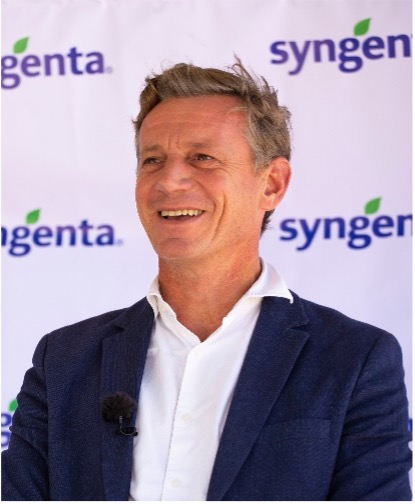
Axel D’Hauthuille
Country Manager, Syngenta Morocco
Graduated in 1999 from the ISTOM engineering school - international agro-development school. He started my career as a cocoa and coffee producer in Côte d’Ivoire, then as a buyer and processor of Vanilla in Madagascar before spending 9 years for the Naturex group in the purchase of aromatic and medicinal plants. After a start in the production and purchase of agricultural raw materials, he has been working since 2014 in the distribution of agricultural inputs (6 years in Côte d’Ivoire, for Arysta and 4 years in Morocco for Syngenta) ...

RELATED CONTENT

  • Authors
    January 12, 2018
    Agricultural investment is a necessary requirement to develop and organize the agricultural sector in Africa. The African agricultural potential offers opportunities to be seized in terms of intensification of production and structuring of the agricultural value chains. Although it is diversified, agricultural investment (public, private and foreign investments), remains weak. The shift towards a modern and intensive mode of agriculture must necessarily go through the development of ...
  • Authors
    Mohammed Rachid Doukkali
    Tharcisse Guèdègbé
    December 22, 2017
    L’agriculture africaine a connu dernièrement une croissance relativement élevée, quoique peu résiliente et tirée principalement par l’extensification. Malgré sa diversité, les niveaux de production restent insuffisants pour autonomiser le continent surtout pour ce qui est des produits alimentaires de base. En misant sur l’intégration, des marges de progrès se présentent aux pays africains pour améliorer l’écosystème de l’agriculture africaine et ses performances. Il s’agit de puiser ...
  • October 10, 2017
    L’objet de ce travail est de proposer la mise en place d’un partenariat de progrès entre la Chine et le Maroc, centré sur la question agroalimentaire en Afrique. C’est dans ce continent que la demande alimentaire va augmenter d’une façon très sensible au cours du XXIème siècle notamment en raison de sa progression démographique et de l’accélération de son urbanisation. L’Afrique est dans l’obligation de réussir sa révolution agricole pour combattre la faim et la pauvreté, accéder à ...
  • Authors
    Onasis Tharcisse A. Guedegbe
    Mohammed Rachid Doukkali
    March 31, 2017
    In comparison to previous decades, remarkable economic performance accompanied the entry of African economies into the new millennium. The agricultural sector, which remains the cornerstone of economic and social development, has not remained on the sidelines. Overall, this sector continues to show robust growth, driven by an increase in productivity, measured in part and overall terms. However, lower-level results point to serious disparities and a need to strengthen progress towar ...
  • Authors
    Onasis Tharcisse A. Guedegbe
    Mohammed Rachid Doukkali
    March 31, 2017
    L’entrée des économies africaines dans le nouveau millénaire s’est accompagnée de performances économiques remarquables, par rapport aux décennies antérieures. Le secteur agricole, qui demeure la clé de voûte du développement économique et social, n’est pas resté en marge. Globalement, ce secteur continue d’enregistrer une croissance robuste, tirée par une hausse de la productivité, mesurée de façon partielle et globale. Les résultats à plus basse échelle laissent toutefois entrevoi ...
  • Authors
    Under the Supervision of
    Philippe Chalmin
    July 4, 2016
    Guinea’s bauxite, Moroccan phosphates, Nigerian Bonny Light, Zambian copper, Côte d'Ivoire’s cocoa, Ethiopian coffee or Madagascar’s vanilla: all are examples demonstrating that raw materials have a dimension that is as global as it is local. Global by the markets on which they are traded, local by their quality, a key element of their price, and their macroeconomic impact, particularly for Africa. In line with the 2016 CyclOpe report, which celebrates three decades of existence thi ...
  • Authors
    Ezana Bocresion
    May 9, 2016
    Ultimately, the question we need to ask ourselves is what sort of investment approach or model best addresses the challenges to the growth of the African Agribusiness Industry. The macro variables around African Agribusiness point to an excellent investment opportunity. The combination of low cost of entry, low production cost, opportunity to increase productivity, and high local prices suggest an attractive return profile. However, the opportunity exists because of basic market f ...
  • July 21, 2015
    The 16th Annual Global Development Conference has been dedicated this year to the theme of ‘Agriculture for Sustainable Growth: Challenges and Opportunities for a New ‘Green Revolution’.  One of the sub-themes that has been addressed during this event is related to the design of the optimal agricultural policy supposed to lead towards development, especially in low-income countries. The objective of this blog is to cover the key elements that make an agricultural policy su ...