حديث الثلاثاء: المنظومة المينائية في المغرب: بوابة نحو قيادة الاقتصاد الأزرق في أفريقيا

May 20, 2026

تتناول هذه الحلقة واقع المنظومة المينائية في المغرب ودورها الاستراتيجي في تعزيز مكانة المملكة كفاعل رئيسي في الاقتصاد الأزرق على مستوى أفريقيا. وتسلط الضوء على تطور البنيات التحتية المينائية، خاصة مع مشاريع كبرى مثل ميناء طنجة المتوسط، التي تساهم في تعزيز الربط التجاري واللوجستي بين أفريقيا وأوروبا والعالم. كما تناقش التحديات المرتبطة بالتحول نحو اقتصاد بحري مستدام، من بينها حماية الموارد البحرية، تطوير الصناعات المرتبطة بالبحر، وتشجيع الابتكار والاستثمار. وتبرز الحلقة كيف أصبحت الموانئ أدوات استراتيجية للتنمية الاقتصادية والاندماج الإقليمي، إلى جانب دورها التقليدي في التجارة والنقل. وفي الختام، يتم التأكيد على أهمية التعاون الأفريقي وتطوير الكفاءات لضمان ريادة المغرب في مجال الاقتصاد الأزرق بالقارة

Speakers

Redouan Najah
Senior International Relations Specialist
Redouan Najah is a Senior International Relations Specialist at the Policy Center for the New South (PCNS).At the PCNS, which he joined in 2019, Redouan Najah conducts research on topics spanning the cyberspace, cyber defense, cybersecurity, Central Africa, and Africa-China relations.Redouan Najah holds a master's degree in Geopolitics and International Relations from University Cadi Ayaad, Marrakech, Morocco, and a bachelor’s degree in Economics and Management, from University Sultan Moulay Slimane, Beni Mellal, Morocco.Redouan is fluent in Arabic and French and has a good knowledge of English. ...

Sanae El Amrani
Directrice des Ports et du Domaine Public Maritime - Présidente de l’Association Marocaine de l’Ingénierie Portuaire et Maritime (AMIPM)
...
RELATED CONTENT

  • Authors
    Numéro spécial du cahier du plan - Volume 2
    December 18, 2019
    Lors du colloque autour du thème « Croissance économique au Maroc : théories, évidences et leçons des expériences récentes », organisé conjointement par le Haut-Commissariat au Plan (HCP) et le Policy Center for the New South et accueilli par le HCP en mai 2017 dans ses locaux à Rabat, des experts et praticiens de près de 30 institutions académiques et non académiques ont échangé et débattu de la croissance économique au Maroc dans un framework transverse alliant le théorique au pra ...
  • November 5, 2019
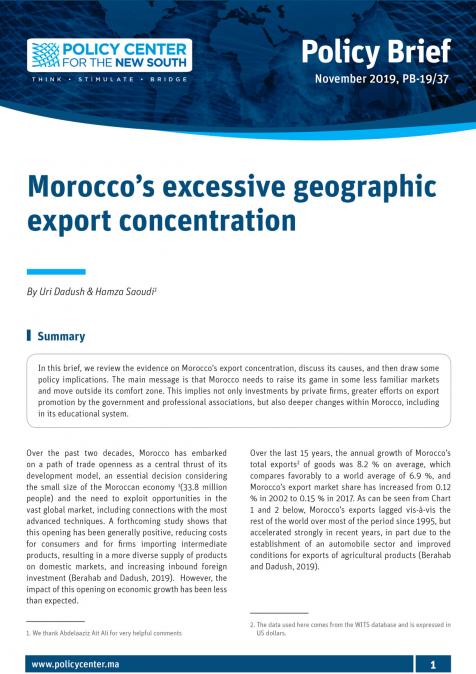
    In this brief, we review the evidence on Morocco’s export concentration, discuss its causes, and then draw some policy implications. The main message is that Morocco needs to raise its game in some less familiar markets and move outside its comfort zone. This implies not only investments by private firms, greater efforts on export promotion by the government and professional associations, but also deeper changes within Morocco, including in its educational system. Over the past two ...
  • Authors
    February 6, 2019
    Ce papier examine la plainte initiée par la Turquie devant l’Organisation mondiale du commerce (OMC) contre le Maroc au sujet des droits antidumping appliqués aux produits d’acier laminés à chaud. La plainte de la Turquie constitue à la fois un précédent et une opportunité. Un précédant d’abord, car jamais le Maroc n’a été impliqué, ni en qualité de partie plaignante ni en qualité de partie défenderesse, dans une affaire devant le GATT ou l’OMC. Une opportunité ensuite, par ce que l ...
  • Authors
    February 6, 2019
    This paper examines Turkey's case against Morocco before the World Trade Organization (WTO), over anti-dumping duties on hot-rolled steel products. Turkey's complaint constitutes both a precedent and an opportunity. First, it is a precedent in that Morocco was previously never involved in a case before GATT or WTO, neither as a plaintiff nor as a defendant. Second, it is an opportunity as the evaluation of the legal process of the complaint enables an assessment of adequacy of Moroc ...
  • Authors
    Vinicius A. Vale
    April 26, 2018
    This paper reports the results of an application using an interregional input-output matrix for Morocco together with regional information on water consumption by sectors. We develop a trade-based index that reveals the relative water use intensities associated with specific interregional and international trade flows. We estimate, for each flow associated with each origin-destination pair, measures of trade in value added and trade in water that are further used to calculate our in ...
  • Authors
    Sandra Polónia Rios
    Pedro da Motta Veiga
    Eduardo Augusto Guimarães
    February 22, 2017
    Despite the sustained growth in the bilateral trade observed at the beginning of the Century, Moroccan – Brazilian economic relations are still going through what could be called the ‘shallow’ phase of relations between two middle-income countries. Trade is concentrated in a few products – those where both countries enjoy long lasting and natural comparative advantages – and face strong difficulties to diversify in terms of products and to upgrade towards more complex models of lin ...
  • Authors
    Vera Songwe
    December 23, 2016
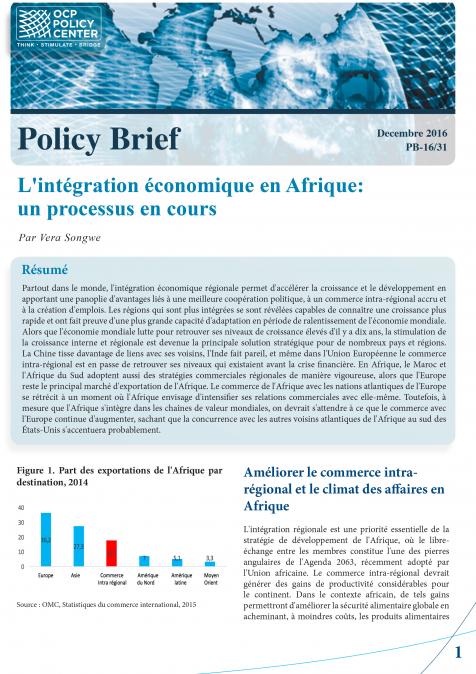
    Partout dans le monde, l'intégration économique régionale permet d'accélérer la croissance et le développement en apportant une panoplie d'avantages liés à une meilleure coopération politique, à un commerce intra-régional accru et à la création d'emplois. Les régions qui sont plus intégrées se sont révélées capables de connaître une croissance plus rapide et ont fait preuve d'une plus grande capacité d'adaptation en période de ralentissement de l'économie mondiale. Alors que l'écono ...
  • Authors
    Edité par
    Idriss El Abbassi
    Lahcen Oulhaj
    Aziz Ragbi
    November 28, 2016
    Le présent ouvrage se propose d’apporter quelques éléments d’appui supplémentaires aux policy-makers pour une meilleure identification des défaillances des marchés au Maroc et une mise en place d’une stratégie de diversification et une politique industrielle efficientes, sans toutefois tomber dans la situation inverse où une stratégie mal définie et des outils mal choisis peuvent se traduire par une défaillance des politiques publiques. L’appréhension des difficultés qu’éprouve l’é ...
  • Authors
    October 27, 2015
    International trade has become a pervasive feature of our lives, yet it remains controversial and resisted across the world. High and rising income inequality, which is often blamed on international trade, especially trade with China, is one reason. But the main driver of inequality is new technology, not international trade. Although trade interacts with new technology in ways that often lead to higher inequality, trade and technology also lie at the root of economic advance. So th ...