The Future of Central Banks in Emerging Markets and Developing Countries

November 22, 2023

As part of the webinar series: “The Global Economy in Transition : Implications for Developing Countries”, the Policy Center for the New South is organizing a webinar titled: " The Future of Central Banks in Emerging Markets and Developing Countries” to contribute to the debate around the evolving roles of central banks and the different challenges they will face in the years to come.

Since the aftermath of the Global Financial Crisis in 2008, there has been a widespread consensus regarding the imperative for central banks to uphold price stability and support the resilience of financial systems. The confluence of COVID-19 pandemic and the persisting Russia-Ukraine conflict has resulted in a surge of inflation not seen for decades.

In response, many central banks have tightened their monetary policies through unprecedented policy rate hikes that could have potential economic long-term effects. Within Emerging Markets and Developing Economies (EMDEs), where inflationary pressures were predominantly rooted in supply-side issues, central banks confront the challenge of rethinking their conventional toolkit.

Furthermore, the growing concerns linked to climate change and inequalities have shaped the policy discussions about expanding the traditional mandates of central banks (price stability and/or maximum sustainable employment) to consider these major ethical issues in the design and implementation of monetary policies.

The rise of cryptocurrencies and other digital assets has underscored the necessity for central banks to adapt their policies while maintaining financial stability and promoting economic growth. The growing interest in Central Bank Digital Currencies (CBDCs) demonstrates central banks proactive and adaptable approach to the changing paradigm that shapes their environment and core missions.

While there is a concern about deepening the digital divide, there is also an opportunity for EMDEs to leapfrog based on new technologies. However, poorly designed CBDCs could pose risks to financial stability, data privacy, legal challenges, financial integrity, cyber risks, and central bank operations.


Speakers
Abdelaaziz Ait Ali
Head - Research in Economics
Abdelaaziz Ait Ali is a principal Economist and head of the Research Department at the Policy Center for the New South. He joined the Center in 2014 after five years of experience at the Central Bank of Morocco. He worked as an economist in the International Studies and Relations Department and was analyzing the real estate price index and financial asset prices for monetary policy and financial stability purposes. Since then, Abdelaaziz has focused on cyclical and structural issues of the Moroccan economy, including macroeconomic management and industrial policy design. He has published articles on the reform of the exchange rate regime in the Moroccan economy and its implications for macroeconomic regulation, as well as on the evolution of the macroeconomic framework over th ...
Otaviano Canuto
Senior Fellow
Senior Fellow at the Policy Center for the New South, Affiliate Professor at Mohammed VI Polytechnic University and Non-Resident Senior Fellow at Brookings Institute. Former Vice President and Executive Director at the World Bank, Executive Director at the International Monetary Fund (IMF) and Vice President at the Inter-American Development Bank. ...

RELATED CONTENT

  • June 21, 2017
    Ce podcast est présenté par Moubarack Lo. Il y analyse l’apport de l’adhésion marocaine à la CEDEAO suite à l’accord de principe donné par ses membres au 51e sommet de Monrovia le 4 juin ...
  • Authors
    Russel Dinh
    January 27, 2016
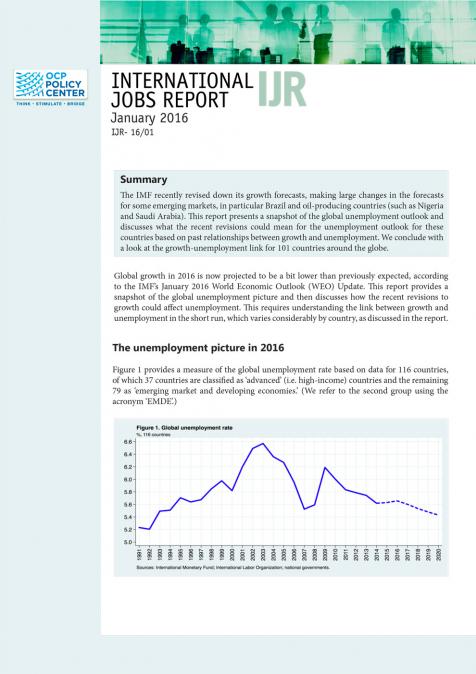
    The IMF recently revised down its growth forecasts, making large changes in the forecasts for some emerging markets, in particular Brazil and oil-producing countries (such as Nigeria and Saudi Arabia). This report presents a snapshot of the global unemployment outlook and discusses what the recent revisions could mean for the unemployment outlook for these countries based on past relationships between growth and unemployment. We conclude with a look at the growth-unemployment link f ...
  • May 2, 2014
    The financial and economic crisis that unfolded across the globe after the 2008 sub-prime meltdown was not just another cyclical bump in the conquering advance of modern capitalism. It was — and still is — a symptom of the exhausted 20th-century way of envisioning the best path to economic growth, consumer satisfaction, and efficient production of goods. Environmental limits to our race to prosperity are just part of the story. The other, and crucial, part is the ongoing technologic ...
  • From

    06
    11:00 am October 2026
    Dans un environnement international reconfiguré, les économies à revenu intermédiaire poursuivent leur processus de convergence dans des conditions plus exigeantes. La fragmentation géopolitique et la réorganisation des chaînes de valeur mondiales modifient les logiques d'insertion productive, tandis que les tensions sur le système monétaire international pèsent sur le financement des économies en développement. L'accélération des transitions technologique et énergétique redistribue par ailleurs les avantages comparatifs et exige des capacités d'adaptation que tous les pays ne peuvent mobiliser au même degré. Les moteurs classiques du rattrapage se trouvent fragilisés, et le risque d'enlisement dans le piège du revenu intermédiaire se pose de manière plus pressante.C'est dans ...