
RELATED CONTENT
-
 July 21, 2016The pace of global growth has tapered off since the crisis and the ensuing rebound. The concept of ‘secular stagnation’ was first used in 1938 by Alvin Hanson in reference to the American economy during the Great Depression. It refers to a situation where growth is slow over a protracted period, underemployment prevails and inflation is low. In such situations, the propensity to save tends to increase as a result of uncertainty and pessimism, and liquidity – which depends on interba ...
 -
 July 4, 2016Guinea’s bauxite, Moroccan phosphates, Nigerian Bonny Light, Zambian copper, Côte d'Ivoire’s cocoa, Ethiopian coffee or Madagascar’s vanilla: all are examples demonstrating that raw materials have a dimension that is as global as it is local. Global by the markets on which they are traded, local by their quality, a key element of their price, and their macroeconomic impact, particularly for Africa. In line with the 2016 CyclOpe report, which celebrates three decades of existence thi ...
 -

-
-
-
-
 June 01, 2016This podcast is performed by Jeffrey Alexander Frankel. He is professor of Capital Formation and Growth at Harvard University's Kennedy School; ...
 -
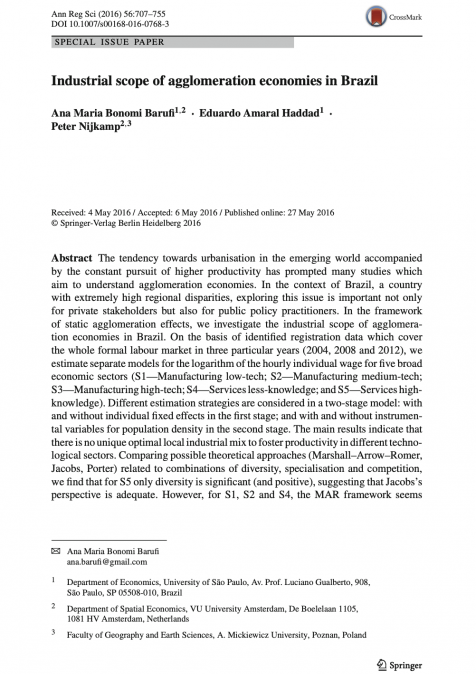 May 27, 2016The tendency towards urbanisation in the emerging world accompanied by the constant pursuit of higher productivity has prompted many studies which aim to understand agglomeration economies. In the context of Brazil, a country with extremely high regional disparities, exploring this issue is important not only for private stakeholders but also for public policy practitioners. In the framework of static agglomeration effects, we investigate the industrial scope of agglomeration econom ...
 -
-
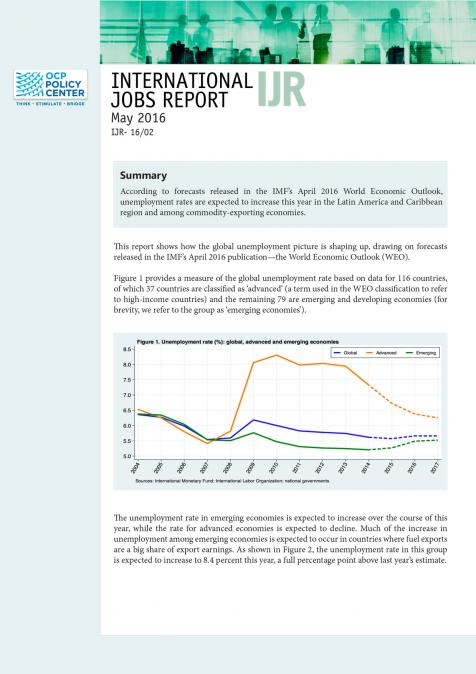 May 11, 2016According to forecasts released in the IMF’s April 2016 World Economic Outlook, unemployment rates are expected to increase this year in the Latin America and Caribbean region and among commodity-exporting economies. ...

