Publications /
Policy Paper

Back
Youth Unemployment in the Middle East & North Africa, and the Moroccan case
Authors
December 6, 2018

This Policy Paper aims to provide a better understanding of the drivers of youth unemployment in the Middle East and North Africa (MENA) region by examining some common factors and then delving deeper into the case of Morocco, a relatively stable country that has historically been a source of large emigration, especially towards Europe.

The MENA region has some of the highest total and youth unemployment rates in the world. High youth unemployment is especially worrisome because it can have lasting effects on lifetime employability and can be the cause of political instability. Migration pressures can increase as it tends to be the young that emigrate.

The analysis in this paper argues that even though the rate of growth of the region’s young population is likely to moderate over the next few years, it is expected to experience another bulge in the 2020’s, and high unemployment is likely to remain a persistent feature in the foreseeable future in several MENA countries. 
 

RELATED CONTENT

  • July 5, 2017
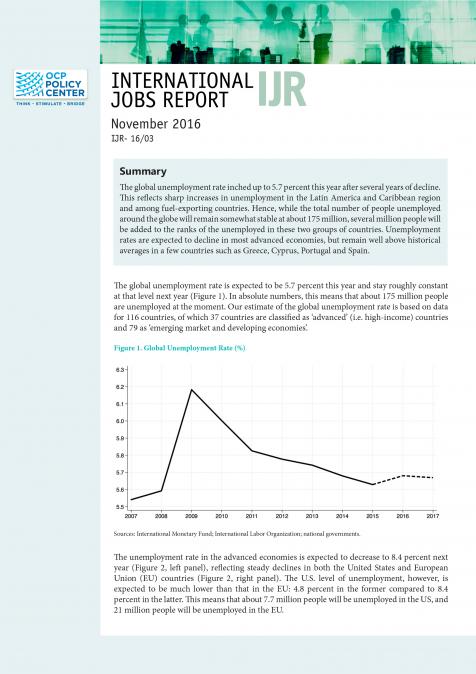
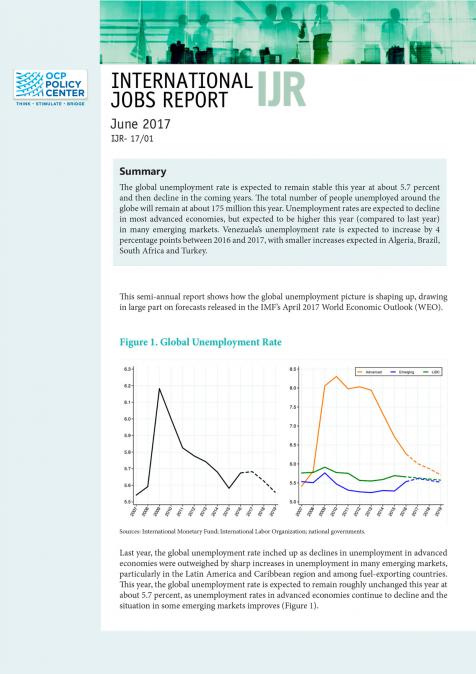
    The global unemployment rate is expected to remain stable this year at about 5.7 percent and then decline in the coming years. The total number of people unemployed around the globe will remain at about 175 million this year. Unemployment rates are expected to decline in most advanced economies, but expected to be higher this year (compared to last year) in many emerging markets. Venezuela’s unemployment rate is expected to increase by 4 percentage points between 2016 and 2017, with ...
  • Authors
    Prakash Loungani
    November 9, 2016
    The global unemployment rate inched up to 5.7 percent this year after several years of decline. This reflects sharp increases in unemployment in the Latin America and Caribbean region and among fuel-exporting countries. Hence, while the total number of people unemployed around the globe will remain somewhat stable at about 175 million, several million people will be added to the ranks of the unemployed in these two groups of countries. Unemployment rates are expected to decline in m ...
  • Authors
    Nuria Boot
    Karim El Mokri
    Simone Tagliapietra
    Karen E. Wilson
    Guntram B. Wolff
    Georg Zachmann
    August 22, 2016
    This joint Bruegel-OCP Policy Center publication comprised of four policy contributions from researchers of both institutions is the result of the establishment of “Platform for Advanced & Emerging Economies Policy Dialogue.” The first edition of this continuous dialogue took place in Rabat on April 1st 2016 under the theme of “Seven Years after the Crisis: Intersecting Perspectives.” In the first paper, “Youth Unemployment in the Mediterranean Region and its Long term Implicat ...
  • Authors
    Russel Dinh
    January 27, 2016
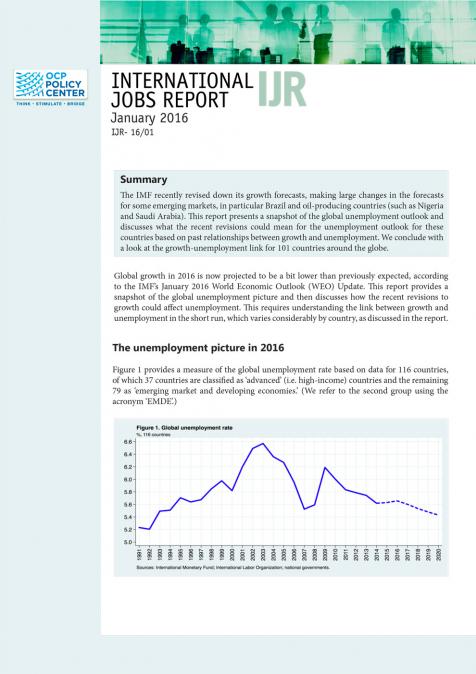
    The IMF recently revised down its growth forecasts, making large changes in the forecasts for some emerging markets, in particular Brazil and oil-producing countries (such as Nigeria and Saudi Arabia). This report presents a snapshot of the global unemployment outlook and discusses what the recent revisions could mean for the unemployment outlook for these countries based on past relationships between growth and unemployment. We conclude with a look at the growth-unemployment link f ...