Publications /
Policy Brief
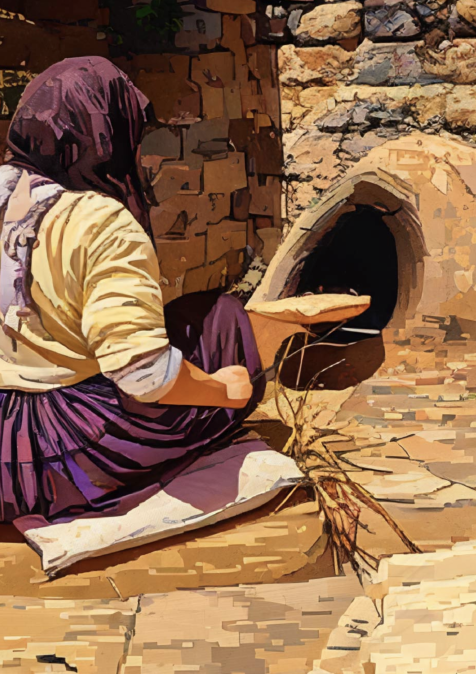
On average, Moroccan women spend almost five hours a day on domestic tasks (cooking, housework, shopping, childcare, etc.). They account for over 90% of the total time spent on domestic tasks by all men and women. This unpaid work represents indispensable services that contribute to the material well-being of individuals and households, without appearing in national production as measured by gross domestic product (GDP). Hence the need to measure this domestic production in order to assess the fair value of women's essential contribution to the national economy, and to consider its impact on household living standards.
Data extracted from censuses and time-budget surveys would make this work statistically visible. Data from the two time-budget surveys carried out by the HCP in 1999 and 2012 accurately describe the use of time by the population living in Morocco; if carried out regularly, they would make it possible to estimate changes in the time devoted to these tasks and the sharing of responsibilities within households. To assess the value of domestic work, we need to be able to put a price on these hours. This price can only be fictitious, since these hours are not based on a market transaction. Various solutions are available. Estimates of the value of home production vary greatly depending on the method used. Whatever the valuation method, the value of unpaid domestic work, particularly that of women, is significant in relation to GDP.
Counting invisible, unpaid work as part of GDP means recognizing and valuing the people who do it, because their role is beneficial and indispensable to society as a whole. Above all, it's a gesture of fairness towards women, who predominantly take on this work. This perspective would facilitate the implementation of gender-sensitive public policies and help define social, economic, and fiscal measures likely to improve the status of women, the main contributors to invisible work.
INTRODUCTION
Traditionally, many of the services and goods produced by women are ignored or undervalued in the system of national accounts. They are said to be "invisible". Four types of activity in particular are poorly represented: domestic work, volunteer work, subsistence production and the informal sector. Both men and women are involved in these sectors, but the first, predominantly female, raises the most difficult accounting problems.
Women's essential contribution to the national economy is overlooked. In employment statistics and national accounts, women's place is underestimated. This underestimation is exacerbated by the growth of unpaid "invisible work", essential work performed by thousands of women in the domestic, agricultural, and informal sectors. The restrictive nature of the definition of economic activity as reflected in national statistics is closely linked to the little economic recognition accorded to women.
For a long time, this issue was perceived as being "naturally" resolved by the complementarity of male and female tasks within the household, but the unequal distribution of the burden of domestic work is one of the main vectors of women's subordination. Generally, most reproductive, non-income-generating activities are considered feminine. Men have priority access to income-generating activities by virtue of their status as the household's main breadwinner, or as the owner of the household's productive assets. Women are often considered to be the household's secondary provider, unlike men, who are expected to support the family from their wages.
This "invisible" part of women's working hours represents a major constraint on their mobility, and therefore on their ability to access income-generating activities. The division of labor within the household and the constraints arising from the female role play a decisive role in the formation and perpetuation of gender inequalities, reinforcing the constraints on women's access to resources and socio-economic opportunities.
THE NATIONAL ACCOUNTING SYSTEM CONCEALS DOMESTIC WORK
Domestic work is the setting for much of most people's private lives. It also contributes to the reproduction of the workforce. Women have traditionally carried out most domestic work, although some married women are now in the labour force rather than full-time homemakers. This work has two aspects and is not confined to the family home. The private aspect covers the production of goods and services for oneself or other people able to care for themselves: maintaining the home, preparing meals and shopping. The social aspect covers raising children, caring for their health and daily needs, and following their schoolwork; it also covers caring for adults who are temporarily or permanently unable to care for themselves, including the provision of personal hygiene and medical care required by their condition.
The added value generated by these service activities, largely performed by women in the domestic household, is not considered in conventional macro-economic aggregates. According to the national accounts, household production appears to have no value, whereas domestic work both increases the value of goods and services purchased and contributes to the formation and maintenance of human capital. Its value is clearly not negligible. This non-market production covers the goods and services that household members produce for their own consumption by combining their unpaid work with the goods and services they acquire on the market.
The exclusion of women's activities at home from recorded national production poses problems for economic analysis and accounting. This exclusion is not self-evident even under the national accounts definition of production: women produce goods and services through domestic activities using inputs bought on the market; only their labour is not market-based. It also treats identical goods and services inconsistently, including them in measured production when they are sold but excluding them when they are not. It makes women working at home appear statistically unproductive (and excludes them from the labour force), although time-use surveys show that women spend roughly as much time on domestic tasks as others spend on paid work outside the home.
This exclusion also runs the risk of skewing production trends when the boundary between the market economy and the domestic economy changes in an economy. Such a change is entirely characteristic of a process of economic development. Lastly, it precludes any analysis of the domestic services economy, or more generally, the free services economy, in the national accounts.
Revisions to the System of National Accounts allow adjustments to adapt to changes in the production system. They clarify the treatment of certain operations, one of which concerns the extension of the production frontier to household goods. Unpaid productive work mobilizes a significant amount of time spent awake, particularly for women, yet it is not one of the standard measures of activity in our society. Despite advances in statistical integration, the estimation of household production remains the subject of considerable debate as to the choice of method (1). The inclusion of productive household activities performed mainly by women in future revisions of the System of National Accounts would undoubtedly have a major impact on the measurement of women's contribution to national development.
Taking account of household production requires us to extend the usual limits of the national accounts production scope. The sheer volume of unpaid work and its relationship with paid work argues strongly in favor of more comprehensive standard measures for many applications and analyses. A complete household satellite account should include a comprehensive and integrated presentation of economic activities of households that contribute to individual well-being, such as production, income redistribution, and wealth accumulation. This is why it is recommended that the national statistical institution develop a satellite account for household production.
TIME-USE SURVEYS: A TOOL FOR MAKING WOMEN'S DOMESTIC WORK VISIBLE
Conventional economic statistics, such as national accounts and employment measures, are designed to measure the market economy, and exclude most of the non-market productive activities of households. Clearly, the goods and services derived from these activities are a source of utility for members of the same household and other households, and contribute to their well-being. The volume of household production is significant.
Data on the time devoted by households on unpaid work comes from household surveys. Time-use surveys gather information on how individuals divide their time between the various activities they engage in on a daily basis, and which have a major impact on their financial security, health, well-being and general happiness. The results of these surveys can help provide answers to a wide range of economic and sociological questions. The growing interest shown in time-use data by economists, sociologists, the business community, policy-makers, women's rights advocates and statisticians has led more and more countries to carry out at least one time-use survey, and created the need to take this notion into account in the regular production of statistics.
Developed countries became increasingly interested in collecting time-use data in the 1960s and 1970s, mainly because they recognized the importance of such data for measuring women's "invisible" unpaid work and assessing its contribution to the national economy and well-being. In Morocco, two time-use surveys were carried out in 1999 and 2012 through the Haut- Commissariat au Plan (HCP).
Another general observation, corroborated by all the studies undertaken, is that women bear a heavier workload, both in terms of unpaid work and total working hours. Not only do these time-use surveys measure production within households, but they also provide other valuable information - changes in the organization of working hours, factors influencing activity, and the modalities and responsibilities of domestic work. — all information that provides an idea of women's real economic contribution.
Time-use surveys can therefore be an important source of data on productive work, since they cover the invisible part of the economy that governments need to take into account when making their decisions.(2)
By combining time-use data with demographic data, it is possible to compare the time-use patterns of men and women, and also of different social groups. In this way, analysts can compare the time devoted on various paid and unpaid activities by men and women, young and old, people with and without children, urban and rural populations, and so on.
A better understanding of how men and women spend their time sheds light on how space and time are structured by gender in our society. It highlights the asymmetrical distribution of working time by gender. While men and women should share domestic work, this change has yet to be reflected in behavior; women do the greater share of housework, whether they live in urban or rural areas, whether there are young children in the household, and regardless of social class, education and other socio-economic factors. In 2012, 90% of unpaid domestic work in Morocco was performed by women.
In Morocco, four out of five working women are non-salaried, and around two-thirds of women of working age, i.e. those aged 15 and over, are considered to be "housewives". This observation skews the measurement of female activity by not focusing on domestic fields. The survey on the observation of women's use of time carried out in 1997-98 (l'Enquête Nationale sur le Budget Temps des Femmes: ENBTF) aimed to quantify women's contribution to economic, domestic and household activities, analyze the allocation of available time between various occupations and deduce the conditions under which women's participation in income-generating activities can be developed. The 2012 survey compared the allocation of time between men and women.
By providing a better understanding of how men and women use their time, the 2012 survey has shed light on the gendered structuring of space and time in society. It highlighted the asymmetrical distribution of working hours by gender. This comparison shows that the time-use budget method revealed an increase in the female activity rate: the revaluation of the estimate is 10% on average, breaking down into 3% in urban areas and 14.2% in rural areas.
The survey revealed a fundamental asymmetry in the distribution of economic and social activities by gender. Women undertake most activities that are poorly paid or unpaid and receive little social recognition, including social reproduction and the small-scale production of goods and services within the family. These basic activities reflect their central role in managing everyday life. Together, these roles represent a considerable contribution to social life but often restrict women's freedom and independence.
The breakdown of women's main functional activities revealed by the HCP survey shows that: i) physiological time (sleep, meals, grooming, etc.) takes up almost half of a woman's day; ii) professional activities are predominantly male. Men devote 4 times more time to them than women (5h25mn vs. 1h21mn). The discrepancy between the male and female averages reflects women's limited access to the job market and the preponderance of the professional status of "family helper" in the activities they carry out when they are employed; iii) women devote 7 times more time than men to domestic activities.
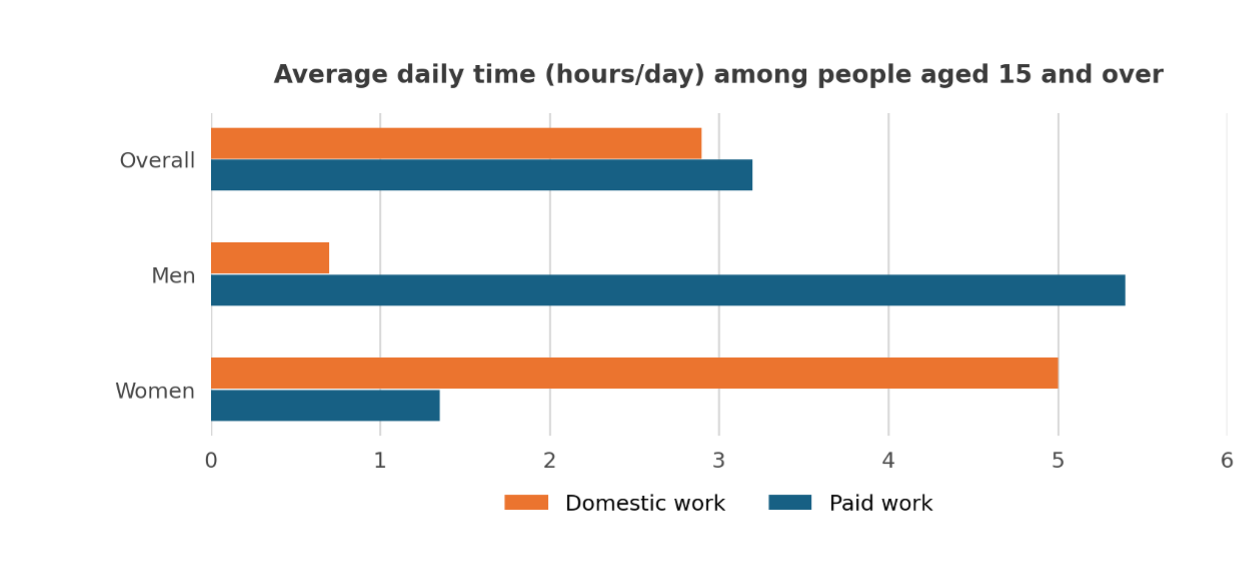
95% of women are involved in domestic activities, devoting an average of 5h00 a day to them. Strictly domestic tasks (cooking, laundry, cleaning, tidying up, etc.) take up 4h33mn of a woman's day. Related activities outside the home (shopping, paying bills, administrative procedures, etc.) take up 27 minutes, and are carried out in particular by female heads of household. On their side, 45 % of men devote an average of 43 minutes a day to domestic work, particularly men who are divorced (43%) or widowed (23%). In short, men devote 4 times more time to professional work and 7 times less time to domestic work than women.
Over the period 1997-2012, Moroccan women's time use has changed significantly. According to HCP data, employed women work 2h44mn more and devote 1h01mn less to domestic tasks. In rural areas, they work 28 minutes more and spend 19 minutes less on domestic chores. In this context, the working time of salaried women rose from 3h38mn to 5h39mn, and that of "family helpers" from 3h12mn to 3h43mn.
Table: Distribution of time spent on domestic work by sex (2012)
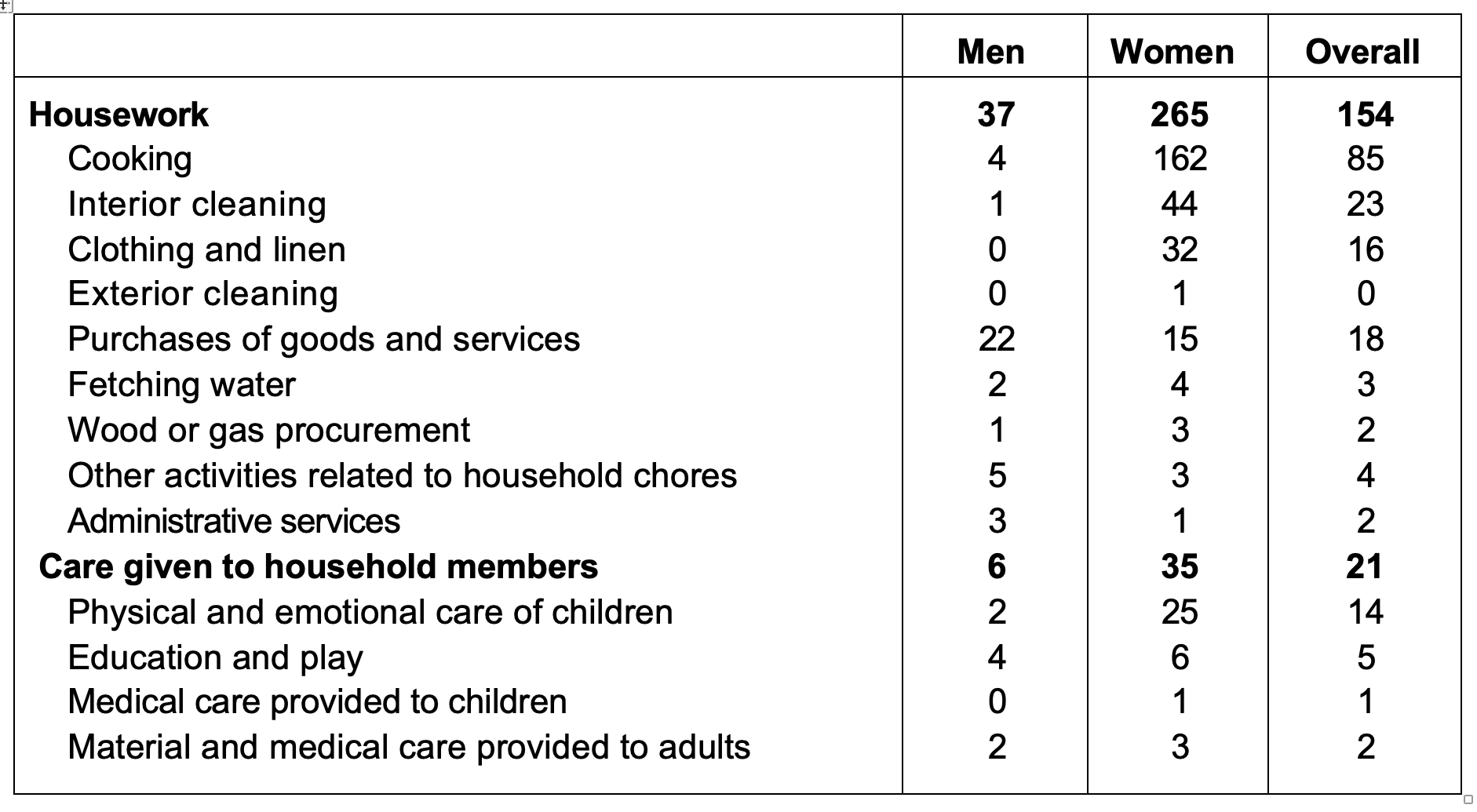
Source: HCP
ASSIGNING VALUE TO WOMEN'S INVISIBLE TIME
Three broad categories of methods have been developed to impute a monetary value to domestic work, based on different substitution patterns between unpaid domestic work and market work. The first two, i) and ii) below, use as market substitutes people paid to perform tasks similar to those constituting domestic work. The third, iii), substitutes household members' unpaid work with that which they are qualified to do on the labour market.
a domestic worker is chosen as a substitute to carry out all the domestic work that the members of the household do themselves. We'll call this the "global substitute" method. The total time devoted on domestic work is then valued at the market wage rate for a domestic worker;
a set of specialized workers is chosen as substitutes to carry out tasks in the home that correspond to their qualifications on the job market (cooks, nursery nurses, gardeners, etc.). This is known as the "Specialized Substitute" method. Their respective market wage rates are used to estimate the value of time devoted on each type of domestic activity corresponding to their specialization;
the substitute for domestic work is the type of market work for which the person performing domestic tasks has been educated and trained. This is the "potential gain" or "opportunity cost of time" method. The domestic work an individual does is then valued at his or her own wage rate on the labor market.
If the aim is to obtain a measure of the shortfall in spending, i.e. the sums that households would have to spend to employ someone to carry out domestic work for them, then all the costs that market wage labor entails must be included, and wage rates must be increased to take account of them.(3) If, on the other hand, the aim is to measure the loss of earnings, i.e. the income households would have received if they had performed paid work on the market instead of unpaid work at home, then the sums that would be taken from monetary income should be deducted. (4)
In its assessment of the overall value of domestic work and women's invisible work, the HCP based itself on the average time spent by Moroccans on productive, unpaid domestic tasks that can be delegated to someone else. The average Moroccan spends 2 hours and 40 minutes a day, or almost 41 days a year. Women spend 4 hours and 46 minutes a day, compared with 27 minutes for men, or almost 73 days a year for women, compared with almost 7 days for men. In 2012, 23.347 billion hours of domestic work were performed in Morocco. Almost all domestic work is done by women (92%).
An initial estimate by the HCP consisted of imputing to them the minimum remuneration that a person employed in this task and paid the SMIG (12.24 DH/h in 2012) would have received. In this estimate, the value of domestic work reached 285 billion Dirhams in 2012, or 34.5% of Morocco's GDP in 2012. A second estimate involved valuing domestic work using the average hourly wage rate of around 22 DH/h, derived from the national accounts for all economic activities. In this case, the value of domestic work comes to 513 billion dirhams, or 62% of GDP.
These two estimates, important as they are, could be compared with other estimates using more elaborate methods (specialized work, opportunity cost...) In practice, however, the choice is often limited by the data available. Each method has its drawbacks. Valuing women's domestic working time at labor market wage rates implies that the productivity of women's labor within the household is the same as that observed on the market: there is no empirical data to verify (or disprove) this hypothesis. It is unlikely that all female domestic tasks can be performed by an unskilled domestic worker, as the global substitute method assumes: some activities undoubtedly require specific skills and are not performed to the same degree in all households (health or education care, for example). In practice, it is unlikely that households would employ the variety of staff that the specialized substitute method assumes in principle.
Estimates are also affected by the determination of the age range of the population considered to be performing domestic work. For a given activity, we also have a fairly wide choice of substitutes: wage rates are often different in the private and public sectors, the range of salaries can be quite wide, and pay rates can differ according to age, gender, experience and qualifications. The list of activities taken into account can be more or less extensive. On these various points, no consensus has emerged as to the most appropriate solution.
CONCLUSION
Over the past seven decades, national accounts statistics have been used extensively to regulate and guide economic development, shape economic and social policies, and evaluate the results of these policies. If domestic production and the invisible work of the women who bear it had been included in the system of macro-economic accounts, either as an integral part of the SNA, or as a separate but comparable element, public authorities would have had a different picture of economic development, and might have implemented quite different economic and social policies.
Overall, the distribution of economic and social activities by gender reveals a fundamental asymmetry. Women undertake most unpaid or poorly paid activities that receive little social recognition, including social reproduction and the small-scale production of goods and services within the household. Recognition of women's invisible, unpaid work is above all a matter of social justice. Recognizing this social and economic contribution gives greater value to the people who make it and has a major impact on women, their families and society more broadly.
Recognition of the value of invisible work would enhance the status of the people who do it. What's more, the data extracted from censuses and general social surveys would make it possible to implement policies aimed at them, thus facilitating their task. These social, economic and fiscal measures would contribute to improving the status of women, who are primarily responsible for invisible work, and their social and financial autonomy. In addition, this assessment of invisible work and its inclusion in GDP would make women's contribution to society visible. According to the International Labour Office (ILO), "if the invisible unpaid work performed by women... were included in labour statistics, ... the participation rate of women would be equal to, or even higher than, that of men".
Thus, accounting for invisible unpaid work means: demonstrating fairness towards the women who do most of this work; recognizing and valuing the people who do it, because their role is beneficial and indispensable to society as a whole; making unpaid work visible by including it in GDP; reducing poverty among women by ensuring the financial security of those who do invisible full-time work.
In addition, to recognize the contribution of women's invisible work to society, we call for it to be measured, evaluated and included in national accounts, as Morocco has pledged to do in the context of the International Conferences on Women. This involves measuring unpaid work using data obtained from censuses and general social surveys on time use; valuing unpaid work in order to know and recognize the value of this contribution each year on an equal footing with that of the market economy; accounting for the unpaid work in the Gross Domestic Product (GDP) to make this essential contribution, mainly by women, visible to the country.
The time-use budget survey, especially if carried out at regular intervals, can provide a statistical basis for monitoring changes in qualitative behavior and the structure of time use. Drawing up a satellite account is also a way of providing a more complete picture of domestic production and including unpaid work in GDP.
Bibliography
Barrière-Maurisson, M.A. (2001), Partage des temps et des tâches dans les ménages, Cahier Travail et Emploi, Ministère de l’Emploi et de la solidarité, La Documentation française, 2001.
Baumgartner, A.D. (2005), Travail familial, modèle d’activité rémunérée et répartition du travail domestique, Démos, Bulletin d’information démographique, 4/2005, Neuchâtel, 2006.
Chadeau, Ann (1992), Que vaut la production non marchande des ménages ?, Revue économique de l’OCDE, no 18, printemps 1992.
Dumontier, F., D. Guillemot & D. Méda, L’évolution des temps sociaux au travers des enquêtes Emploi du temps, Économie et statistique, nos 352–353, 2002.
Hamdad, M. (2003), La valeur travail non rémunérée des ménages, Tendances et sources des changements, Conférence économique de Statistique Canada, mai 2003.
HCP (2014), Le budget-temps ou l’Enquête Nationale sur l’Emploi du Temps au Maroc 2011–2012. Présentation des premiers résultats par A. Lahlimi Alami, 28 octobre 2014.
HCP (2014), Enquête nationale sur l’emploi des temps des Marocains 2012, Tableaux statistiques.
HCP (2014), Enquête nationale sur l’emploi des temps des Marocains 2012, Note méthodologique.
HCP (2020), La femme marocaine en chiffres, Évolution des caractéristiques démographiques et socioprofessionnelles.
Jaïdi, L. (2012), Code de la famille, l’égalité genre et partage du patrimoine, Rapport sur le partage des biens, Association marocaine de lutte contre la violence à l’égard des femmes, Casablanca.
Ministère de la Prévision Économique et du Plan, Les Emplois du temps de la femme au Maroc. Enquête Nationale sur le Budget Temps des Femmes 1997/98. Rapport de synthèse, vol. 2, Direction de la statistique.
Ministère de la Prévision Économique et du Plan, Le nouveau système de comptabilité nationale au Maroc, Direction de la statistique.
Nations Unies, Conseil économique et social, Statistiques sociales : intégration du genre dans les statistiques. Intégration du travail non rémunéré dans les politiques nationales, note du secrétariat, 18–20 février 2004, Bangkok.
Ponthieu, S. & A. Schreiber (2006), Dans les couples de salariés, la répartition du travail domestique reste inégale, Données sociales, La société française.
1). In international experiments, the process of recognizing and valuing the productive nature of domestic activities by the SNA involves a valuation based on estimating time input from time-use surveys and calculating the added value by estimating intermediate consumption.
2). Time-use budget statistics are quantitative summaries of how men and women "spend" their time, usually over a 24-hour or weekly period. These statistics are obtained from a sample of individuals. They provide information on the distribution of time between paid work, unpaid domestic tasks (e.g. cooking, cleaning, shopping and caring for children, the elderly, the sick or the disabled), community and voluntary activities, and personal activities (e.g. meals, leisure, study, rest, etc.).
3). These are essentially the compulsory social security contributions payable by the employer. If the analogy with commercial employment is taken further, other possible costs incurred by the employer, such as food, accommodation and transport, should be added.
4). The most important of these are employee social security contributions and income tax. Other adjustments could be made to take account of additional expenditure on transport, food or clothing, for example, as well as additional income in the form of various benefits, bonuses, etc.