Publications /
Policy Brief

Back
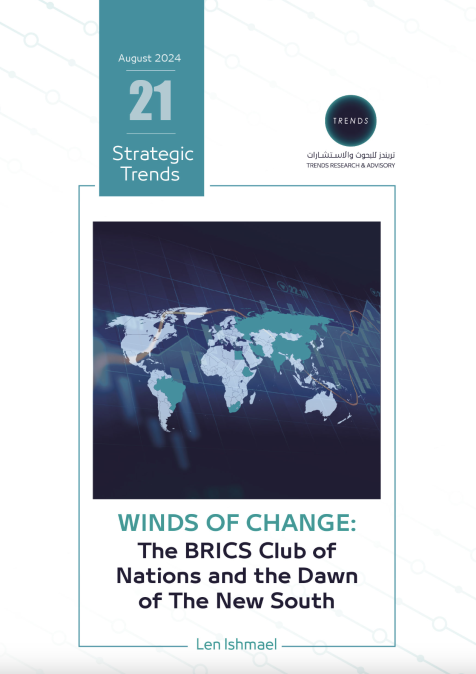
WINDS OF CHANGE: The BRICS Club of Nations and the Dawn of The New South
Authors
November 4, 2024

This paper was originaly published on trendsresearch.org


In this era of polycrises, where a global health pandemic coincides with wars in Europe and the Middle East, alongside Great Power rivalries and climate emergencies, countries around the world—rich and poor alike— are feeling the profound impacts. The Global South,1 in particular, has been disproportionately affected, with the World Bank warning of a ‘decade of lost development.’ As geopolitical tensions rise, security concerns are reshaping the nature of economic relationships between nations. This shift is especially evident in the complex interactions surrounding new technologies and the raw materials they depend on.

The traditional Western-led liberal world order, founded on principles of competition, open markets, free trade, and comparative advantage, is increasingly being challenged by protectionist behaviors in Western markets. The recent focus on de-risking and friend-shoring, justified by both security and economic concerns, has led to the adoption of anti-competitive practices. While the need for economic resilience is widely acknowledged, some argue that these measures are designed to undermine China’s comparative advantage in certain strategic sectors, thereby impeding its challenge to the hegemonic status of the United States and Western power more broadly. Regardless of the rationale, these new policies are adding another layer of disruption to global supply chains, already strained by recent crises. This trend raises concerns about the future of global trade as a critical tool for development, which has historically lifted millions out of poverty.

The specter of twelve rounds of Western sanctions on Russia as a consequence of the latter’s war in Ukraine since February 2022, and most recently, G7 initiatives to bankroll Ukraine’s war efforts through funds derived from interests on frozen Russian assets, has led several countries -spearheaded by BRICS members - to consider alternatives to the Western financial institutional architecture in a bid to safeguard their own interests. These measures risk fragmenting the existing global financial infrastructure and derailing benefits derived from decades of economic integration in the face of new barriers to cross border investment, commerce, and trade. Recent research shows that trade restrictions have more than tripled since 2019, financial sanctions have expanded and the geopolitical risk index has also spiked, following Russia’s invasion of Ukraine.2 While this and other reports suggest an absence of clear signs of de-globalization, the point is nonetheless being made that below-the-surface trends speak to increasing fragmentation with “trade and investment flows being redirected along geopolitical lines.”3 After decades of accepting the West’s rules, there is a sense that the era of the Global South is dawning, and that Western interests are no longer de facto those of the rest of the world. It is in this milieu that the BRICS and their initiatives take on heightened economic and political significance.
  • Authors
    Abderrahmane Mebtoul
    April 1, 2011
    Pièce maîtresse dans la région euroméditerranéenne, le Maghreb est sollicité par l'Union européenne, et plus récemment par les Etats-Unis, dans le cadre d'une compétition entre ces deux pôles dans leur recherche d'une hégémonie économique. Plusieurs années après que l'Accord d'Association avec l'Europe est entré en vigueur, a-t-il permis une coopération économique, financière et sociale orientée vers une véritable accumulation du savoir-faire organisationnel et technologique ? Quell ...
  • Authors
    François Gemenne
    March 1, 2011
    This paper analyzes the future of migrations related to climate changes and environment degradations. He shows how the dominant public reasoning remains inappropriate for addressing these issues, because of the Western/Northern countries' misconception of the relation between migration and environmental changes, including the cultural and political biases these countries show in the solutions they propose. The discrepancy between public policies and the actual reality of climatic an ...
  • Authors
    Françoise Nicolas
    January 1, 2011
    La montée en puissance de la Chine et de l’Inde domine les débats économiques depuis quelques années déjà. Poursuivant une stratégie d’internationalisation résolue, les entreprises chinoises et indiennes sont désormais présentes dans bon nombre de régions du globe. Ce dynamisme n’a pas manqué de susciter des inquiétudes mais aussi des espoirs, notamment dans le monde en développement, où ces deux pays sont perçus comme des partenaires potentiellement plus bienveillants que les pays ...
  • Authors
    Kassim Bouhou
    September 17, 2010
    Before the 9/11 events, US-Maghreb relations were growing stronger, especially after the United States had long left the floor to the Maghreb’s “natural” European partner. Therefore the American action in this region was in line with a mechanism previously set off by Clinton Administration member, Stuart Eizenstat, which aimed at reducing intra regional obstacles and stimulating American investments towards an area where Americans were little-represented. Hence Washington seemed mor ...
  • Authors
    Radhi Meddeb
    September 17, 2010
    The Gulf Cooperation Council (GCC) is a regional organization which was created in 1981, reassembling six Arab countries together: Saudi Arabia, Kuwait, Bahrain, Oman, Qatar, and the United Arab Emirates (UAE). Thanks to their oil income, GCC countries have enjoyed economic boom since 2002, hence breaking with the 1990s economic slow-down. The year 2002 corresponds to the oil prices’ entry in an upward spiral which has resulted in an increase of both income and foreign assets. This ...
  • Authors
    Dida Badi
    February 20, 2010
    The industrial revolution underwent by Europe in the 18th century has triggered the need for the major colonial powers to find new markets for their manufactured products. It is in this colonial competitive framework that European explorers delivered information about the different access roads, as well as the Tuareg tribes, notably the Kel Ajjer and the Kel Ahaggar. ...
  • Authors
    Jean-Luc Peduzzi
    February 20, 2010
    On November 5th 2009, a cocaine-loaded Boeing 727 aircraft arriving from Venezuela was discovered torched and emptied on a makeshift airstrip in the Malian desert (Gao region). The sahel-saharan area is clearly a contact zone between very distant worlds. ...
  • From

    15
    5:00 pm October 2026
      The Policy Center for the New South, in partnership with The Asian Network, is organizing a webinar titled “Emerging Powers and the Remaking of Global Order” to examine the growing role of emerging powers and the Global South at a time of profound transformation in the international system.As power becomes more diffuse, economic gravity shifts, multilateralism comes under pressure, and strategic competition intensifies, countries across Asia, Africa, the Gulf, and Latin America are seeking greater strategic autonomy, strengthening South-South trade and investment, advancing digital and green transitions, and calling for greater representation in global governance.These ambitions, however, unfold against significant challenges, including debt vulnerabilities, climat ...