Publications /
Book / Report

Back
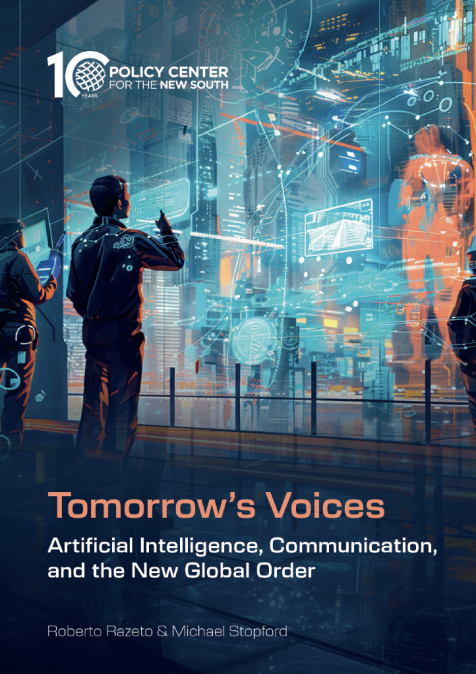
Tomorrow’s Voices: Artificial Intelligence, Communication, and the New Global Order
Authors
Roberto Razeto
Michael Stopford
February 10, 2025

Tomorrow’s Voices: Artificial Intelligence, Communication, and the New Global Order" by Roberto Razeto and Michael Stopford is an eye-opening exploration of how communication—and the rise of artificial intelligence—are reshaping the world. In an era defined by climate crises, pandemics, and spiralling geopolitical tensions, the book reveals how language, diplomacy, and AI-driven technology can bridge divides and drive global solutions. In fact today’s daunting global challenges can only be met through an effective use of communications.

From the power of storytelling to the ethical challenges of AI, Razeto and Stopford present real-world examples of communication's transformative impact. They show how AI, when used responsibly, can amplify voices, foster transparency, and combat misinformation. Yet, they also warn of the dangers: how unchecked technology might mislead, manipulate, or deepen divides.

Through vivid case studies, the authors illustrate the role of communication in fostering a more resilient, interconnected world. "Tomorrow’s Voices" invites readers to imagine a future where communication not only informs but inspires collective action, guided by ethics and innovation. This is more than a treatise—it’s a call to shape the digital age with clarity, empathy, and purpose.
  • Authors
    Abderrahmane Mebtoul
    April 1, 2011
    Pièce maîtresse dans la région euroméditerranéenne, le Maghreb est sollicité par l'Union européenne, et plus récemment par les Etats-Unis, dans le cadre d'une compétition entre ces deux pôles dans leur recherche d'une hégémonie économique. Plusieurs années après que l'Accord d'Association avec l'Europe est entré en vigueur, a-t-il permis une coopération économique, financière et sociale orientée vers une véritable accumulation du savoir-faire organisationnel et technologique ? Quell ...
  • Authors
    François Gemenne
    March 1, 2011
    This paper analyzes the future of migrations related to climate changes and environment degradations. He shows how the dominant public reasoning remains inappropriate for addressing these issues, because of the Western/Northern countries' misconception of the relation between migration and environmental changes, including the cultural and political biases these countries show in the solutions they propose. The discrepancy between public policies and the actual reality of climatic an ...
  • Authors
    Françoise Nicolas
    January 1, 2011
    La montée en puissance de la Chine et de l’Inde domine les débats économiques depuis quelques années déjà. Poursuivant une stratégie d’internationalisation résolue, les entreprises chinoises et indiennes sont désormais présentes dans bon nombre de régions du globe. Ce dynamisme n’a pas manqué de susciter des inquiétudes mais aussi des espoirs, notamment dans le monde en développement, où ces deux pays sont perçus comme des partenaires potentiellement plus bienveillants que les pays ...
  • Authors
    Kassim Bouhou
    September 17, 2010
    Before the 9/11 events, US-Maghreb relations were growing stronger, especially after the United States had long left the floor to the Maghreb’s “natural” European partner. Therefore the American action in this region was in line with a mechanism previously set off by Clinton Administration member, Stuart Eizenstat, which aimed at reducing intra regional obstacles and stimulating American investments towards an area where Americans were little-represented. Hence Washington seemed mor ...
  • Authors
    Radhi Meddeb
    September 17, 2010
    The Gulf Cooperation Council (GCC) is a regional organization which was created in 1981, reassembling six Arab countries together: Saudi Arabia, Kuwait, Bahrain, Oman, Qatar, and the United Arab Emirates (UAE). Thanks to their oil income, GCC countries have enjoyed economic boom since 2002, hence breaking with the 1990s economic slow-down. The year 2002 corresponds to the oil prices’ entry in an upward spiral which has resulted in an increase of both income and foreign assets. This ...
  • Authors
    Dida Badi
    February 20, 2010
    The industrial revolution underwent by Europe in the 18th century has triggered the need for the major colonial powers to find new markets for their manufactured products. It is in this colonial competitive framework that European explorers delivered information about the different access roads, as well as the Tuareg tribes, notably the Kel Ajjer and the Kel Ahaggar. ...
  • Authors
    Jean-Luc Peduzzi
    February 20, 2010
    On November 5th 2009, a cocaine-loaded Boeing 727 aircraft arriving from Venezuela was discovered torched and emptied on a makeshift airstrip in the Malian desert (Gao region). The sahel-saharan area is clearly a contact zone between very distant worlds. ...
  • From

    15
    5:00 pm October 2026
      The Policy Center for the New South, in partnership with The Asian Network, is organizing a webinar titled “Emerging Powers and the Remaking of Global Order” to examine the growing role of emerging powers and the Global South at a time of profound transformation in the international system.As power becomes more diffuse, economic gravity shifts, multilateralism comes under pressure, and strategic competition intensifies, countries across Asia, Africa, the Gulf, and Latin America are seeking greater strategic autonomy, strengthening South-South trade and investment, advancing digital and green transitions, and calling for greater representation in global governance.These ambitions, however, unfold against significant challenges, including debt vulnerabilities, climat ...