Publications /
Book / Report

Back
Seven Years after the Crisis: Intersecting Perspectives
Authors
Nuria Boot
Karim El Mokri
Simone Tagliapietra
Karen E. Wilson
Guntram B. Wolff
Georg Zachmann
August 22, 2016

This joint Bruegel-OCP Policy Center publication comprised of four policy contributions from researchers of both institutions is the result of the establishment of “Platform for Advanced & Emerging Economies Policy Dialogue.” The first edition of this continuous dialogue took place in Rabat on April 1st 2016 under the theme of “Seven Years after the Crisis: Intersecting Perspectives.”

In the first paper, “Youth Unemployment in the Mediterranean Region and its Long term Implications”, written by Nuria Boot, Karen E. Wilson and Guntram B. Wolff, the focus is on the correlation between youth unemployment in the Mediterranean region and the problems that this leads to in Europe as a whole.

The second paper, “Energy Across the Mediterranean: A call for Realism”, by Simone Tagliapietra and George Zachmann, advises the European Union to draw lessons from two decades of unproductive regional cooperation attempts.

Karim El Aynaoui, Uri Dadush, Karim El Mokri and Rim Berahab contributed with the paper “The Unmet Challenge of Interdependence in the EU-MENA space: A View from the South”. They examine bilateral relations between Europe and the Arab world, especially as they relate to trade, migration, investment, and energy.

In “Industrial Policy, Structural Change and Global Value Chains Participation: A Case Study of Morocco, Tunisia and Egypt”, Abdelaaziz Ait Ali and Yassine Msadfa use two methods to analyse the pace of structural transformation (the positive change in manufacturing capability) in Morocco, Tunisia and Egypt.
RELATED CONTENT

  • July 5, 2017
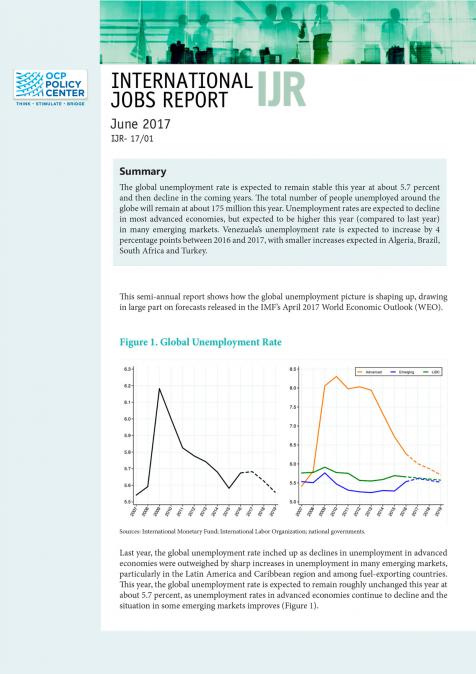
    The global unemployment rate is expected to remain stable this year at about 5.7 percent and then decline in the coming years. The total number of people unemployed around the globe will remain at about 175 million this year. Unemployment rates are expected to decline in most advanced economies, but expected to be higher this year (compared to last year) in many emerging markets. Venezuela’s unemployment rate is expected to increase by 4 percentage points between 2016 and 2017, with ...
  • Authors
    Prakash Loungani
    November 9, 2016
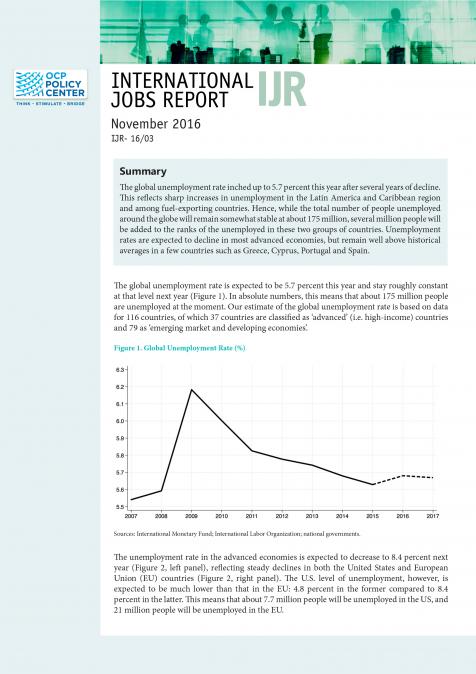
    The global unemployment rate inched up to 5.7 percent this year after several years of decline. This reflects sharp increases in unemployment in the Latin America and Caribbean region and among fuel-exporting countries. Hence, while the total number of people unemployed around the globe will remain somewhat stable at about 175 million, several million people will be added to the ranks of the unemployed in these two groups of countries. Unemployment rates are expected to decline in m ...
  • Authors
    Nuria Boot
    Karim El Mokri
    Simone Tagliapietra
    Karen E. Wilson
    Guntram B. Wolff
    Georg Zachmann
    August 22, 2016
    This joint Bruegel-OCP Policy Center publication comprised of four policy contributions from researchers of both institutions is the result of the establishment of “Platform for Advanced & Emerging Economies Policy Dialogue.” The first edition of this continuous dialogue took place in Rabat on April 1st 2016 under the theme of “Seven Years after the Crisis: Intersecting Perspectives.” In the first paper, “Youth Unemployment in the Mediterranean Region and its Long term Implicat ...
  • Authors
    Russel Dinh
    January 27, 2016
    The IMF recently revised down its growth forecasts, making large changes in the forecasts for some emerging markets, in particular Brazil and oil-producing countries (such as Nigeria and Saudi Arabia). This report presents a snapshot of the global unemployment outlook and discusses what the recent revisions could mean for the unemployment outlook for these countries based on past relationships between growth and unemployment. We conclude with a look at the growth-unemployment link f ...