Publications /
Research Paper

Back
L'émergence des cryptomonnaies en Afrique : réalité ou surévaluation ?
December 8, 2022

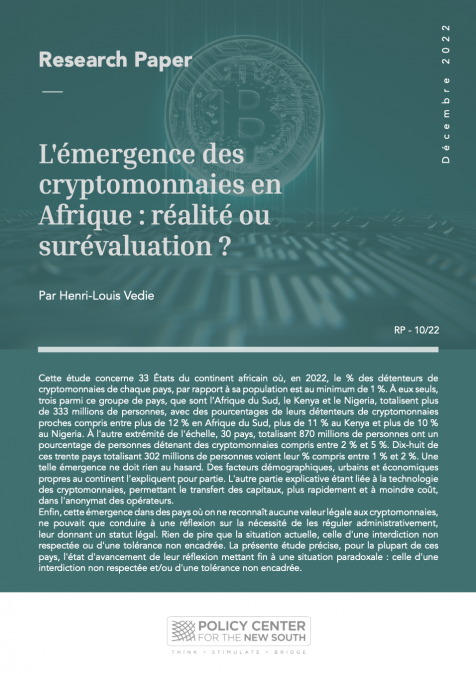
Cette étude concerne 33 États du continent africain où, en 2022, le % des détenteurs de cryptomonnaies de chaque pays, par rapport à sa population est au minimum de 1 %. À eux seuls, trois parmi ce groupe de pays, que sont l’Afrique du Sud, le Kenya et le Nigeria, totalisent plus de 333 millions de personnes, avec des pourcentages de leurs détenteurs de cryptomonnaies proches compris entre plus de 12 % en Afrique du Sud, plus de 11 % au Kenya et plus de 10 % au Nigeria. À l'autre extrémité de l'échelle, 30 pays, totalisant 870 millions de personnes ont un pourcentage de personnes détenant des cryptomonnaies compris entre 2 % et 5 %. Dix-huit de ces trente pays totalisant 302 millions de personnes voient leur % compris entre 1 % et 2 %. Une telle émergence ne doit rien au hasard. Des facteurs démographiques, urbains et économiques propres au continent l'expliquent pour partie. L'autre partie explicative étant liée à la technologie des cryptomonnaies, permettant le transfert des capitaux, plus rapidement et à moindre coût, dans l'anonymat des opérateurs.
Enfin, cette émergence dans des pays où on ne reconnaît aucune valeur légale aux cryptomonnaies, ne pouvait que conduire à une réflexion sur la nécessité de les réguler administrativement, leur donnant un statut légal. Rien de pire que la situation actuelle, celle d'une interdiction non respectée ou d'une tolérance non encadrée. La présente étude précise, pour la plupart de ces pays, l'état d'avancement de leur réflexion mettant fin à une situation paradoxale : celle d'une interdiction non respectée et/ou d'une tolérance non encadrée.

RELATED CONTENT

  • August 3, 2026
    This policy paper explores how China’s economic development model—rooted in pragmatism, long-term planning, and civilizational renewal—has become its most compelling soft power asset, particularly in the eyes of the Global South. While critically engaging with Joseph Nye’s original conception of soft power as a primarily cultural and normative force, the paper argues that China’s ability to transform itself from an impoverished postimperial state into the world’s largest trading nat ...
  • Authors
    Edited by
    July 13, 2026
    Available soon on livremoi. The 2026 edition of the Annual Report on the African Economy examines the issue of the valorization of Africa’s natural resources, particularly its mineral wealth. While the continent holds some of the world’s largest known reserves of a wide range of minerals and metals, the objective is not merely to catalogue these resources, but rather to explore the conditions under which natural resource endowments can be transformed into drivers of Africa’s in ...
  • July 3, 2026
    This Policy Paper has also been published in French and Spanish by Le Grand Continent Morocco offers a compelling example of how a middle-income economy can navigate a more fragmented global environment, characterized by weak growth and slower convergence. Since 2022, economic activity has remained relatively strong, with growth exceeding that of many comparable economies. Non-agricultural growth has averaged 4.4% since 2022, around 1.3 percentage points above its historical av ...
  • Authors
    July 2, 2026
    Africa is facing a massive electricity deficit that is impacting its economic and social development, and its ability to catch up with the rest of the world. It is imperative that the continent increase its electricity production to connect the 600 million people who are currently without access and to improve the quality of service for the millions who are suffering from frequent blackouts and load-shedding. Economic development in the 21st century will crucially depend on the digi ...
  • June 26, 2026
    Au Maroc, la problématique des jeunes NEETs (Ni en emploi, ni en études, ni en formation) constitue une urgence nationale, alimentée par 300 000 abandons scolaires annuels. Face à ce défi, le modèle de l'École de la Deuxième chance nouvelle génération (E2C-NG) a démontré sa pertinence en affichant un taux d'insertion exceptionnel de 81 %.Cependant, ce succès institutionnel repose intégralement sur un tissu associatif local aujourd'hui fragilisé. L'analyse inédite des donné ...
  • June 26, 2026
    In Morocco, the issue of young NEETs (Not in Employment, Education, or Training) is a national emergency, fueled by 300,000 students dropping out of school each year. In response to this challenge, the “New Generation Second Chance School” (E2C-NG) model has proven its effectiveness by achieving an exceptional employment rate of 81%.However, this institutional success rests entirely on a local network of organizations that is now under strain. A previously unpublished analysis of da ...
  • June 24, 2026
    Africa, Latin America, and the Caribbean have both the potential and the desire to transform their people's lives through Green Industrial Policy. Yet they have long been constrained by structural obstacles embedded in the international system. The current rupture in that system, which ...