Publications /
Policy Brief

Back
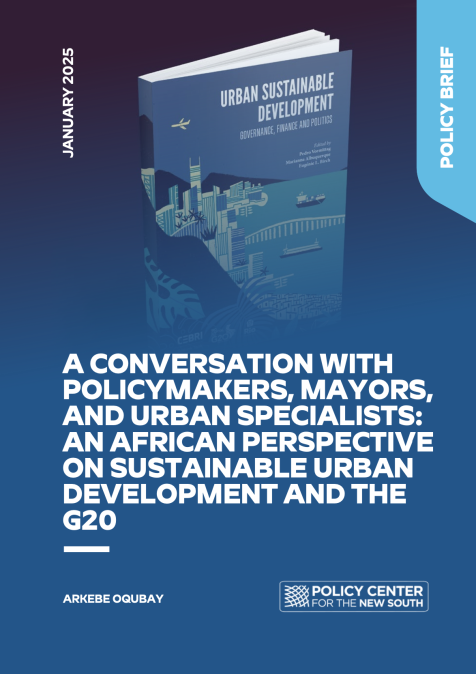
A Conversation with Policymakers, Mayors, and Urban Specialists: An African Perspective on Sustainable Urban Development and the G20
Authors
Arkebe Oqubay
January 20, 2025

This paper, included in the report "Urban Sustainable Development: Governance, Finance and Politics.", was originally published on:https://cebri.org/en/doc/356/cebri-and-rio-g20-committee-publish-urban-sustainable-development-governance-finance-and-politics

 © Vormittag, Pedro, Marianna Albuquerque & Eugénie Birch (Eds.). 2024. Urban Sustainable Development: Governance, Finance and Politics. Rio de Janeiro: CEBRI.


Sustainable urban development is vital for Africa, offering opportunities for a better future that requires political commitment and a collective response to global challenges. A shared perspective and productive debate on Africa’s challenges and future are essential to enhance economic transformation, urban sustainability, and the transition to a carbon-neutral economy. This commentary presents a compelling conversation among African policymakers, leaders, practitioners, and specialists on this pressing theme conducted in September 2024.

The conversation was based on a semi-structured qualitative survey featuring a qualitative format, targeted at a spectrum of African mayors, national policymakers, leaders of continental organizations, and development practitioners—urban specialists. The respondents play a critical role in shaping public policy and practice and include Prime Ministers and the African Union Commission Chairperson, offering a snapshot of their perspectives and concerns. Of the fifty invited participants, nearly 50% completed the survey, including eight ministers, seven officials of continental organizations, five development and urban experts, and the mayors of Rabat, Freetown, Windhoek, and Cape Town.

Cities are vital in attaining the United Nations 17 Sustainable Development Goals (SDGs) and the net-zero goals endorsed in 2015 under the Paris Agreement. The questionnaire comprised questions underpinned by cities’ contributions as innovation and economic growth engines, as well as Africa’s commitment to the common aspiration of the global community. African countries made a significant stride by unanimously adopting Agenda 2063, a 50-year road map with a theme of “Africa We Want,” which places sustainable urban development at its core. Most recently, in September 2024, the African Union Commission successfully organized an African Urban Forum in Addis Ababa. This pivotal forum delved into African urbanization and the challenges of financing to achieve sustainable and resilient urban development.
RELATED CONTENT

  • Authors
    Abderrahmane Mebtoul
    December 1, 2013
    L’intégration du secteur informel ne peut être réalisée sans l’existence d’un Etat de droit et elle nécessite une cohérence des politiques de développement, qui s’impose plus que jamais face à l’ampleur des économies parallèles. L’intégration du secteur informel ne pourra pas se faire non plus sans une sérieuse amélioration du niveau d’éducation et une véritable réduction des inégalités hommes/femmes ...
  • Authors
    Ian Lesser
    November 18, 2013
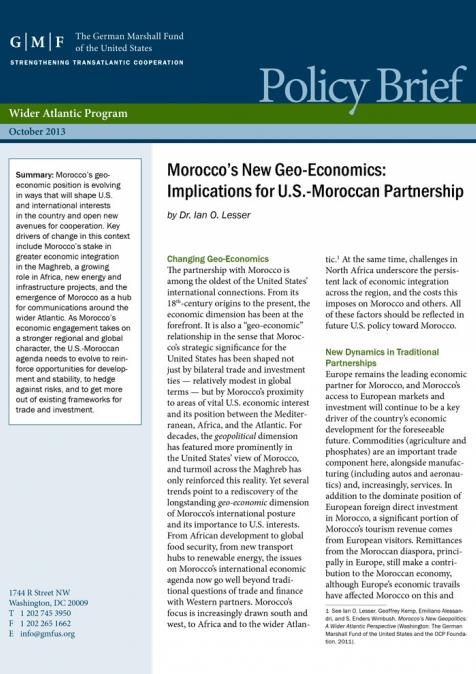
    This policy brief argues for a closer relationship between Morocco and the United States. Morocco’s geo-economic position is evolving in ways that will shape U.S. and international interests in the country and open new avenues for cooperation. Key drivers of change in this context include Morocco’s stake in greater economic integration in the Maghreb, a growing role in Africa, new energy and infrastructure projects, and the emergence of Morocco as a hub for communications around th ...
  • Authors
    Mihoub Mezouaghi
    November 1, 2013
    Le discours sur la « colocalisation » est chargé de bonnes intentions à l’attention des pays du sud de la Méditerranée qui, depuis quelques années, réclament avec insistance une contrepartie à l’accès à leur marché (notamment en matière de transfert de technologie pour permettre d’accélérer leur industrialisation). La « colocalisation » est alors présentée comme une « forme avancée de la délocalisation ». Mais, ce discours s’adresse en même temps à l’opinion publique française lorsq ...
  • Authors
    John B. Richardson
    Armando Marques Guedes
    Xavier de la Gorce
    Anne-François de Saint Salvy
    Paul Holthus
    November 29, 2012
    This paper examines the challenges posed by human activity on the Atlantic Ocean itself, and around its coasts, looking at it not so much as a vast expanse separating the Americas from Africa and Europe but rather as a shared resource and an important connector. All littoral states face a common challenge in maintaining its value as a foundation for sustained “blue growth” in the years to come. In Chapter 1, Armando Marques Guedes traces the evolution of the economic activities that ...
  • Authors
    Françoise Nicolas
    January 1, 2011
    La montée en puissance de la Chine et de l’Inde domine les débats économiques depuis quelques années déjà. Poursuivant une stratégie d’internationalisation résolue, les entreprises chinoises et indiennes sont désormais présentes dans bon nombre de régions du globe. Ce dynamisme n’a pas manqué de susciter des inquiétudes mais aussi des espoirs, notamment dans le monde en développement, où ces deux pays sont perçus comme des partenaires potentiellement plus bienveillants que les pays ...
  • Authors
    Kassim Bouhou
    September 17, 2010
    Before the 9/11 events, US-Maghreb relations were growing stronger, especially after the United States had long left the floor to the Maghreb’s “natural” European partner. Therefore the American action in this region was in line with a mechanism previously set off by Clinton Administration member, Stuart Eizenstat, which aimed at reducing intra regional obstacles and stimulating American investments towards an area where Americans were little-represented. Hence Washington seemed mor ...
  • Authors
    Flore Gubert
    September 1, 2010
    The potential synergy between development and migration has become a key feature of most international migration politics. However, this relationship is far from evident. Flore Gubert helps better understand the complexity of this relationship through the comparison of two regional contexts (Mexico and North Africa), and shows how the political and economic context prevailing in the countries of origin modifies the link between migration and development. This Note de l'Ifri is the ...
  • From

    06
    11:00 am October 2026
    Dans un environnement international reconfiguré, les économies à revenu intermédiaire poursuivent leur processus de convergence dans des conditions plus exigeantes. La fragmentation géopolitique et la réorganisation des chaînes de valeur mondiales modifient les logiques d'insertion productive, tandis que les tensions sur le système monétaire international pèsent sur le financement des économies en développement. L'accélération des transitions technologique et énergétique redistribue par ailleurs les avantages comparatifs et exige des capacités d'adaptation que tous les pays ne peuvent mobiliser au même degré. Les moteurs classiques du rattrapage se trouvent fragilisés, et le risque d'enlisement dans le piège du revenu intermédiaire se pose de manière plus pressante.C'est dans ...
  • From

    24
    5:30 pm September 2026
    Dans cet épisode d’Africafé, Amadou Diop analyse les défis de sécurité maritime auxquels font face les pays de l’Afrique atlantique, de la piraterie aux trafics transfrontaliers. Il souligne la nécessité de mutualiser les moyens et de partager l’information entre États. L’échange aborde aussi le potentiel économique de cet espace et les conditions d’une coopération maritime plus cohérente, notamment dans le cadre de l’Initiative atlantique du Maroc. ...