Publications /
Policy Brief

Back
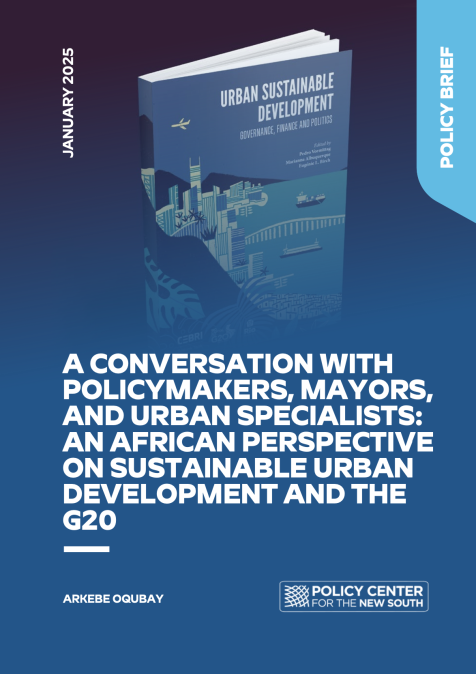
A Conversation with Policymakers, Mayors, and Urban Specialists: An African Perspective on Sustainable Urban Development and the G20
Authors
Arkebe Oqubay
January 20, 2025

This paper, included in the report "Urban Sustainable Development: Governance, Finance and Politics.", was originally published on:https://cebri.org/en/doc/356/cebri-and-rio-g20-committee-publish-urban-sustainable-development-governance-finance-and-politics

 © Vormittag, Pedro, Marianna Albuquerque & Eugénie Birch (Eds.). 2024. Urban Sustainable Development: Governance, Finance and Politics. Rio de Janeiro: CEBRI.


Sustainable urban development is vital for Africa, offering opportunities for a better future that requires political commitment and a collective response to global challenges. A shared perspective and productive debate on Africa’s challenges and future are essential to enhance economic transformation, urban sustainability, and the transition to a carbon-neutral economy. This commentary presents a compelling conversation among African policymakers, leaders, practitioners, and specialists on this pressing theme conducted in September 2024.

The conversation was based on a semi-structured qualitative survey featuring a qualitative format, targeted at a spectrum of African mayors, national policymakers, leaders of continental organizations, and development practitioners—urban specialists. The respondents play a critical role in shaping public policy and practice and include Prime Ministers and the African Union Commission Chairperson, offering a snapshot of their perspectives and concerns. Of the fifty invited participants, nearly 50% completed the survey, including eight ministers, seven officials of continental organizations, five development and urban experts, and the mayors of Rabat, Freetown, Windhoek, and Cape Town.

Cities are vital in attaining the United Nations 17 Sustainable Development Goals (SDGs) and the net-zero goals endorsed in 2015 under the Paris Agreement. The questionnaire comprised questions underpinned by cities’ contributions as innovation and economic growth engines, as well as Africa’s commitment to the common aspiration of the global community. African countries made a significant stride by unanimously adopting Agenda 2063, a 50-year road map with a theme of “Africa We Want,” which places sustainable urban development at its core. Most recently, in September 2024, the African Union Commission successfully organized an African Urban Forum in Addis Ababa. This pivotal forum delved into African urbanization and the challenges of financing to achieve sustainable and resilient urban development.

RELATED CONTENT

  • September 25, 2026
    Dans cet épisode d’Africafé, Amadou Diop analyse les défis de sécurité maritime auxquels font face les pays de l’Afrique atlantique, de la piraterie aux trafics transfrontaliers. Il souligne la nécessité de mutualiser les moyens et de partager l’information entre États. L’échange aborde...
  • Authors
    September 23, 2026
    Depuis 2010, environ, on sait que la Méditerranée orientale est une nouvelle province gazière. Des ressources gazières ont en effet été découvertes au large de quatre pays ou territoires, l’Égypte, Israël, Chypre et Gaza. Deux d’entre eux sont devenus producteurs et exportateurs de gaz naturel, l’Égypte et Israël. Au large de Gaza, le champ gazier de Gaza Marine n’a jamais été développé et il est très peu probable qu’il le soit prochainement en raison des très fortes tensions entre ...
  • September 23, 2026
    تتناول هذه الحلقة حدود السباق المتسارع لتطوير نماذج الذكاء الاصطناعي والتحديات المرتبطة بفهم سلوكها والتحكم فيه. ويناقش الأستاذ كريم دربان، أستاذ بالمدرسة الوطنية للتجارة والتسيير بالدار البيضاء، مدى إمكانية الوثوق بهذه النماذج في اتخاذ القرار وحدود السلطة التي يمكن تفويضها لها. كما تتط...
  • Authors
    Luladay Berhanu Mengistie
    Guillaume Gérout Suominen
    September 21, 2026
    The African Union Summit of February 2026 instructed the African Continental Free Trade Area (AfCFTA) Council of Ministers to negotiate a Protocol on Industrial Policy and Development. This work, handled without adequate preparation, is likely to reproduce the weaknesses it is meant to remedy. This paper is a conceptual mapping exercise, written to raise the preparatory questions before drafting begins, rather than to prescribe outcomes.It proceeds in five sections:1. It works towar ...
  • Authors
    Pedro Henrique de Christo
    Travis Knoll
    September 18, 2026
    The Brazilian context involving a clean-electricity base, a more balanced lobbying landscape, and mounting climate and social pressure, makes it more difficult for the kind of abrupt and unrestrained energy policy swing seen in Colombia. The trend in Brazil tends to be more economically viable for renewables. However, these structural conditions by themselves will not guarantee the success of the transition. Fruition will depend on whether policymakers use this window to prepare for ...
  • Authors
    September 17, 2026
    Various competing cross-border payment networks have become vehicles for geopolitical competition. As tensions have risen, many countries want to secure access to cross-border payment systems by joining with like-minded countries to form interoperable networks, either via tokenization or Instant Payment Systems (IPSs). Three major projects are under development, serving the strategic interests of the US, China and the Rest of the World—corresponding to the three trading spheres taki ...
  • Authors
    September 14, 2026
    Le déclenchement de la Guerre en Iran et le blocage du détroit d’Ormuz ont eu des conséquences majeures sur un grand nombre de marchés mondiaux de matières premières. Si l’attention médiatique s’est logiquement portée sur le pétrole et le gaz naturel, ainsi que sur l’aluminium, en raison de la forte dépendance de l’offre de ce métal aux prix de l’énergie, le soufre, comme l’hélium, l’éthylène, le propylène ou l’urée, a également été pris dans les rets de ce conflit. Loin d’être une ...
  • September 11, 2026
    Le marché du travail marocain connaît, depuis les années 2000, une expansion continue de la scolarisation qui ne s'est pas accompagnée d'une transformation équivalente de la structure productive de l'économie, ouvrant la voie à des situations d'inadéquation verticale entre le niveau de formation des actifs occupés et les exigences des emplois qu'ils occupent. La présente étude analyse les déterminants du déclassement (sur-éducation) et du surclassement (sous- éducation) à partir des ...